Daily Life & Culture
Viking Hygiene: What Antler Combs and Filed Teeth Reveal
Viking hygiene without the myth: how antler composite combs were built, why Saturday was called laugardagr, and what the Coppergate deposits really show.
Contents
- Viking Hygiene Starts in the Workshop, Not in the Grave
- How a Composite Comb Was Built
- Laugardagr: The Linguistic History of the Norse Washing Day
- Hávamál: Ride to the Assembly Washed
- Snorralaug, Baðstofa and the Limits of the Bathhouse Story
- What Outsiders Wrote About the Norse
- Coppergate: Lice, Worms and Filed Teeth
- Myth vs Fact
- Our Take: Grooming Was a Craft First
Dig at Hedeby and sooner or later you hit a layer that looks like the floor of a joiner’s workshop: shavings, offcuts, sawdust. Except the material is not wood. It is antler. Those waste heaps are the hardest evidence on Viking hygiene that archaeology has to offer. They do not tell us that a chieftain could afford a handsome comb. They tell us that people in the North made a living producing combs in series, and that there were enough buyers to keep them at it for generations.
So this article does not revisit the question of whether Vikings washed. They did, and our overview of Viking daily life already walks through the standard grooming set of comb, tweezers, ear spoon and razor, along with the weekly washing day. What follows is the layer underneath: the craft behind the kit, the linguistic history of that washing day, the limits of the bathhouse story, and the distinctly unpleasant evidence from the rubbish pits of York.
Viking Hygiene Starts in the Workshop, Not in the Grave
Antler is not an arbitrary material. It has a dense outer wall around a porous core, and its fibre structure makes it springy enough to take fine teeth without splintering. Bone is more brittle. It chips under the saw and stands up less well to being dragged through hair every day. That Viking Age comb-makers chose antler almost every time was therefore not a matter of taste. It was a material decision made by people who understood their craft. Red deer supplied most of it, while further north elk and reindeer provided the raw stock.
There is also an economic advantage that is easy to overlook: deer shed their antlers every year. The raw material could be gathered, stockpiled and traded across long distances without a single animal dying for it. Antler was a renewable material with a predictable supply, and predictable supply is precisely what makes serial production possible. In the workshop areas of Hedeby, on the Schlei inlet in what is now northern Germany, and in the older trading site of Ribe in Jutland, the remains of that supply chain lie exposed: beam offcuts, botched tooth plates, sawdust in thick bands.
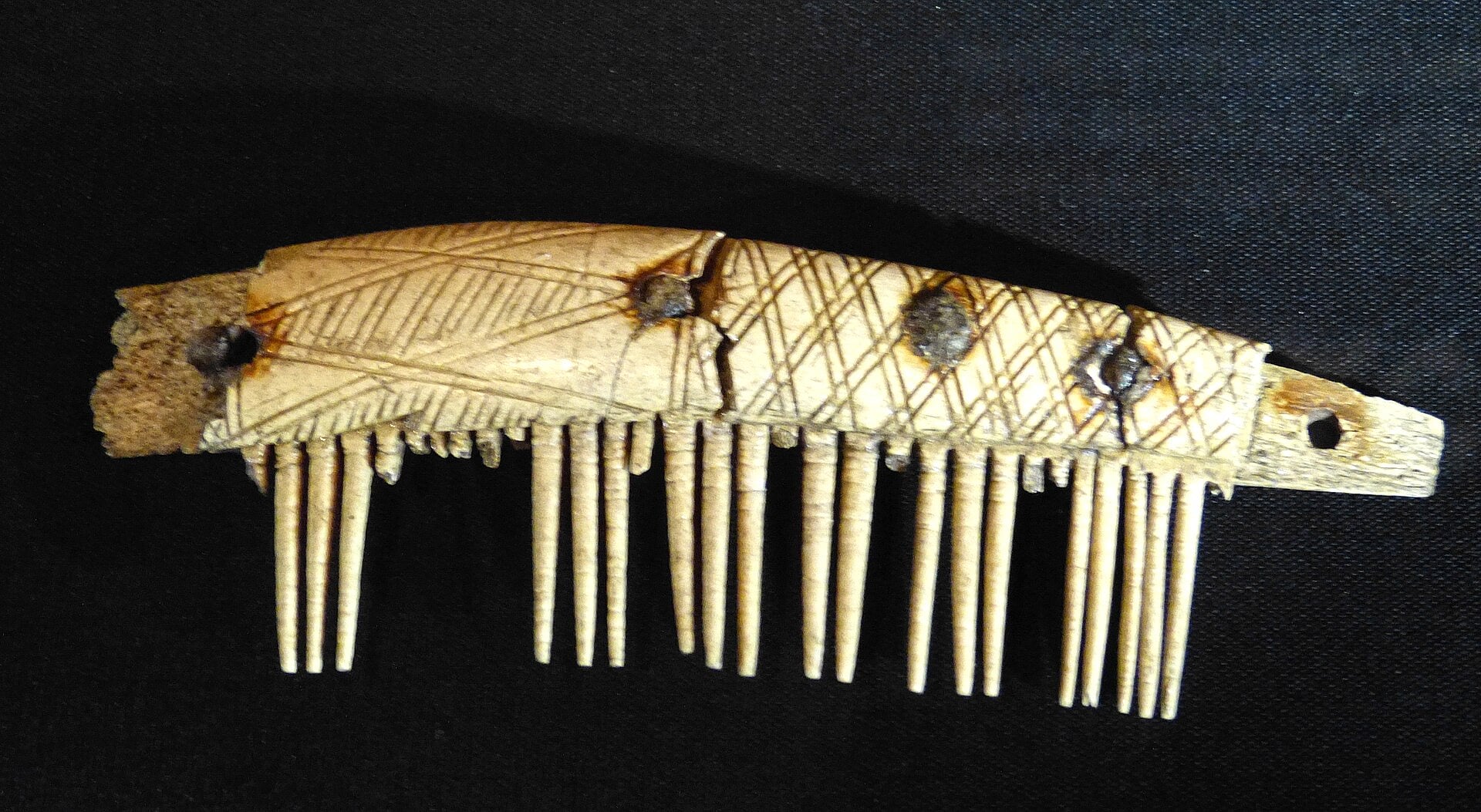
The photograph above this article shows a typical Viking Age composite comb: narrow tooth plates clamped between two side bars and locked with iron rivets, the whole thing finished with incised hatching. The form stays remarkably stable across centuries and across the whole of northern Europe. Consistency like that does not happen by accident. It comes from established workshop routine.
| Stage of work | What it leaves behind | Where it shows up |
|---|---|---|
| Collecting and storing antler | Beam offcuts, tine tips | Workshop areas at Hedeby and Ribe |
| Sawing out the plates | Sawdust, failed cuts | Comb-makers’ waste deposits |
| Shaping the side bars | Offcuts from the outer wall | Hedeby |
| Setting the rivets | Iron rivets in an even row | Surviving combs from graves |
| Cutting the teeth | Saw marks along the side bar edge | Visible on original pieces |
| Incising the decoration | Cross-hatching, ring-and-dot motifs | Combs from Birka and Gotland |
| Fitting a case | A second comb body without teeth | Comb cases from Birka and Gotland |
How a Composite Comb Was Built
A Viking Age comb is not carved from a single blank. It is an assembly of a dozen or more parts, and the order of operations can be read straight off the finds. The blank tooth plates were riveted between the two side bars first, and only then did the maker saw in the teeth. The saw regularly ran past the plates and left fine parallel nicks along the lower edge of the side bars. Those marks are a recognised diagnostic of the technique, and they still betray the sequence a thousand years later.
The teeth themselves do two different jobs. Coarse teeth untangle. Fine teeth drag out nits along with the cement that glues them to the hair shaft. On double-sided examples the two gauges sit on opposite edges; on single-sided ones they often sit side by side along the same edge. Anyone carrying one of these on a belt was not wearing an ornament. They were carrying a tool with two clearly separated functions.
One last detail gives the game away entirely: combs were repaired. Because the construction is riveted rather than carved, a broken tooth plate could be replaced on its own instead of writing off the whole object. That is the entire point of such an elaborate build, and it is the best indication that these things were worked hard rather than simply laid out prettily in a grave. Nobody repairs a luxury trinket. They replace it.
Listen to Scar while you read on:
Laugardagr: The Linguistic History of the Norse Washing Day
The Old Norse name for Saturday is laugardagr, built from laug and dagr. Dagr is the day. Laug means a bath or warm wash water, and it is cognate with the German word Lauge, lye. The weekday is, quite literally, bathing day.
This is not a reconstruction pulled from a dictionary. The word is still in everyday use: lördag in Swedish, lørdag in Danish and Norwegian, laugardagur in Icelandic, leygardagur in Faroese. More telling is what happened across the language border. Finnish lauantai is a loan from Old Norse. A neighbouring people borrowed not some ordinary everyday term but specifically the name of the washing day. Words travel when the thing behind them is conspicuous.
English and German preserve no trace of it. “Saturday” honours Saturn, German Samstag descends through church Latin from the Sabbath, and neither has anything to do with water. That the washing day functioned as a fixed social appointment in the North is covered in our daily life article. What is striking here is something else: the sheer durability of the word. Conversion to Christianity, centuries of sound change and a thousand years of ordinary life have failed to get bathing day out of the Nordic calendar.
Hávamál: Ride to the Assembly Washed
The Hávamál, preserved in the Codex Regius, is not a treatise on hygiene, but it treats washing as a matter of basic decency. Stanza 4 lists what a guest entering a hall is owed:
“Water is what a guest needs when he comes to the table, a towel, and a welcome freely given.” (Hávamál, stanza 4)
Water and a towel sit on the same footing as food and greeting. Not as a courtesy, but as an obligation on the host.
Stanza 61 flips the perspective and is the more interesting verse. A man should ride to the assembly washed and fed, it says, even if his clothes are poor, and no one should be ashamed of his shoes or breeches. That is a clear order of priorities. The body must be in order; the clothing is allowed to be shabby. In a society that argued out its legal disputes in front of the assembled neighbourhood, a washed head was part of your credibility. A worn cloak was not.
Snorralaug, Baðstofa and the Limits of the Bathhouse Story
Here the evidence thins out, and it is worth saying so plainly. A built bathhouse with a water supply is not securely attested for Viking Age Scandinavia. The most photographed candidate, the Snorralaug at Reykholt in Iceland, is a stone-built pool fed by a hot spring and traditionally associated with the historian Snorri Sturluson, who was killed in 1241. That is high medieval, roughly two centuries after the Viking Age ended. Captioning that pool as a Viking bath collapses a gap wider than the one between us and the Thirty Years’ War.
The Icelandic word baðstofa, literally “bath room”, calls for the same caution. The name came from a room where steam was raised with heated stones and water. Over the following centuries the meaning drifted to the farm’s shared living and sleeping room, where people spun, talked and slept. The name stayed; the function moved. The word therefore attests a practice, but not necessarily its age.
The same applies to the much-repeated claim that Norsemen bleached their hair and beards with harsh lye. The Old Norse word for soap, sápa, certainly existed, and Pliny the Elder describes a Gallic and Germanic soap used to colour hair in his Naturalis Historia. But Pliny wrote in the first century, about different people. We file the bleaching as a plausible assumption, not a finding.
What Outsiders Wrote About the Norse
The English chronicle attributed to John of Wallingford complains about the Danes settled in the country: they combed their hair daily, bathed every Saturday, changed their clothes far too often, and had thereby turned the heads of English women. It was written as an accusation against intruders. What survives is a description of routine, set down by someone with no conceivable motive to flatter the Norse. That is exactly what makes the passage valuable. Praise from a hostile pen weighs more than self-promotion.
A second voice reaches us from Hedeby itself. Ibrahim ibn Yaqub al-Tartushi, a traveller from al-Andalus, visited the trading town around 965 and noted, among other things, an artificial eye cosmetic worn there by men and women alike. Grooming in the North was therefore not only cleaning but also presentation. For more on that trading hub, see our profile of Hedeby, the lost trading city.
The third and best-known source, the Abbasid envoy Ahmad ibn Fadlan’s account from the Volga, is already placed in context in our daily life article: what he objected to was the shared basin, not an absence of washing.
Coppergate: Lice, Worms and Filed Teeth
Jorvik, Viking Age York, supplies the counter-evidence. The waterlogged, oxygen-poor deposits at Coppergate preserved organic material that would have vanished almost anywhere else: lice, fleas, nits still wedged between comb teeth. The site also produced a famous large human coprolite, recovered in 1972 from the Lloyds Bank excavation, containing the eggs of whipworm and maw-worm. The same person could carry a finely decorated comb on the belt and a colony of intestinal parasites in the gut.
None of that contradicts the comb industry. It explains it. In the tenth century exactly one device worked against lice, and it is the same one lying in all those graves: a fine-toothed comb, used patiently and often. The workshops of Hedeby were not serving a beauty market in any modern sense. They were serving a concrete, permanent and extremely itchy problem. Water came from a stream, a well or a fjord and was heated in a cauldron over an open hearth; livestock shared the longhouse through winter; straw and furs could not be boiled. Under those conditions the comb was not vanity. It was the most effective available technology.
The teeth of the dead tell two stories at once. The first is involuntary: flour ground on stone querns carried grit that wore the chewing surfaces flat over the years. The second is deliberate. The Swedish osteologist Caroline Arcini published a study in 2005 describing some two dozen men from Scandinavian cemeteries whose upper front teeth carry horizontal filed grooves, heavily concentrated at Kopparsvik near Visby on Gotland. Further cases have surfaced in Denmark and England since, and later research has pushed the number of known individuals considerably higher. The first systematic description, however, is Arcini’s, and her figure was of a different order of magnitude. What the practice says about the Norse view of the body is something we work through in detail in our article on Viking tattoos.
Myth vs Fact
| The claim | What the evidence says |
|---|---|
| Vikings never washed | Wrong. Combs were series production from specialist workshops |
| Vikings were clean by modern standards | Wrong. Lice, nits and intestinal parasites are all documented |
| Combs were mostly made of bone | Oversimplified. Antler was preferred because it is springier |
| Combs were an elite luxury | Wrong. They appear across every category of burial |
| Lye bleaching of hair is proven | Unclear. Plausible, but without hard Viking Age evidence |
| Filed teeth were dental care | Wrong. Body modification, first described systematically by Arcini in 2005 |
| Viking Age bathhouses are confirmed | Partly. The best-known pool, Snorralaug, is high medieval |
Our Take: Grooming Was a Craft First
The popular story has swung hard from one extreme to the other. The Viking was a lice-ridden savage; now he is routinely presented in documentaries as a hygiene role model who shamed the rest of Europe. Both versions measure the North against a bathtub and miss what the finds actually document in density.
Our reading is that personal upkeep in the North was, before anything else, a feat of craft. Somebody had to gather antler, saw it, rivet it, cut the teeth, incise the decoration and fit a case, and somebody had to pay for all of it. The composite comb is one of the very few Viking Age mass-produced goods we can follow end to end, from a shed antler through the workshop pit to the burial chamber. That chain would never have existed without steady demand. The real point, then, is not cleanliness. It is a functioning production line for a grooming tool.
The second strand of this article fits the same shape. The culture that turned out combs in series also filed grooves into the front teeth of individual men. Both treat the body as something to be worked on, displayed and read by others. Judging Viking hygiene solely by how often anyone washed misses that entirely. The more interesting question is how much labour a farming society with no concept of bacteria was willing to invest in the surface of its own body.
Image source: Wolfgang Sauber (CC BY-SA 4.0), via Wikimedia Commons