Daily Life & Culture
The Role of Women in Viking Society
The viking women role in daily life: household power and keys, textile work, divorce rights, and what the graves can and cannot prove. A clear-eyed look.

Contents
- The husfreyja: Who Ran the Farm While the Ship Was Away
- Two Bronze Shells: Dress as a Passport
- Wool, Sails and the Viking Women’s Role in the Economy
- Law, Marriage and Inheritance: What the Sources Can and Cannot Prove
- What Graves Reveal About Women’s Everyday Lives
- Oseberg and the View From Outside
- Conclusion: Room to Move, Inside Hard Edges
Ask about the role of women in Viking society and you will usually be handed one of two postcards. The first shows a shield maiden with an axe, striding through a television battle. The second shows a silent figure by the hearth, waiting for a sail. Neither survives contact with the evidence. What the finds, the law and the texts actually describe is a woman who ran a working farm with livestock, stores, servants and a textile workshop, who could inherit land and walk out of a marriage, and who nonetheless lived in a society where men decided matters of politics, feud and law.
The evidence itself is lopsided, and that matters more than most articles admit. For the Viking Age proper we have archaeology: graves, settlement layers, dress fittings, tools. We have runestones, the only text genuinely produced during the period. Everything else, sagas, law books, histories of kings, was written down in the thirteenth century, some two hundred years later. Forget that gap and you mistake a memory for a transcript.
The husfreyja: Who Ran the Farm While the Ship Was Away
The Old Norse word for the mistress of a household is husfreyja, literally something close to “lady of the house”. It is not a courtesy title but a job description. A Scandinavian farm of the period was an enterprise: dairy cattle, sheep, grain, a store cupboard that had to carry everyone through a winter which in Iceland or northern Norway could last half the year, plus free servants and enslaved workers who needed feeding and directing. Run that badly and by spring there is no household left to argue about.
That is where the economics bite. Men were seasonally absent: trading, raiding, sitting at the assembly, wintering somewhere far downriver. The farm did not pause for them. Plain operational logic, not romance, says that somebody made the decisions meanwhile, and as a rule that somebody was the woman of the house.
The traditional badge of that position is the key. Keys, along with small chains and rings hung with knives, shears, awls and needle cases, turn up regularly in women’s graves of the Viking Age, worn at the belt or suspended between the shoulder brooches. The familiar reading is straightforward: whoever can open the chest and the store room controls the household’s wealth.
This is where a little scepticism pays off. The interpretation is plausible, but it is still argued over rather than settled. Not every woman was buried with a key, plenty of excavated keys have no plausible lock behind them, and some examples look more emblematic than practical. Both readings stay open: a working tool of household management, and a symbol placed in the grave to mark a role. It may well have been both at once, which is precisely what makes the object worth arguing about.
Two Bronze Shells: Dress as a Passport
When archaeologists identify a Scandinavian woman’s grave of the Viking Age, they usually do it from a single feature: a pair of oval brooches, sitting at chest height. These domed bronze fittings, frequently cast with dense interlace ornament, fastened the shoulder straps of the overgarment often called an apron dress. A string of glass and semi-precious beads commonly hung between the two, and one brooch might carry the chain of tools mentioned above.

Image credit: Gabriel Hildebrand (CC BY 2.5), via Wikimedia Commons
Their curved shells earned them the nickname tortoise brooches. For researchers they are the type fossil of female dress in Scandinavia, with an implication reaching well beyond costume history. Where such pairs turn up outside Scandinavia, in England, across the North Atlantic islands, along the river routes of eastern Europe, they are treated as strong evidence that Scandinavian women were not merely passing through but living there.
That single point rearranges the whole picture of the period. A movement made only of raiders and merchants leaves weapons and coins in foreign soil, not women’s dress fittings. Settlement leaves both. What strikes the editorial team here is how much more solid the brooch is as a witness than any saga passage: it can be dated, it can be traced to a region, and it does not shade the truth about where it came from.
Wool, Sails and the Viking Women’s Role in the Economy
Two of the most common objects in Scandinavian settlement layers are also two of the dullest looking: spindle whorls of stone, clay or bone, and loom weights of fired clay. They are the fingerprint of an industry. On the upright warp-weighted loom, whose threads were held taut by exactly these weights, cloth was produced, and in the Viking Age cloth was not a consumer good. It was infrastructure.
Getting there took a long chain of labour. Shear the sheep, sort the fleece, wash it, comb or card it, draw it into thread on a hand spindle, ply the thread, dress the loom, weave, then full the finished cloth. Every stage costs hours, and the most expensive stage is not the weaving but the spinning. For one household’s clothes, blankets and sacks that is a permanent background task. For a sail it becomes something else entirely.
This is where textile work turns strategic. The square sail of a seagoing ship is a large surface of dense, often woollen cloth that must take a gale without tearing. Experimental reconstructions of Viking ships and their rigging have made the scale plain: the effort behind one large sail is measured in person-years, not weeks. A fleet needs many sails. And the people spinning and weaving were, on everything the finds and later texts suggest, overwhelmingly women.
In our assessment this is the most underrated fact in the whole discussion. The Viking Age is narrated through ships, weapons and voyages. Yet no longship leaves the fjord without a sail, and no sail exists without years of labour-heavy work done indoors. The northern expansion rested on a wool economy that women organised and carried out. Leave that out and you tell half a story.
That tension between the everyday woman and the legendary one has found its way into music as well.
Law, Marriage and Inheritance: What the Sources Can and Cannot Prove
Icelandic and Norwegian law of the period recognised something that was far from standard elsewhere in medieval Europe: divorce initiated by the wife. Marriage in this legal imagination was closer to a contract between families than to an indissoluble sacrament, and contracts can be ended. Property moved in both directions when a marriage was made, the bride price from the husband’s side and the goods a woman brought from her own family, and it did not simply stay with him if the marriage collapsed.
The Icelandic sagas narrate such cases with striking matter-of-factness. In Njals saga, Unn ends her marriage to Hrut once the match has failed, and the quarrel that follows is largely about getting the property back. In the Laxdaela saga, Gudrun Osvifsdottir is the figure through whom the whole theme is worked out: several marriages, a separation she herself brings about, and across the entire narrative a woman whose choices drive the plot rather than decorate it.
The source criticism belongs in the same breath. Both sagas were written down in the thirteenth century by Christian Icelanders, about ancestors two centuries removed from them. They are literature with a purpose, not court records. What they reliably establish is that a wife-initiated divorce was a tellable, legally imaginable act. What they cannot establish is how often it happened in the ninth or tenth century. The law compilations reach us the same way, in thirteenth-century manuscripts.
Closer to the Viking Age itself stand the runestones, above all the dense Swedish group of the eleventh century. Many name women as the commissioners of a monument, or as people through whom property passes. The Hillersjo stone in Uppland is the best known example: its inscription lays out an entire chain of inheritance in which land descends through two women. Commissioning a carved monument requires means, and being named as heir requires a claim. That is not a literary motif. It is legal practice cut into rock.
What Graves Reveal About Women’s Everyday Lives
Burials are the most tempting and the most slippery evidence we have. A grave shows what mourners considered fitting, not what the dead woman did with her days. The table below keeps the two apart.
| Find category | Typical evidence | What it proves / what it does NOT prove |
|---|---|---|
| Oval brooches | A matched pair at chest height, often with beads strung between | Proves Scandinavian female dress and, when found abroad, the presence of Scandinavian women. Proves nothing about rank or occupation. |
| Keys and tool pendants | At the belt or on a chain between the brooches | Proves access to lockable property and the tools of running a household. Does not settle the household-power reading, which is still debated. |
| Spindle whorls and loom weights | Extremely common in settlement layers, also as grave goods | Proves textile production as a continuous domestic activity. Does not prove that only women performed it. |
| Glass and carnelian beads | Necklaces containing imported pieces | Proves the household was plugged into long-distance trade networks. Does not prove the buried woman travelled. |
| Scales and weight sets | Rare, but attested | Proves involvement in weighing and payment. Does not prove a career as a long-distance merchant. |
| Weapons | Very rare in graves with female skeletal evidence | Proves weapons in the burial context. Does not automatically prove a lived warrior role, as the argument around shield maidens shows. |
| Textile tools in elite burials | Weaving swords, combs, implements | Proves that textile work carried prestige into the highest ranks. Does not prove the buried woman wove herself. |
The purpose of that table is not to strip the finds of meaning but to keep each claim inside its own borders. Archaeology gives unusually hard evidence for dress, equipment and economic practice. For the inner life of social roles it gives indications, not proof.
Oseberg and the View From Outside
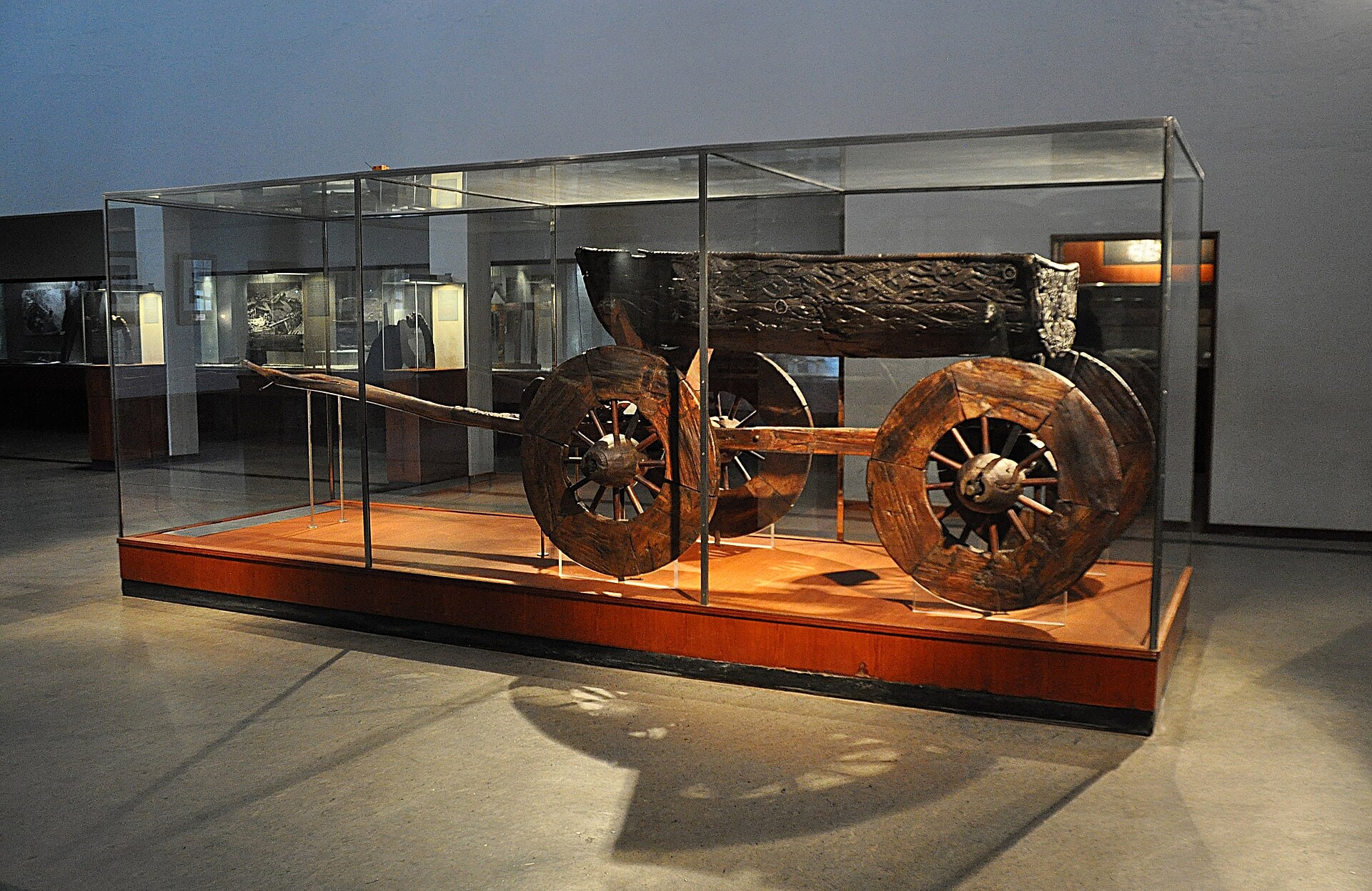
The richest ship burial known from the Viking Age lies in Norway, and it held two women. The burial chamber of the Oseberg ship is dated by dendrochronology to the year 834, an unusually precise anchor for a period where dating is often a matter of ranges. Among the goods placed inside were an elaborately carved wagon, sledges, animals, household equipment and a substantial quantity of textiles together with the tools to make them.
Who those two women were remains unresolved. There are proposals and ongoing arguments about kinship, status and who was buried for whom, but no secure answer, and it should be left exactly there. What the find shows beyond dispute is that the most lavish burial of the age was made for two women, and that textile work had a place even at that level of display.
Two outside accounts look north and are quoted constantly, usually past the point they can bear. The Arab envoy Ibn Fadlan, writing in the tenth century, describes a funeral among the Rus on the Volga in which an enslaved woman is killed and burned with her dead master. Adam of Bremen, writing in the eleventh century about the pagan Swedes, never travelled north himself and had a clear stake in making the case for mission. Both are outsider descriptions with interests of their own, and both should be read at arm’s length.
One point survives all of that source criticism, and it is routinely skipped. The rights discussed in this article belonged to free women. Enslaved women, visible in the sources as thralls and bondmaids, controlled neither property nor their own bodies. The Viking Age did not have a single role for women. It had at least two sharply different ones, and the dividing line ran not between the sexes but between free and unfree.
Conclusion: Room to Move, Inside Hard Edges
The honest answer to the question is this: a striking amount of room to act, drawn inside firm borders. Women ran economic enterprises, controlled property, inherited land, could end a marriage, and carried the textile production without which no fleet would have sailed anywhere. At the same time they did not sit at the assembly, did not plead cases as principals, and held a status that depended on family, property and personal freedom.
What makes this picture worth having is that it refuses both postcards. It sells neither an egalitarian north nor a voiceless life at the hearth. It shows something more awkward: a society that granted women very real economic and legal power because it would not have functioned without it, and that kept the political floor closed to them all the same. Anyone trying to understand the Viking Age should take the ring of keys at least as seriously as the sword.