Warriors & Battles
The Mammen Axe: Viking Silver Art of a Warrior Elite
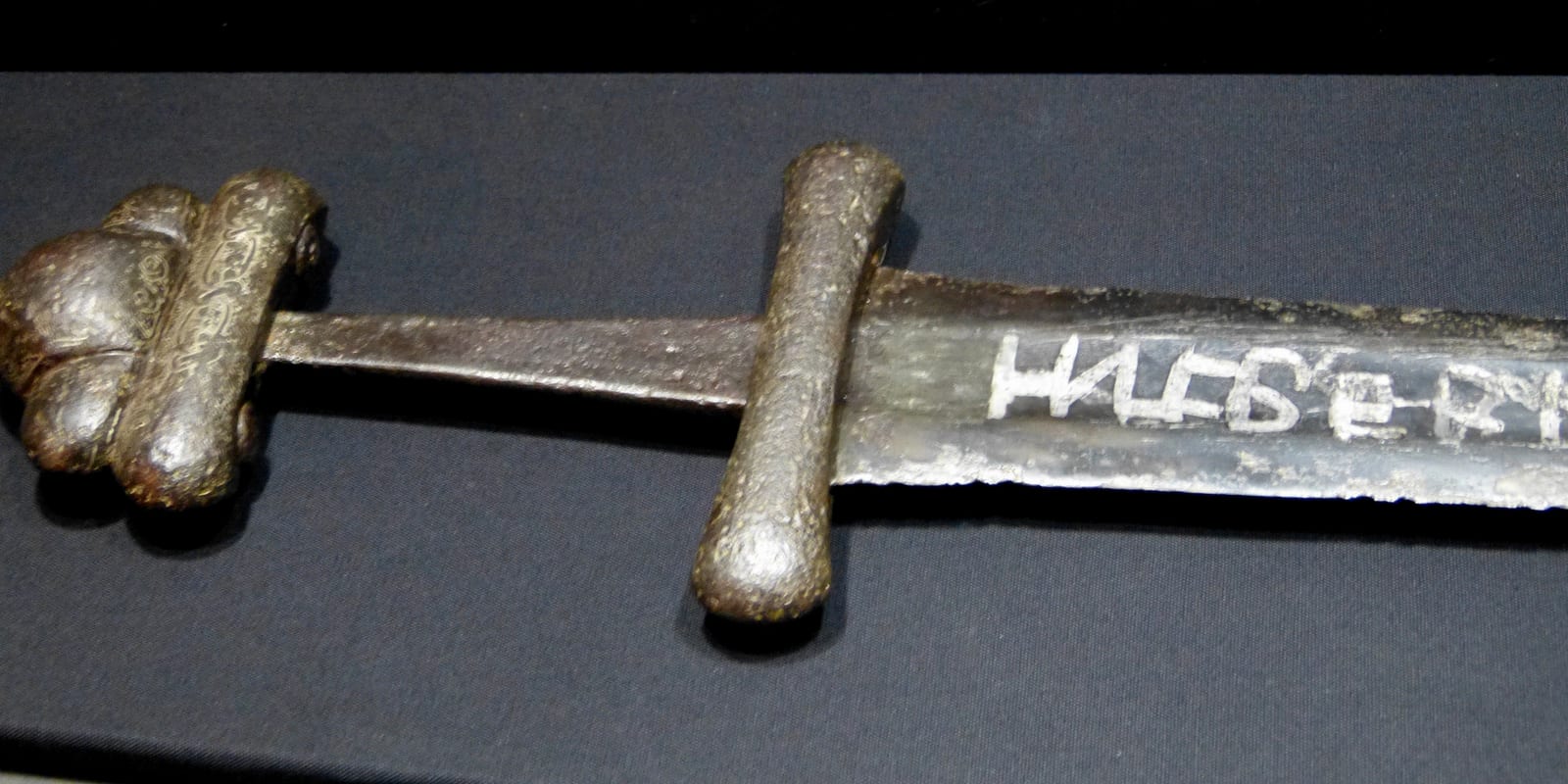
The Mammen axe Viking find of 1868: how a silver-inlaid axe head from a Danish chamber grave dated to the winter of 970/971 named an entire art style.
Contents
- A mound near Bjerringbro, and not an archaeologist in sight
- Winter 970/971: how tree rings date a grave
- The axe itself: silver that sits inside the iron
- What the Mammen axe tells us about Viking rank and wealth
- Bird, tree, mask: what the imagery means, and what it does not
- The Mammen style: how one object named a period
- What actually survives of Mammen
In 1868, men digging into a burial mound near the village of Mammen in central Jutland were not looking for history. They were looking for soil. What came out of that mound now sits behind glass in Copenhagen and has given its name to an entire art style of the tenth century. The Mammen axe is one of those rare cases where the Viking Age speaks to us not through sagas or Christian chroniclers but through a single piece of iron into which somebody hammered hair-thin threads of silver more than a thousand years ago. The axe is small. It is not heavy, not menacing, not impressive by size. And it still tells us more about the Danish elite than most weapons ever recovered from a grave.
A mound near Bjerringbro, and not an archaeologist in sight
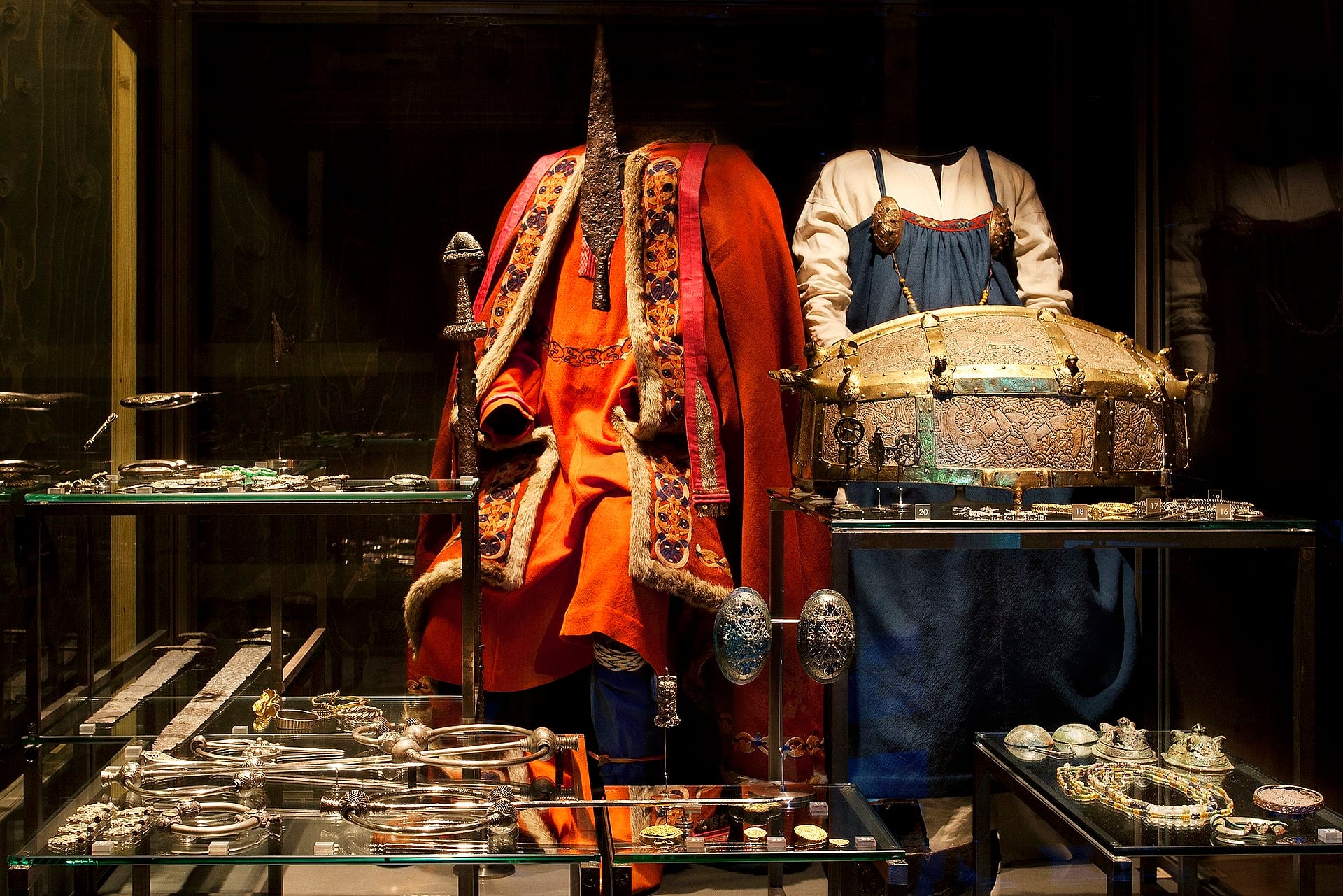
The site is called Bjerringhøj, a burial mound at Mammen, close to Bjerringbro in what is today the Viborg region. Inside the mound lay a timber burial chamber, and inside that chamber a man of considerable rank had been laid to rest. Alongside the axe came textiles of extraordinary quality: woollen cloth with silk trim, embroidery, metal thread, traces of fur, and two large wax candles.
The real problem with this find is not in the ground. It is in the way the find was made. The chamber was not carefully excavated, it was torn open. The objects reached the National Museum piece by piece, some of them by roundabout routes, and nobody recorded what lay where, what belonged together, or what stayed behind in the spoil heap. Anyone reading a list of the Mammen grave goods today is therefore not reading an observation. They are reading a reconstruction.
That is exactly why the National Museum returned to the mound generations later. During the 1980s, what remained of the structure was investigated again, soil sections were recorded and timber was recovered. It sounds like tidying up after the fact. In reality it was the step that turned a famous museum object back into a datable archaeological context.
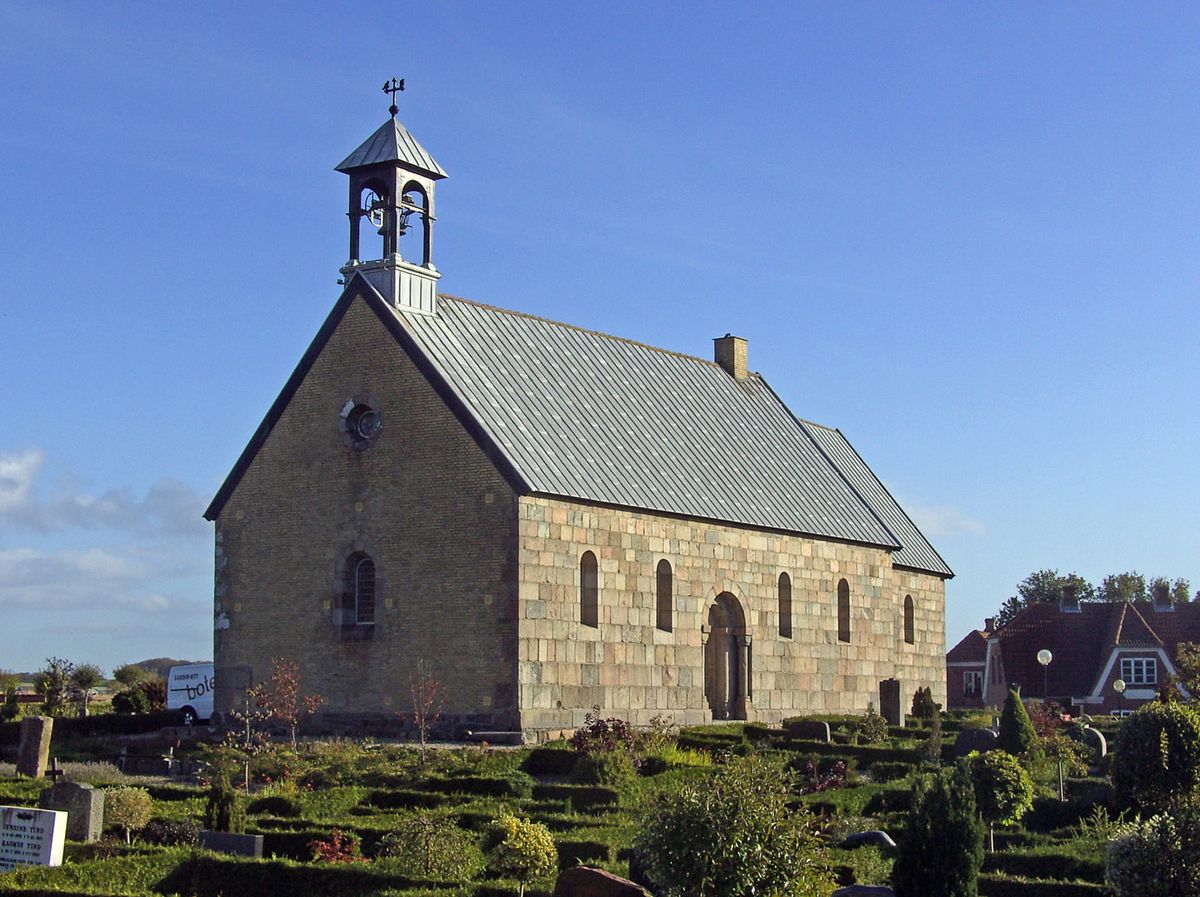
Image source: Bococo (CC BY-SA 3.0), via Wikimedia Commons
Winter 970/971: how tree rings date a grave
The single most important number attached to this find does not come from a chronicle. It comes from wood. The timbers of the burial chamber could be dated dendrochronologically, that is, by the pattern of their annual growth rings. The result was precise: the trees were felled in the winter of 970/971. Since nobody seasons construction timber for years before building a grave chamber, that winter is taken as the date of the burial itself.
Dendrochronology matters here because it does not deal in statistical ranges. A radiocarbon date offers a window of several decades. A well preserved beam with its outer ring intact offers a season. For the Viking Age, where written sources from the North itself are almost entirely missing, that is the difference between fog and floodlight.
And this particular winter drops the find into the middle of a political earthquake. These are the years of Harald Bluetooth, the king who brought Denmark under his rule and pushed through the shift to Christianity. The great runestone he raised at Jelling belongs to the same decades and speaks the same visual language as the axe.
King Harald ordered this monument made for Gorm his father and Thyra his mother, that Harald who won all of Denmark for himself, and Norway, and made the Danes Christian.
If you want the stones themselves in detail, we cover them in our article on the Jelling stones. For the man from Mammen, the date means one thing above all: he did not die at some vague point in the Viking Age. He died in the decade that decided which religion and which royal power would shape Denmark from then on.
The axe itself: silver that sits inside the iron
The Mammen axe is not a heavy chopping weapon. It is a relatively light, handy axe head whose blade widens downwards into a broad cutting edge. The effort that went into it is not in the mass. It is in the surface.
The technique is called inlaying, or damascening. The smith works over the iron surface with fine crossed strokes until it is rough and minutely toothed. Silver wire and thin silver sheet are then hammered into that roughened iron until the soft metal grips and cannot be pulled out again. The surface is then smoothed and polished. The result is a design that is neither painted nor glued on. It lives inside the material.
What makes the piece unusual is that the two faces of the blade carry different decoration. One side shows a bird with spread plumage caught in scrolling tendrils. The other shows a plant motif together with mask or face elements. Nobody decorates a weapon this way with close combat in mind. This was made to be looked at.
Listen to Járn ok þrumr while you read on:
What the Mammen axe tells us about Viking rank and wealth
The instinct to read a rich weapon grave as a warrior grave is understandable, but here it stops far too early. The axe is only one part of the assemblage, and it is not even the most expensive part.
The textiles from the chamber are among the most significant surviving cloth from the entire Viking Age in northern Europe. Silk had to travel long trade routes from the east. Metal thread and elaborate embroidery cost weeks of specialist labour. Fine wool with fur trim was a small fortune in a society without mechanised weaving. Then there are the two wax candles. Candles of that kind are unusual in pagan burial practice in the North and are generally read as a Christian element, which fits Harald’s decade exactly.
Put together, this is not the picture the films sell. The man in this mound was not a brawler. He belonged to the immediate circle of royal power: someone with access to imported silk, to silver, to specialist craftsmen, and to a new and politically charged burial vocabulary. How closely weaponry and social rank were tied together in this period is something we set out in more detail in our article on Viking weapons.
The life of the find at a glance:
- Winter 970/971: the timber for the burial chamber is felled, and the dead man is laid in the Bjerringhøj mound.
- 1868: locals cutting into the mound break into the chamber. No scientific record is made.
- Late nineteenth century: the axe, the textiles and other objects reach Copenhagen and are illustrated early in the research literature.
- 1980s: the National Museum re-examines the site and places the find back into a proper archaeological context.
- Today: the axe ranks among the best known objects in the Viking Age collection of the National Museum of Denmark.
Bird, tree, mask: what the imagery means, and what it does not
The motif on one face of the blade is usually described as a bird set within tendrils. From there the interpreting begins, and this is where caution is needed, because none of the readings can be proven.
| Reading | The case for it | Why it stays uncertain |
|---|---|---|
| Gullinkambi, the cock of Norse tradition | Bird motifs are common in the pagan imagery of the North | The figure is heavily stylised and cannot be identified to species |
| A Christian phoenix or dove | The candles in the grave and Harald’s conversion policy support a Christian reading | A bird in foliage is a stock motif, not a statement of faith |
| The plant as Yggdrasil or as a tree of life | Both traditions place a tree at the centre of their imagery | Which is precisely why the motif blurs pagan and Christian rather than separating them |
Our editorial take is this. The ambiguity is probably not an accident. It looks like the point. The find comes from the decade in which a king had his kingdom baptised while the older imagery was still everywhere in daily use. A prestige axe that can be read either way is not a contradiction in that situation. It is shrewd diplomacy worked in metal. Turning it into a clear statement of belief forces a period of transition into a category that did not yet exist.
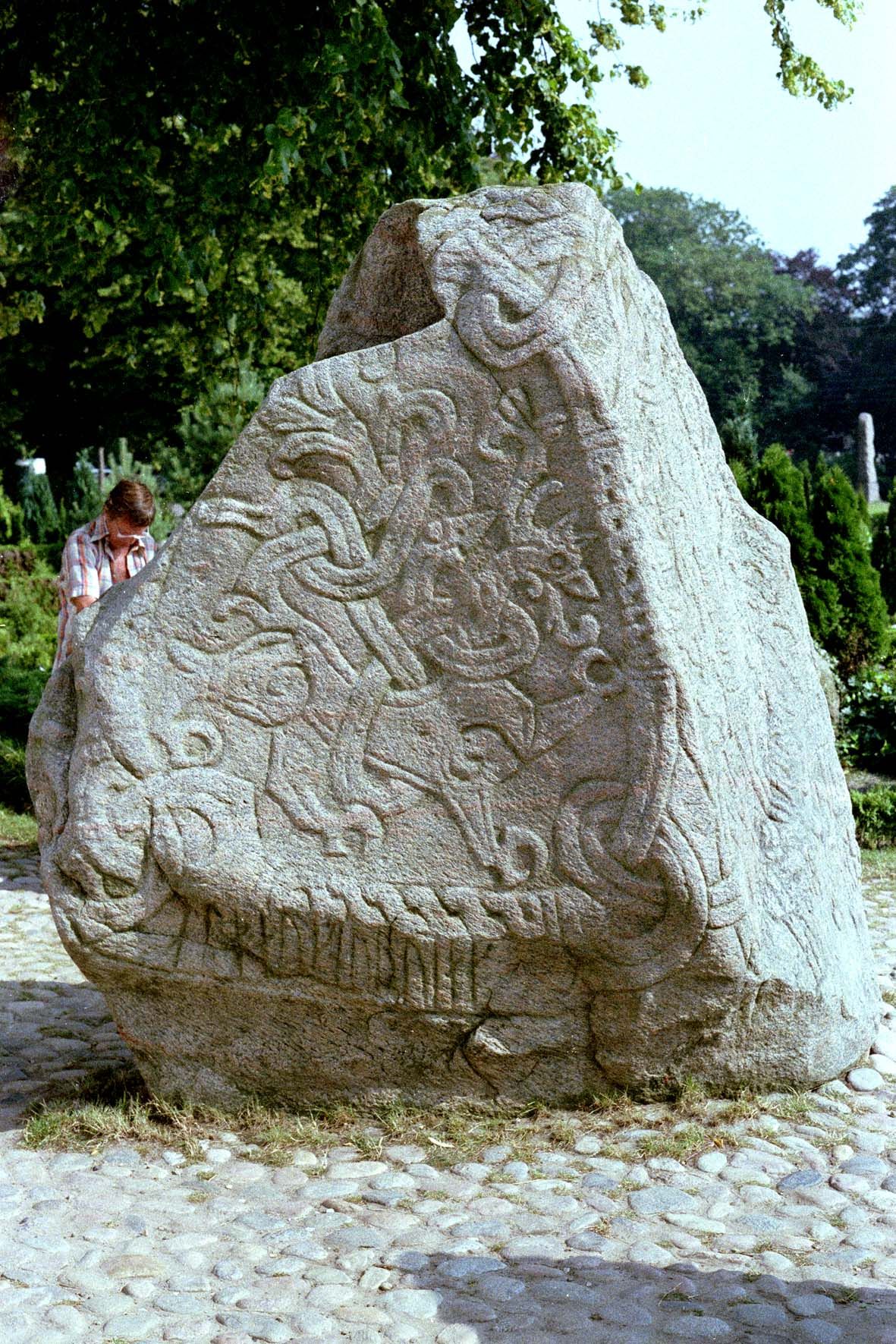
Image source: Sven Rosborn (CC BY-SA 3.0), via Wikimedia Commons
The Mammen style: how one object named a period
Viking Age art styles almost always carry place names, because they are named after the find in which they first became clearly recognisable. For the Mammen style, that find is the axe. Its hallmarks are animal bodies filled with dense rows of dots, heavier and fleshier forms than in the older styles, and tendrils and leaf offshoots that curl around the creatures. The style belongs to the second half of the tenth century and leads on into the later Ringerike style.
It is not a local curiosity either. It turns up across northern Europe, on stone, on bone and on precious metal:
| Object | Where it is kept | Why it belongs here |
|---|---|---|
| Mammen axe | National Museum of Denmark, Copenhagen | The name-giving piece, silver inlaid into iron |
| Large Jelling stone | Jelling, Denmark, standing in the open | The great beast with its coiling serpent, the same language in granite |
| Bamberg casket | Bayerisches Nationalmuseum, Munich | Bone carving with animal ornament in the style |
| Cammin casket | Original lost in the Second World War, casts survive | A reminder of how fragile our record actually is |
| San Isidoro casket | León, Spain | Evidence of how far northern forms travelled |
| Årnes bone cylinder | Norway | Related ornament worked onto an everyday object |
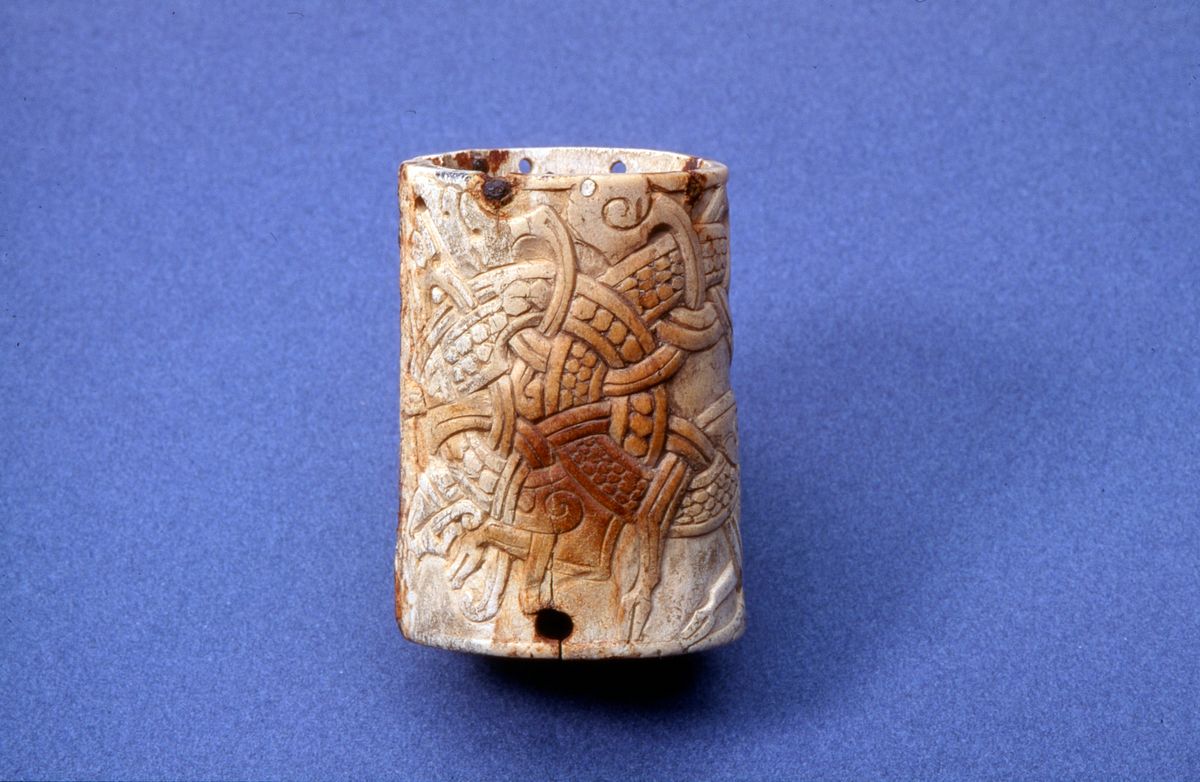
Image source: Per E. Fredriksen (CC BY-SA 4.0), via Wikimedia Commons
The Cammin casket is the most instructive case of all. The original was lost during the Second World War, and what survives are casts and older photographs. Set that beside the undocumented recovery at Mammen and you get an honest sense of how thin the basis for some standard statements about the Viking Age really is. We work with whatever chance, war and ploughing happened to leave behind.
What actually survives of Mammen
As a weapon, the Mammen axe is unremarkable. As a source, it is first rate. It dates a grave to a single winter, it ties a Jutland village to the royal power at Jelling, it shows craftsmanship at the highest level available in tenth century Scandinavia, and it supplies the reference point on which a whole art style hangs.
What it does not supply is a story. We do not know the man’s name. We do not know his office. We do not know whether he ever held the axe or whether it was made for the grave itself. Popular culture is happy to fill gaps like that with a grim warrior portrait. The evidence is more restrained and more honest. It shows wealth, connections, technical mastery and a religious turning point, but no biography.
That may be exactly why this find has refused to leave the research literature for more than 150 years. An object that leaves a question open stays interesting far longer than one that answers it.
Hero image source: Nationalmuseet - The National Museum of Denmark from Denmark (CC BY-SA 2.0), via Wikimedia Commons