Runes & Symbols
Thor Hammer Amulets: What the Viking Finds Really Show
Thor hammer amulet Viking finds examined: over a thousand pendants mapped, the runic hammer from Købelev, and what the graves can and cannot really prove.
Contents
Almost everything we say about Norse religion rests on texts written down by Christians, centuries after the fact, usually in Iceland. The Thor hammer amulet is one of the rare Viking subjects where that dependence breaks. These little pendants are physical objects. They can be weighed, measured, mapped, dated by the graves they sit in, and counted. Over a thousand of them survive. That makes them one of the very few places where we can check the sagas against something solid.
So this article does not retell the myth. We have covered the symbolism of Mjölnir in a separate piece. What follows is a look at the evidence itself: how many hammers there are, where they turn up, when they appear and vanish, and which handful of individual finds genuinely moved the scholarship forward.
The corpus: small, cheap, and everywhere
An archaeologist calls something a Thor’s hammer when it has a short shaft, a T-shaped or splayed head, and a suspension loop or hooked terminal at the top. Most are between two and five centimetres long and weigh less than ten grams. They were made in silver, copper alloy, iron, lead, amber, and occasionally gold.
The best count we have comes from Jörn Staecker, who catalogued hammer and cross pendants across the Baltic region in the late 1990s and gave the field its typology. Metal detecting and rescue excavation have added steadily to that total since, without changing the shape of the picture.
The dating is where it gets interesting, because the window is narrow. Hammer pendants are not an ancient, timeless part of Norse material culture. The earliest examples belong to the ninth century, the great bulk to the tenth, and by the later eleventh century they have all but disappeared from the record. Two centuries, more or less. That span lines up almost exactly with the arrival and consolidation of Christianity in Scandinavia, and no honest reading of this Viking amulet class can ignore the coincidence.
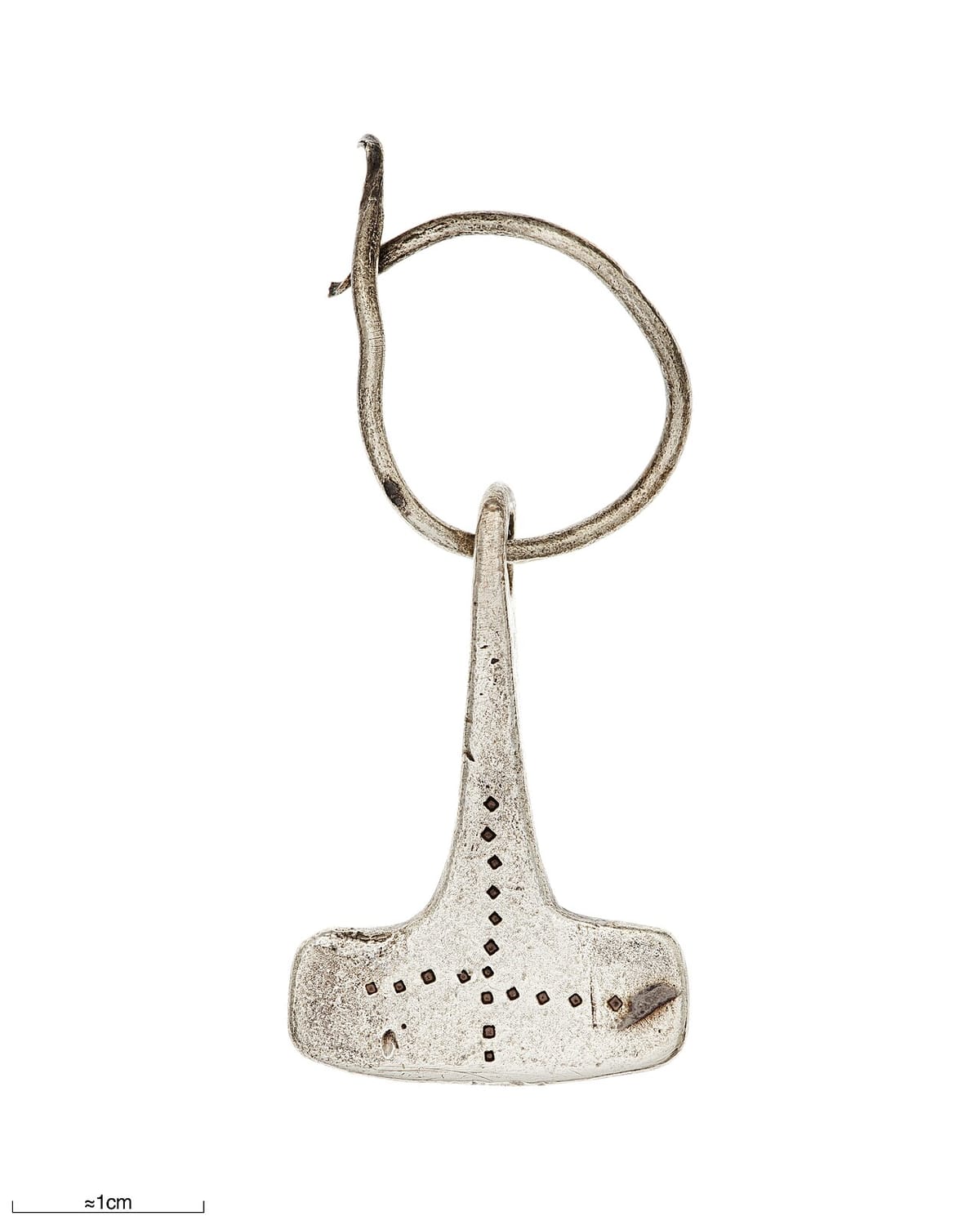
Image: Ola Myrin, Historiska museet (CC BY 4.0), via Wikimedia Commons
Mapping the Thor hammer amulet: a Viking trade footprint
Plot every known example and you get a distribution that tracks Scandinavian movement almost perfectly. Densities are highest in central Sweden and on the Baltic islands, then Denmark and southern Norway. From that core the finds thin outwards: west to Iceland and Ireland, south into northern Germany, and east along the river routes to Staraya Ladoga and Gnezdovo in what is now Russia.
The edges of the map are the most revealing part. In England, the Portable Antiquities Scheme has recorded a growing series of hammer pendants from the Danelaw counties, including pieces from Lincolnshire and Norfolk. And at Repton in Derbyshire, where the Danish army wintered in 873, a burial produced a hammer pendant alongside weapons and a boar’s tusk. Finds that can be tied to a dated historical event are vanishingly rare, which makes that one grave disproportionately useful.
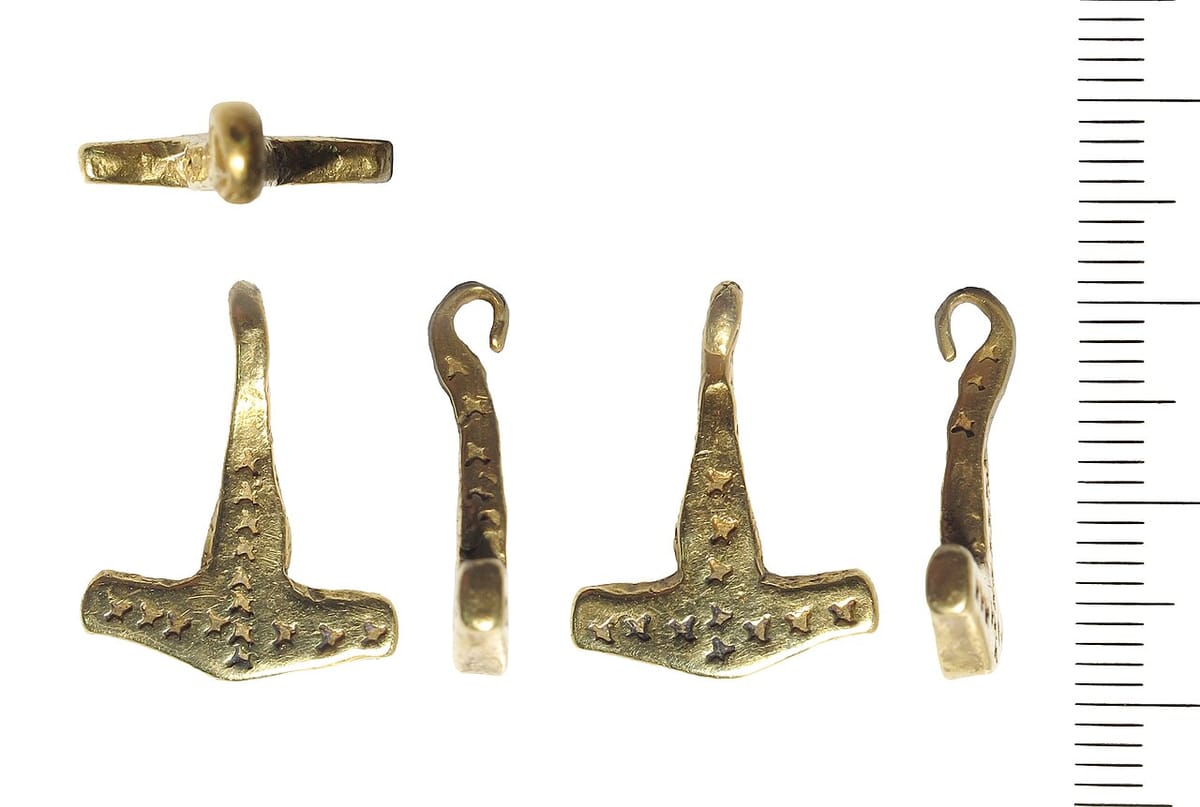
Image: Lincolnshire County Council, Adam Daubney, Portable Antiquities Scheme (CC BY-SA 4.0), via Wikimedia Commons
It is tempting to read that spread as a map of belief pushing outward against Christianity. It is more honestly a map of commerce. Hammers travelled with the same people, in the same bags, along the same routes as hacksilver, beads, and folding scales, and they cluster where other Scandinavian imports cluster: at trading places, river mouths, and transhipment points such as Birka.
Put Þórr on while you read the rest, the track about the god behind these amulets:
Købelev, 2014: the object that named itself
For decades this whole category rested on an inference, and a slightly uncomfortable one. The object resembles a hammer. Thor owned a hammer. Therefore the object represents Thor’s hammer. Not a single specimen said so itself. Sceptics could always argue for tool models, anvil symbols, or a purely decorative motif that later scholarship had over-read.
That gap closed on the Danish island of Lolland. In 2014, at Købelev, a small bronze pendant with silver plating came out of the ground carrying a short runic inscription: hmar x is. It is a slightly garbled rendering of Old Norse hamar es, and it means exactly what it looks like:
This is a hammer.
Nothing about that sentence is eloquent, and that is rather the point. For the first time, an object of this class labels itself, in the language of the people who wore it. The find is now in the National Museum of Denmark, and it remains the only known Viking Age hammer pendant carrying such an inscription.
Iron rings: the find class nobody puts on a t-shirt
Say “Thor’s hammer” and most people picture a silver pendant on a cord. There is a second and entirely separate group of finds that almost never reaches popular culture: the hammer rings, torshammarringar in Swedish. These are open iron rings, neck-sized or arm-sized, with one or several small iron hammers threaded onto them, sometimes together with spirals and loops.
Their distribution is startlingly tight. The overwhelming majority come from the Mälaren valley in Sweden, meaning Uppland, Södermanland, and Västmanland, with scattered outliers further east. Almost all of them come from cremation burials, deposited with the burnt bone or pushed into the grave fill. A rusting iron ring was not everyday jewellery. These look like objects made or chosen for the funeral itself, which puts them in a different functional category from the silver pendants entirely.
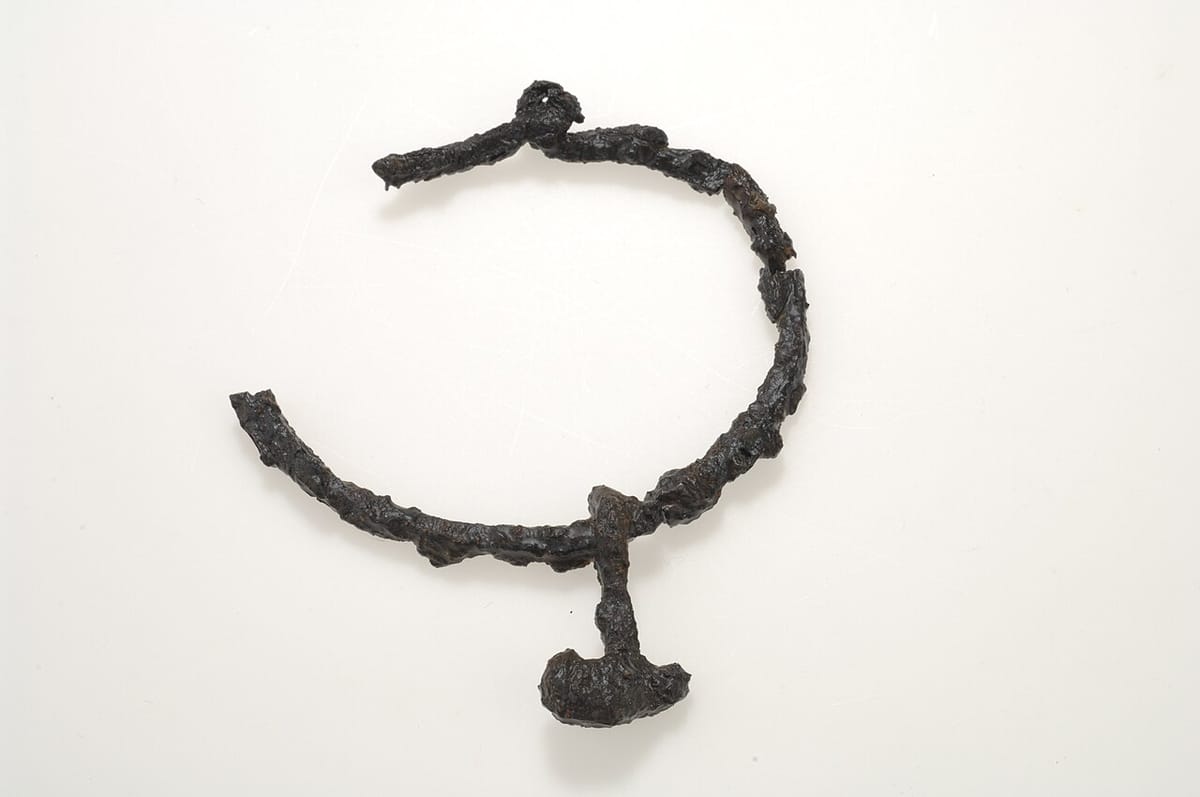
Image: The Swedish History Museum, Stockholm (CC BY 2.0), via Wikimedia Commons
That regional concentration is one of the strongest arguments against a single, uniform hammer cult across the Norse world. What was apparently standard funerary practice around Lake Mälaren left no trace at all in Jutland or western Norway. Look closely and the category breaks into local habits.
One mould, two religions
The single most instructive find for the religious question is not an ornament but a tool. At Trendgården in northern Jutland, archaeologists recovered a soapstone casting mould with matrices for several objects at once, among them a Thor’s hammer and a Christian cross. One craftsman, one pour of metal, one workshop, both symbols.
A silver pendant from Foss in Iceland makes the same point from the other direction: its outline can be read as a hammer or as a cross with equal justification, and it was probably meant to work either way. This is not an oddity but a pattern, and it fits what the written sources say about the conversion generations. The Icelandic Landnámabók says of Helgi the Lean that he believed in Christ but called on Thor at sea and in tight corners. Snorri Sturluson, in Hákonar saga góða, describes King Hakon making the sign of the cross over the drinking horn while a loyal jarl assured the farmers present that the king had signed the hammer.
| Find | Place | Date | Why it matters |
|---|---|---|---|
| Købelev hammer | Lolland, Denmark | 10th c. | Only runic inscription: “this is a hammer” |
| Trendgården mould | North Jutland, Denmark | 10th c. | Hammer and cross cast in one mould |
| Foss pendant | Iceland | 10th c. | Deliberately readable as hammer or cross |
| Repton grave 511 | Derbyshire, England | c. 873/874 | Hammer in a historically dated burial |
| Mälaren hammer rings | Sweden | 9th to 10th c. | Separate class, almost only in cremations |
Myth against evidence
It is worth setting the common claims against what the material actually supports.
| Popular claim | What the finds show |
|---|---|
| The hammer was a warrior’s and a man’s badge | Pendants occur in male and female graves, and in Sweden strikingly often with women |
| Every Viking wore one | They stay a minority grave good; most burials contain none |
| The amulet is as old as belief in Thor | As a pendant it is only traceable from the ninth century |
| Hammer and cross were opposites | Trendgården shows both produced in one workshop |
| Thor’s hammers all look alike | Range runs from rough forged iron to fine granulation, with no standard form |
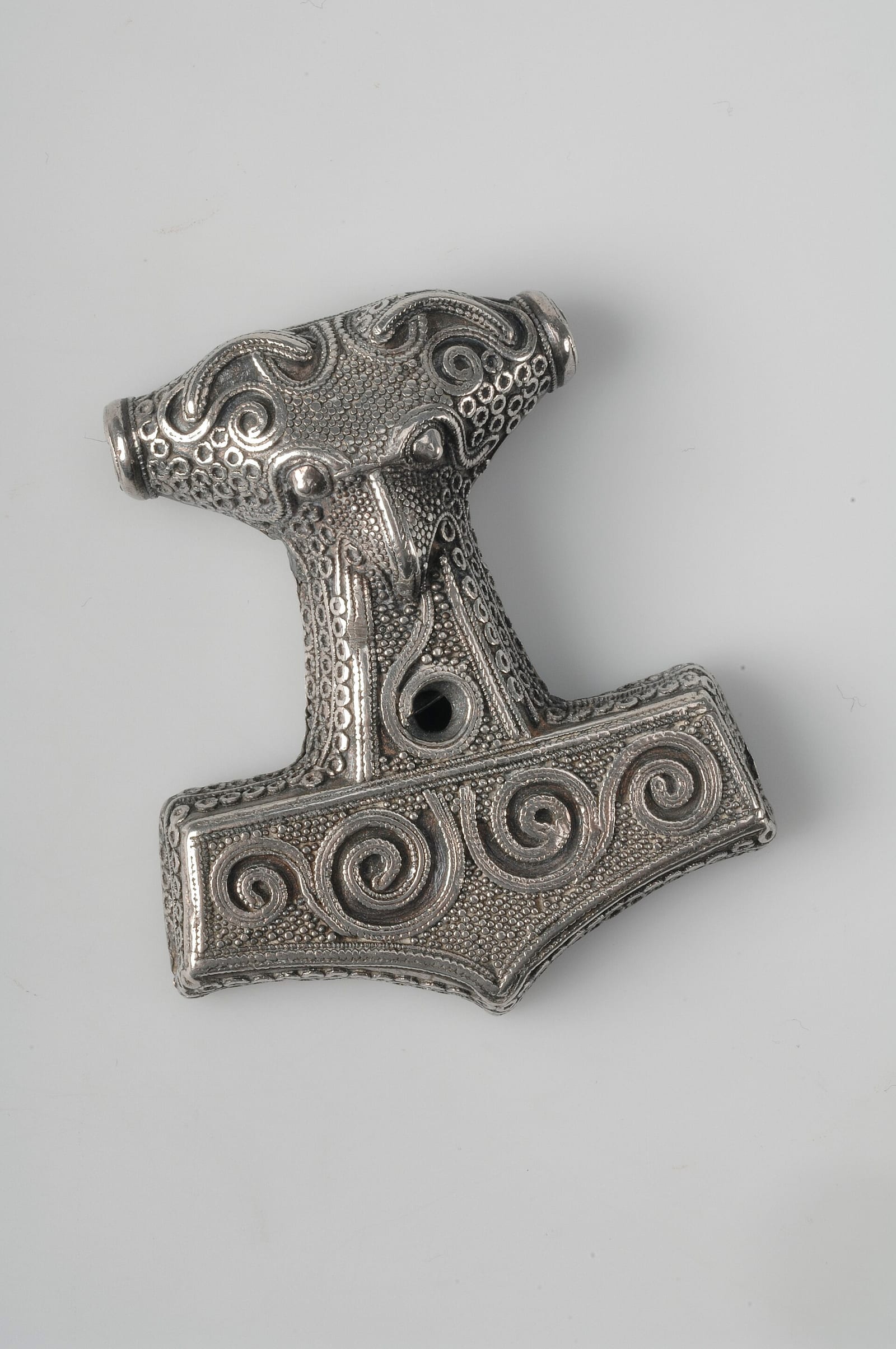
That last row deserves a footnote. The elaborate silver pieces with granulation and filigree, like the one at the top of this article, are prestige objects and thoroughly untypical. They are over-represented in our mental image because museums and picture archives put them in the display case. The statistically ordinary Thor’s hammer is small, plain, and often crudely made.
Where the evidence stops
There is a line that popular writing about this material crosses almost every time. No hammer pendant tells us what the person wearing it believed. An object in a grave may be a statement of faith, an heirloom, a charm, a fashionable trinket, or a choice made by mourners that the dead person never made at all. Archaeology can prove presence. It cannot prove conviction.
Our own reading, having gone through the find pattern: the most interesting thing about this class of object is chronological rather than theological. Hammer pendants appear in quantity at precisely the moment Christianity becomes visible in Scandinavia, and they vanish once it has won. That sequence suggests they became a wearable sign because of the competition, not before it. Nobody needs a badge for something everyone already shares. On this reading the Thor’s hammer pendant is not an ancient relic of heathen piety at all but a late invention, born from the need to take a visible position in a religiously mixed neighbourhood. It is an interpretation rather than a proven fact, but it accounts for the dating curve better than anything else on offer.
One thing the texts do confirm is that the hammer was never only a weapon. In Þrymskviða, in the Poetic Edda, the giant demands at the sham wedding that the hammer be brought in to hallow the bride. It was an instrument of blessing as much as of destruction, and that double role explains neatly why it converted so easily into something you could hang around your neck. Which is why these small, unglamorous scraps of silver, iron, and amber remain among the most eloquent objects the Viking Age left behind.
Hero image: The Swedish History Museum, Stockholm (CC BY 2.0), via Wikimedia Commons