Runes & Symbols
The Gotland Picture Stones: Comics From the Viking Age
The Gotland picture stones show how Vikings imagined Odin, Sleipnir and Valhalla. Explore the famous stones, their history and how to read them today.

Contents
- What Makes the Gotland Picture Stones Unique in the Viking World
- Seven Centuries in Stone: From Sun Wheels to Sailing Ships
- The Tjängvide Stone: An Eight-Legged Horse Rides Into Valhalla
- Ardre VIII: A Whole Saga Collection on One Slab
- Stora Hammars: A Sacrifice Beneath the Valknut
- Reading a Picture Stone Like a Comic Strip
- Where to See the Gotland Picture Stones Today
Most of what we know about Norse mythology comes from texts written down in Iceland two centuries after the last longship raid. But there is one place where the Viking Age drew its own pictures, and nobody had to write anything down at all. On the Swedish island of Gotland, out in the Baltic Sea, stand the Gotland picture stones: flat limestone slabs that the Vikings and their ancestors covered with sailing ships, riders, battles, and beings that step straight out of myth. Taken together, they form the largest surviving picture archive of the pre-Christian North. And they really do work a bit like comics: framed panels, stock symbols everyone recognized, stories told in sequence. The only thing missing is the speech bubbles, which is precisely why scholars have been arguing about them for 150 years.
What Makes the Gotland Picture Stones Unique in the Viking World
More than 500 picture stones and fragments are known today, and virtually all of them come from this single island. That alone is remarkable. Runestones exist by the thousand across Scandinavia, yet picture stones of this kind are an almost exclusively Gotlandic phenomenon. A handful of stones in the Gotlandic style have turned up abroad, most famously at Grobina in Latvia, where archaeologists excavated a Viking Age settlement with strong ties to Gotland. Wherever Gotlanders settled, it seems, their stones followed.
The raw material explains part of the story. Gotland is essentially one giant slab of limestone, which splits into large, even plates and carves far more easily than granite. The carvers worked their designs in shallow relief and then painted them; traces of pigment survive on some finds. The bold red panels you see on museum stones today are modern paint, added so that weathered lines become legible again, but the originals would have been at least as colorful.
The other thing that sets these monuments apart is their silence. A runestone spells out its message in writing: who raised it, for whom, and why. Most picture stones say nothing. They tell their stories purely in images, and only the latest examples add runic bands around the edges. For modern readers that silence cuts both ways. It forces us to interpret, because no inscription confirms who sits on the horse or whose ship is sailing. But it also preserves something texts rarely give us: an unfiltered look at which images the people of the Viking Age themselves considered worth cutting into stone.
Seven Centuries in Stone: From Sun Wheels to Sailing Ships
Picture stones were not a Viking invention. When the first slabs were raised, the raid on Lindisfarne still lay almost four centuries in the future. The Swedish archaeologist Sune Lindqvist, who catalogued the material in his landmark study “Gotlands Bildsteine” in the early 1940s, sorted the stones into groups spanning roughly 700 years. Simplified, the development looks like this:
| Period | Shape and imagery |
|---|---|
| c. 400-600 | Tall slabs with whirling discs and sun symbols, flanked by animal pairs and rowing ships |
| c. 500-700 | Smaller, plainer stones with animals and geometric patterns |
| c. 700-900 | The great narrative stones with their mushroom silhouette: sailing ships, riders, battle and welcome scenes |
| c. 900-1100 | Late stones with runic bands, gradually merging into the Christian runestone tradition |
Read the table from top to bottom and you watch a culture change its mind about what stone is for. The early stones think in symbols: sun wheel, spiral, serpent pair. The later stones think in stories. From the 8th century onward, right as the Viking Age begins, the storytelling ambition explodes. Ships get sails, riders get destinations, and scenes fill up with characters. It is as if someone switched from painting icons to drawing graphic novels.
The Tjängvide Stone: An Eight-Legged Horse Rides Into Valhalla
No picture stone is reproduced more often than the slab found in 1844 at Tjängvide farm in Alskog parish, now on display in the Swedish History Museum in Stockholm. Its upper panel shows a rider on a horse with eight legs, welcomed by a woman holding up a drinking horn. Behind them stand a building and further figures.
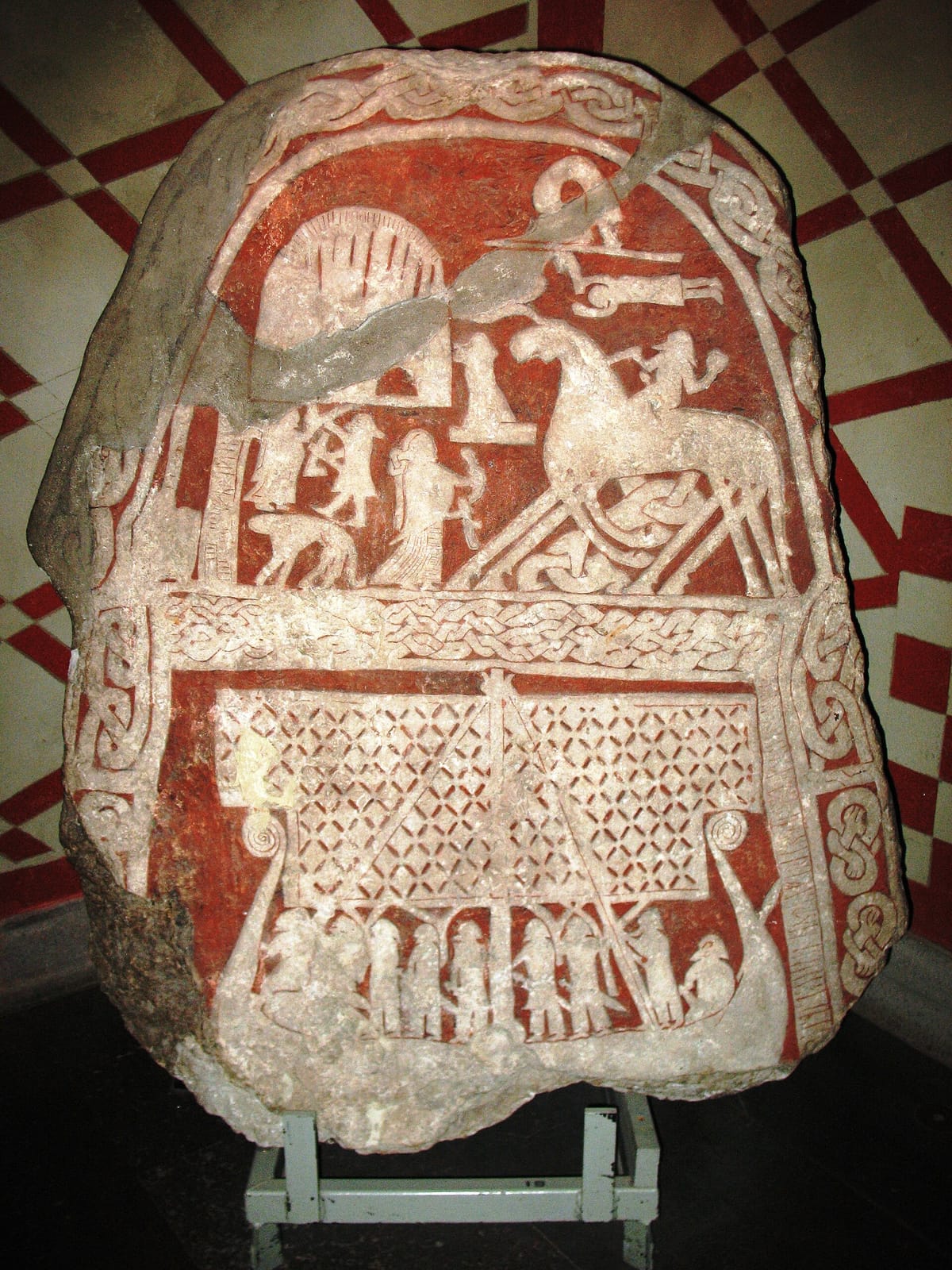 Image credit: Berig (CC BY-SA 4.0), via Wikimedia Commons
An eight-legged horse can only mean one thing in Norse tradition: Sleipnir, Odin’s steed, known from the Edda. Whether the rider is Odin himself or a fallen warrior being carried to the afterlife on the god’s horse is a debate that has run since the stone came out of the ground. The woman with the horn is usually read as a valkyrie greeting the newcomer at the gates of Valhalla. This welcome scene is no one-off: it repeats on stone after stone, almost like a formula, a fixed image every Viking Age viewer understood at a glance. Below it, a ship with a diamond-patterned sail crosses the panel, most likely the voyage of the dead across the water. The Tjängvide stone also carries a short runic inscription, which suggests it was raised in memory of a dead man.
Put on Valhalla by Domsgard while you read on. The song tells exactly the journey this stone depicts: a warrior’s road to the golden hall.
Ardre VIII: A Whole Saga Collection on One Slab
In 1900, workmen lifting the wooden floor of Ardre church discovered eight picture stones beneath it, recycled centuries earlier as convenient paving slabs. The largest, known today as Ardre VIII, turned out to be one of the richest narrative stones ever found. Dozens of figures and scenes crowd a single surface, usually dated to the 8th or 9th century.
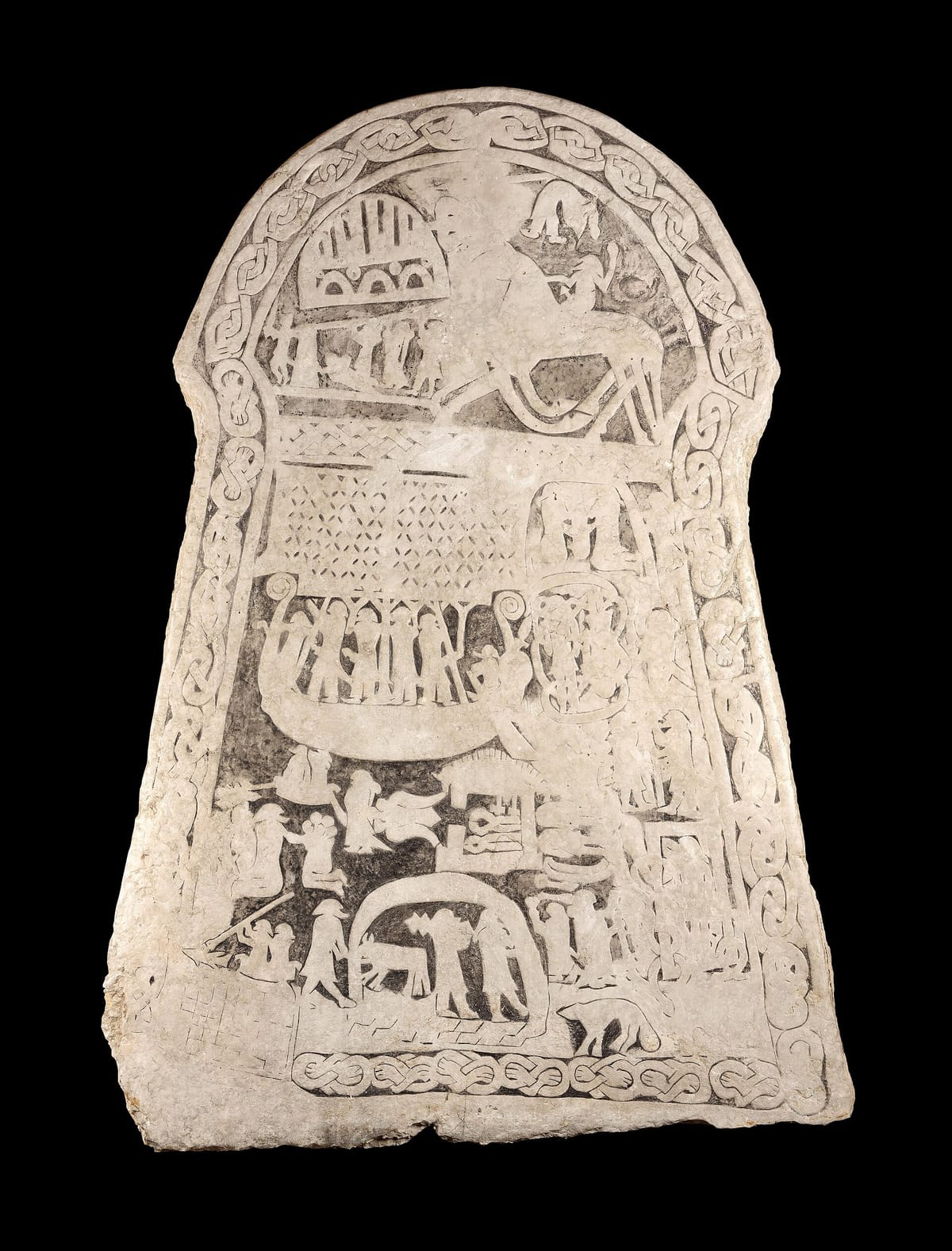 Image credit: Ola Myrin, Historiska museet (CC BY 4.0), via Wikimedia Commons
At the top, another eight-legged horse gallops toward a hall. Below it, a fully crewed sailing ship cuts across the stone. And in the lower half the storytelling gets specific. There is a smithy with tools laid out, two headless bodies lying beside it, and a bird-like figure flying away. That matches, beat for beat, the legend of Wayland the Smith as the Poetic Edda tells it: the captive smith kills his tormentor’s sons and escapes on wings of his own making. Another scene is commonly linked to Thor’s famous fishing trip, when the thunder god baited his hook with an ox head to catch the Midgard Serpent. One slab, several sagas, carved centuries before anyone in Iceland wrote them down. If you want proof that these stories circulated in the Viking Age itself, Ardre VIII is the strongest exhibit there is.
Stora Hammars: A Sacrifice Beneath the Valknut
Not every great stone has been moved indoors. At Stora Hammars in Lärbro parish, in northern Gotland, the picture stones still stand in the open air, on the spot they have occupied for well over a thousand years. The most famous of them, Stora Hammars I, is divided into stacked panels like the pages of a book.
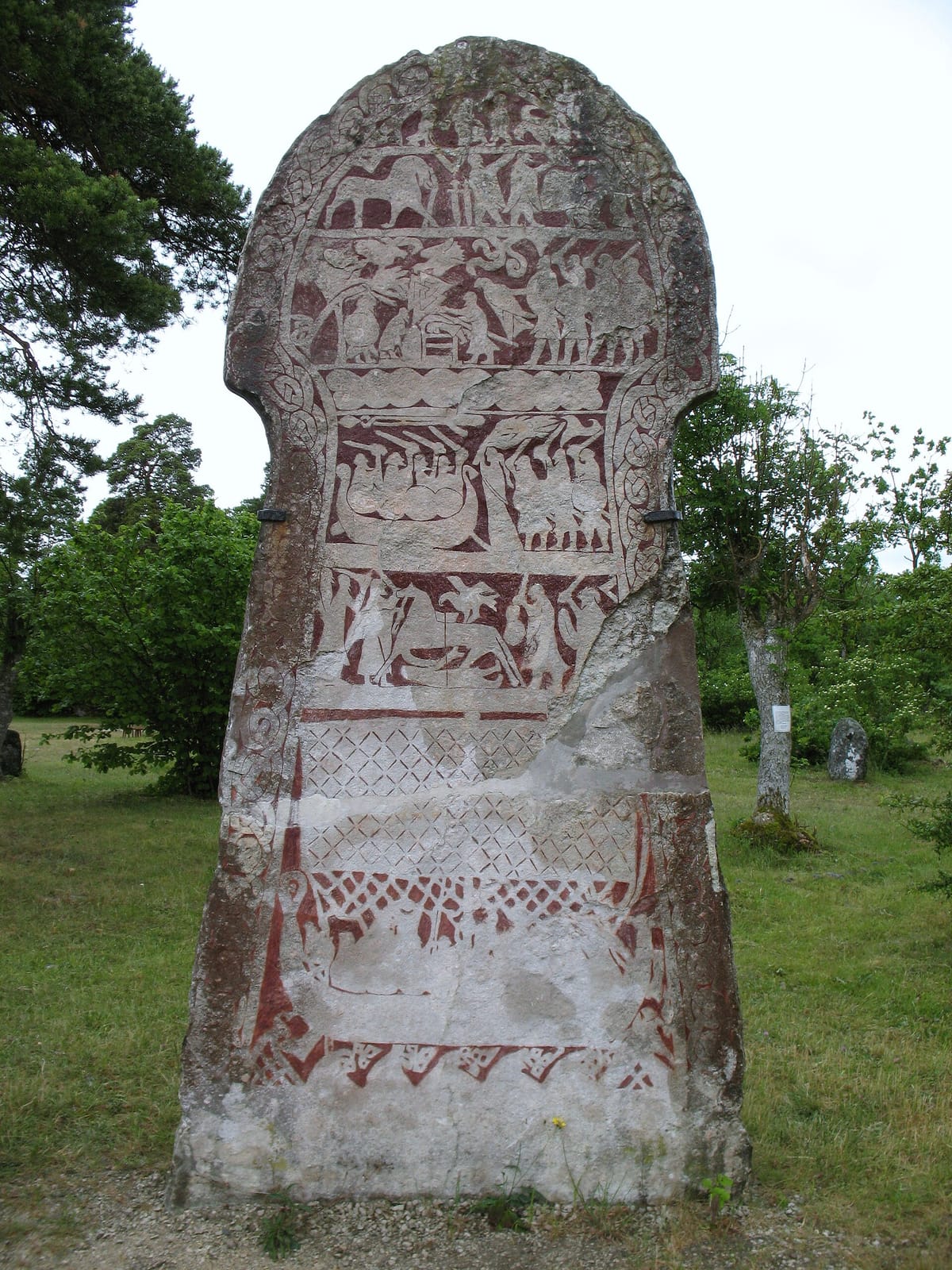 Image credit: Berig (CC BY-SA 3.0), via Wikimedia Commons
One of those panels has earned a grim reputation. A figure lies face down across an altar while an armed man bends over him with a weapon. To the left, a body hangs from a tree. And floating above the whole scene is a valknut, the symbol of three interlocked triangles that keeps appearing wherever Odin is near. The most widely accepted reading is a human sacrifice to the Allfather, since written sources describe hanged men as Odin’s offering. Some scholars have gone further and claimed the panel shows the notorious blood eagle, the gruesome execution known from the sagas. That cannot be proven, and this is exactly where caution matters: the stone shows, we interpret. What is certain is that ritual, violence and death sit unusually close together on this one piece of limestone.
Reading a Picture Stone Like a Comic Strip
The comic comparison is more than a catchy headline. The great narrative stones genuinely use the same core techniques as a modern graphic novel. They divide the surface into framed panels read from top to bottom. They rely on recurring visual shorthand that regular viewers decode instantly: the ship for the voyage, the rider for arrival in the beyond, the woman with the horn for the welcome. And they compress an entire legend into one key moment, exactly the way a single comic panel freezes a whole plot.
Our editorial take, after years of covering Viking Age monuments: the picture stones are the most underrated source on Norse mythology, full stop. Everyone knows the Edda, plenty of people know the great runestones, yet remarkably few realize that the Viking Age left us actual carved and painted picture stories of its myths. The stones stand closer to that world than any manuscript, because they were made right in the middle of the era they describe.
As for their purpose: the stones stood beside roads, bridges and boundaries, in full view of everyone passing by. Most researchers read them as memorials for the dead, though the dead were not necessarily buried beneath them. A picture stone was less a gravestone than a public monument. It secured a man’s memory and, at the same time, advertised the afterlife that awaited him.
Where to See the Gotland Picture Stones Today
The largest collection by far belongs to Gotlands Museum in Visby, whose picture stone hall in the Fornsalen gathers the island’s most important slabs under one roof. Individual masterpieces such as the Tjängvide stone and Ardre VIII are displayed at the Swedish History Museum in Stockholm. If you would rather meet the stones where they belong, several sites on Gotland keep them in the landscape, including Stora Hammars and the two mighty slabs of Buttle Änge, which still rise from the meadows they were raised in.
One practical tip for travelers: keep an eye on Gotland’s small country churches. Medieval builders loved the flat limestone slabs as building material, so picture stone fragments keep turning up in walls, thresholds and floors. The find at Ardre was not a lucky exception. It was the rule.
A visit changes how you see the Vikings, and it does so quietly. Among all the swords and ship rivets in the museum cases, the picture stones offer something different: not a tool, not a weapon, but a worldview. On these slabs, people of the Viking Age explained, without a single word, how they imagined death, the gods and the last great journey. All we have to do is learn to read what they drew.
Header image credit: Historiska museet (CC BY 2.5), via Wikimedia Commons