History
Ragnar Lothbrok: Legend and Truth
Ragnar Lothbrok is Viking legend's most famous king. What sagas claim about him, what chronicles confirm about his sons, and where legend and truth diverge.
Contents
Few figures from the Viking Age are more famous today - or more historically contested - than Ragnar Lothbrok. TV shows and novels paint him as a charismatic king, husband of the shield-maiden Lagertha, father of a small army of legendary sons, and the terror of two kingdoms. But ask the question any historian asks first - did this man actually exist? - and things get complicated fast. Ragnar Lothbrok’s story is a textbook case of legend and history tangled together in the Viking Age, and untangling that knot is the whole point of this article.
Who Was Ragnar Lothbrok, Supposedly?
The nickname Lothbrok - Old Norse loðbrók, “hairy breeches” - comes from a saga episode in which Ragnar has fur-lined, pitch-hardened trousers made to protect himself while fighting a giant serpent that was holding a Swedish jarl’s daughter captive. Winning her hand as a reward for slaying the beast is a classic opening move in Norse heroic saga, complete with monster and prize.
After that wife’s death, tradition continues, Ragnar married the legendary shield-maiden Lagertha and later Aslaug, a woman portrayed as the daughter of the dragon-slayer Sigurd from the famous Völsung saga cycle. With Aslaug, he supposedly fathered several sons who would go on to become major figures in their own right. Ragnar is described as a Danish or Swedish king who repeatedly raided England and France - allegedly even sacking Paris.
Does that sound like a coherent biography? That’s exactly the problem. It’s too coherent.
The Sources: Saga and Chronicle
The primary source for Ragnar’s life is the Ragnars saga loðbrókar, an Icelandic saga likely composed in the 13th century - once again, several hundred years after the events it describes. A second key source is the Gesta Danorum by the Danish scholar Saxo Grammaticus, also written in the 13th century, a Latin history that blends Danish royal legend with genuine chronicle material.
Both works present Ragnar as a real historical figure - but both are also, much like the Vinland sagas, the product of centuries of oral transmission, in which material from different men, times, and places can compress into a single, more satisfying story. Saxo and the Ragnars saga also disagree on major details - the chronology of Ragnar’s marriages and campaigns among them - which would be unusual for two accounts describing the same real person.
Historians have long suspected that “Ragnar Lothbrok” may not have been a single individual at all, but a legendary composite figure - a name onto which oral tradition gradually attached the deeds of several different ninth-century Viking leaders. That wouldn’t be unusual; heroic epics routinely fuse multiple real people into one larger-than-life character.
The Ragnars saga reports, in paraphrase, that Ragnar - jealous of his sons’ growing fame - set off on one final, reckless expedition to England with too few ships to match his earlier triumphs.
That psychologically loaded motivation makes for a compelling story. It cannot be verified as historical fact.
The Snake Pit
The best-known part of the Ragnar legend is also its least plausible: his death. According to the saga, Ragnar was captured during his final English campaign and thrown, on the orders of King Ælla of Northumbria, into a pit of venomous snakes. Dying, he is said to have declared that the piglets would grunt if they knew how the boar suffered - a line foretelling that his sons would take terrible revenge for his death.
This scene is pure saga material: dramatic, symbolically loaded, and structured to set up the next chapter of the story. No contemporary English or Frankish document mentions Ragnar dying in a snake pit - which is notable, since those same chronicles are strikingly precise about other events from the same period. The snake pit almost certainly belongs to the realm of legendary embellishment, and may even be a retroactive explanation: a satisfying cause invented for something that was already known to be true, namely that Ælla was later killed by Ragnar’s sons.
Where Legend Meets Real History
This is where things get interesting. While Ragnar himself dissolves into saga fog, his supposed sons step abruptly into the clear light of real, contemporary record-keeping.
The Anglo-Saxon Chronicle, one of the most reliable sources for early medieval English history, records the landing of a massive force in eastern England in 865 CE - later dubbed by historians the Great Heathen Army. This was no ordinary raid of the kind England had known since the Lindisfarne raid of 793; it was a coordinated, multi-year invasion aimed explicitly at conquest, not just plunder.
The Chronicle credits the army’s leadership to several brothers, including:
- Ivar the Boneless (Ívarr hinn beinlausi), generally regarded as the army’s military strategist
- Halfdan Ragnarsson, who later ruled parts of Northumbria directly
- Björn Ironside (Björn Járnsíða), credited in later sources with campaigns as far as France and reportedly even the Mediterranean
- Sigurd Snake-in-the-Eye (Sigurðr ormr í auga), whose nickname alone sounds like something out of legend
Unlike their father, these men are far better attested historically. Ivar and Halfdan appear by name in the Anglo-Saxon Chronicle, not merely in Norse sagas. Over the following years, the Great Heathen Army conquered the Anglo-Saxon kingdoms of Northumbria and East Anglia, killing King Ælla of Northumbria in 867 and King Edmund of East Anglia in 869 - both events confirmed by multiple independent sources.
And there’s the crux of the whole story: the father is legend, the sons are history. The link between them - that these real, powerful leaders considered themselves sons of a shared, already-famous father, or were later assigned one by chroniclers - may well be the very seed from which the Ragnar legend grew in the first place.
Why Ælla Made Such a Convenient Villain
That King Ælla, specifically, became Ragnar’s killer in the legend makes sense from a storytelling standpoint. Ælla really was the historical king overthrown and killed by the Great Heathen Army - led by the sons of Ragnar - in 867. The saga only needs to supply that death with a motive: if the sons were already going to defeat Ælla, it was a short step to also blame him for their (legendary) father’s death and turn the whole thing into a revenge story. Whether Ælla was actually responsible for Ragnar’s death - assuming Ragnar existed at all - cannot be established from the sources.
Some historians go further, suggesting that the notorious “blood eagle” execution some later sources attribute to Ivar the Boneless as revenge on Ælla is itself a later literary flourish - one more example of how difficult it is to separate fact from embellishment in this tradition.
What Archaeology Says About the Great Heathen Army
Unlike Ragnar himself, the Great Heathen Army left solid archaeological traces. At Repton, a village in the English Midlands where the Chronicle records a winter camp for 873-874, excavations uncovered a mass grave containing the remains of roughly 260 to 300 people, mostly men of fighting age, many bearing weapon injuries. Radiocarbon dating that accounts for the so-called “marine reservoir effect” - a distortion that affects people with fish-heavy diets - now places the grave convincingly within the timeframe of the Great Heathen Army.
At Torksey in Lincolnshire, where the Chronicle records another winter camp for 872-873, excavations turned up large quantities of coins, weights, and metal objects consistent with a large, seasonal military camp - not a permanent settlement, but a fortified base for an army that needed to overwinter before its next campaign. These finds independently confirm that the Chronicle’s account of the Great Heathen Army’s scale and movements holds up - even though they can say nothing about a leader named Ragnar, since graves don’t come with family trees attached.
What We Actually Know - and What We Don’t
Here’s where the evidence currently stands:
- Well established: A Great Heathen Army landed in England in 865, conquered several Anglo-Saxon kingdoms, and was led by a group of named brothers.
- Well established: Ivar the Boneless and Halfdan Ragnarsson appear as real people in the Anglo-Saxon Chronicle.
- Uncertain to unlikely: That a single man named Ragnar Lothbrok actually existed as their father and personally carried out all the campaigns attributed to him.
- Almost certainly legendary: The specifics of his life - the serpent fight, the marriage to Lagertha, the death in the snake pit.
This distinction isn’t pedantry. It shows, in miniature, how Viking Age history tends to work: a real, dramatic event - the 865 invasion and the collapse of two kingdoms - generates, over generations of oral retelling, a hunger for explanation. Who were these men? Who was their father? Out of that hunger grows a figure increasingly dressed in the trappings of classic heroic saga, until a single charismatic hero stands at the center of the story - one that no contemporary source ever actually names.
The Legacy of a Possibly Invented King
Whether Ragnar Lothbrok was one man, several men, or a pure storytelling device, his impact is undeniably real. He became the defining symbol of the Viking Age itself, the father figure behind one of the most consequential military campaigns in English history, and the template for countless later stories about Norse warriors. The sagas themselves have no interest in sober source criticism - they exist to tell a good story, and for centuries, they’ve done exactly that with tremendous success.
What makes the story compelling today is precisely this double layer: we can follow the legend and be drawn in by the snake pit and the vow of revenge, while knowing all along that the verified history - the Great Heathen Army and its real leaders - was every bit as dramatic. Sometimes the truth needs no embellishment at all. The real history of the Viking Age was gripping enough on its own.
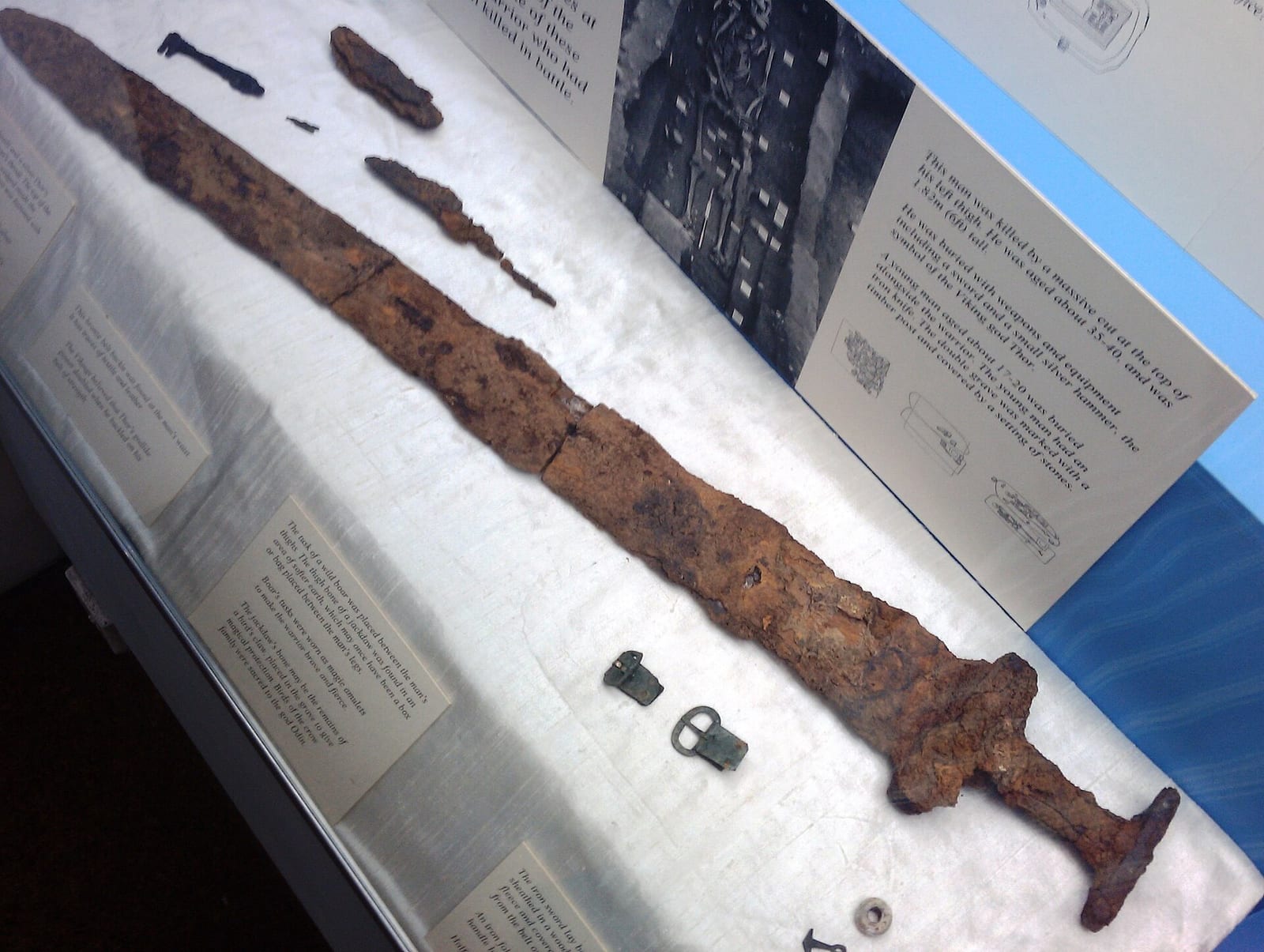
Image: Roger from Derby, UK (CC BY 3.0), via Wikimedia Commons