Mythology
The Norse Creation Myth: Ymir, Ginnungagap and the First Humans
The Norse creation myth in full: Ginnungagap, the giant Ymir, the cow Audhumla and the first humans Ask and Embla, as the Eddas and Snorri actually tell it.
Contents
- Before the Worlds: What Ginnungagap Actually Was
- Ymir, Audhumla and the Logic of the Thaw
- The First Killing: A World Built Out of a Corpse
- Fencing the Middle: Midgard and a Clock Already Running
- Ask and Embla: Driftwood Given Breath
- Myth Versus Source: Where the Norse Creation Myth Gets Retold Wrong
- Why This Beginning Had to End in Fire
Most creation stories answer the question of who made the world. The Norse creation myth answers a different one: what the world is made of. There is no voice in the dark, no command, no week of work. There is a gulf with two edges, a frost giant, a cow, and three brothers who kill, butcher and build. What they produce is not a creation at all but a construction, assembled from a corpse: soil from flesh, sea from blood, sky from a skull.
Two bodies of text carry the story. The Poetic Edda, preserved in the Icelandic Codex Regius manuscript, gives it in verse across Völuspá, Vafþrúðnismál and Grímnismál. Snorri Sturluson’s Prose Edda, written around 1220, retells it in orderly prose in the section called Gylfaginning. The two do not always agree, and the disagreements are the interesting part. Snorri was a Christian chieftain compiling a handbook for poets, not a believer preserving a creed, and wherever his account runs unusually smooth it is worth checking the verse underneath it.
Before the Worlds: What Ginnungagap Actually Was
The beginning is not nothingness. It is a gap with edges, and the Old Norse word for it is Ginnungagap. The second element, gap, plainly means a gulf or chasm. The first, ginnunga, is still argued over: the common reading links it to a verb meaning “to yawn” or “to gape”, while another line of scholarship takes it as an intensifier with magical force. Anyone who presents either reading as settled is going further than the evidence allows.
The oldest surviving description is the third stanza of Völuspá, where a seeress recalls a time before anything had shape:
Early in ages, when Ymir lived: no sand, no sea, no cold waves. Earth was nowhere, nor sky above, only a gaping gulf, and grass nowhere.
Snorri gives this emptiness a map. To the north lies Niflheim, a world of mist and ice with the spring Hvergelmir at its centre. From it pour the rivers known collectively as the Élivágar, whose venom hardens as it flows until layer upon layer of rime presses into the gulf. To the south lies Muspelheim, hot and uninhabitable, guarded by Surtr with a flaming sword, and from it drift sparks and warm air.
Where meltwater met that warmth, the drops quickened. It is a strikingly physical opening. The Norse creation myth does not begin with a word or a wish but with a thaw.
Ymir, Audhumla and the Logic of the Thaw
The first being is Ymir, called Aurgelmir in Vafþrúðnismál. He is the ancestor of the rime giants, the hrímþursar, and he reproduces in a way Snorri reports almost apologetically: as Ymir sleeps, a man and a woman grow from beneath his left arm, while his two feet beget a six-headed son between them. From that line descend the jötnar, the older power the gods will never be rid of.
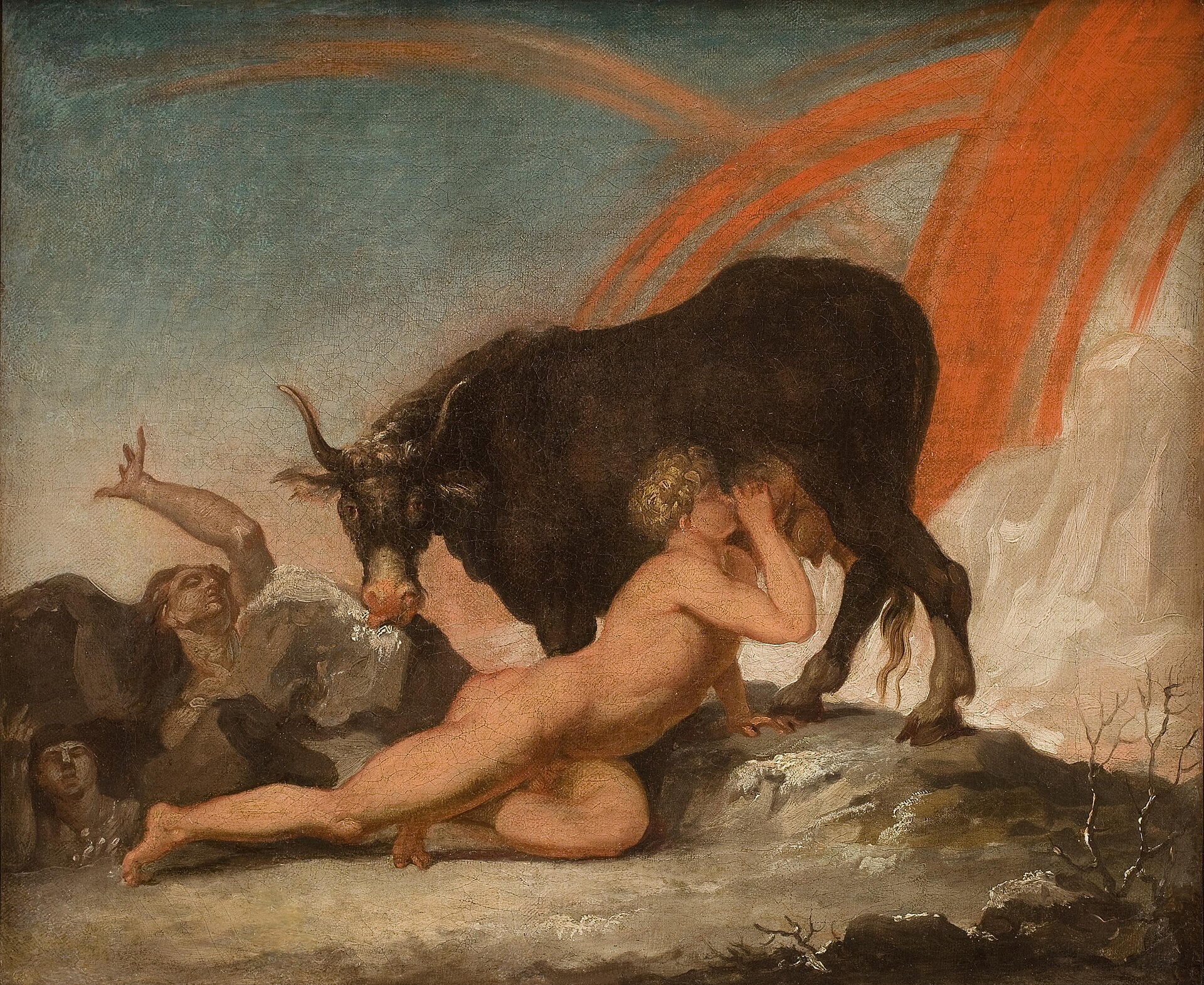
Out of the same melting rime comes the cow Audhumla. She feeds Ymir from four rivers of milk and feeds herself by licking salty blocks of ice. On the first day hair appears beneath her tongue, on the second a head, on the third a whole man: Búri. His son Borr marries Bestla, daughter of the giant Bölþorn, and their three sons are Odin, Vili and Vé.
One detail rarely survives the retellings. Audhumla appears only in Snorri. She is absent from the entire Poetic Edda. Whether he preserved an oral tradition that otherwise vanished, or filled a gap with an image of his own, cannot be decided from the texts we have. A noticeable share of what people picture when they think of the Norse creation myth is specifically Snorri’s version of it.
Put Scar on while you read the rest:
The First Killing: A World Built Out of a Corpse
The three brothers kill Ymir. No quarrel precedes it, no insult, no prophecy. The sources supply no motive at all, only the outcome. So much blood pours from the wound that it drowns the whole race of rime giants. One escapes: Bergelmir saves himself and his wife in something the Old Norse calls a lúðr, a word that can mean a mill box, a hollowed trough or a coffin depending on who is translating. Whatever the vessel was, the Edda here tells a flood story with a single surviving couple, and that is worth noticing on its own.
The brothers then drag the body into the middle of the gulf and build with it. This is the structural heart of the Norse creation myth, and Snorri lists the correspondences item by item in Gylfaginning, while Grímnismál confirms the same scheme in verse, independently of him.
| Part of Ymir | What it became | Source |
|---|---|---|
| Flesh | the earth | Gylfaginning, Grímnismál 40 |
| Blood | the sea and all waters | Gylfaginning, Grímnismál 40 |
| Bones | mountains and crags | Gylfaginning, Grímnismál 40 |
| Teeth and bone splinters | rocks and scree | Gylfaginning |
| Skull | the vault of the sky | Gylfaginning, Grímnismál 40 |
| Brains | the clouds | Gylfaginning, Grímnismál 41 |
| Brows or eyelashes | the wall around Midgard | Gylfaginning, Grímnismál 41 |
| Maggots in the flesh | the dwarfs | Gylfaginning |
Two entries in that list are easy to skim past. The dwarfs, first of all, begin as maggots. Snorri says they lived as worms in the dead flesh and were only afterwards granted intelligence and human shape by the decision of the gods. The master smiths of the North, the makers of Mjölnir and Gungnir, start out as decay. Second, four of them are posted at the corners of the skull to hold up the sky, and their names are Norðri, Suðri, Austri and Vestri. The cardinal directions of Old Norse are the names of dwarfs holding a dead giant’s head in place.
Fencing the Middle: Midgard and a Clock Already Running
From Ymir’s lashes the gods raise a wall and enclose Midgard, literally the “middle enclosure”. The word describes a legal condition rather than a geographical centre: inside the fence there is law and settlement, outside begins what belongs to the giants. The same logic organises the whole Norse cosmos, up to and including Yggdrasil, the ash that binds the levels together.
Only then is time installed. Sparks from Muspelheim are fixed in the sky and given fixed courses. Sól and Máni, sun and moon, are the children of Mundilfæri according to both Gylfaginning and Vafþrúðnismál, and they do not travel willingly. The wolves Sköll and Hati run behind them and will catch them at Ragnarok. Nótt, the night, and her son Dagr, the day, receive horses and chariots of their own.
That is a remarkable piece of engineering. The Norse creation myth does not simply set up a calendar, it sets one up under pressure. From the first day, sun and moon are fleeing something that eventually wins. The world is not only built, it is built with an expiry date.
Ask and Embla: Driftwood Given Breath
Both main sources describe the making of humankind, and they disagree about who did it. Völuspá 17 and 18 have three Aesir find two pieces of wood on a shore, strengthless and without fate. The three are named Odin, Hœnir and Lóðurr. They supply what is missing, and the wood becomes Ask and Embla.
Precisely what they supply is one of the most argued-over passages in the Edda. The Old Norse terms are önd, óðr, and the pair lá ok litu góða. Önd is breath and the life-spirit, óðr covers mind, sense and poetic fury, and the third pair is usually rendered as vital warmth and good colour, though that reading is not secure. Snorri names different givers, the brothers Odin, Vili and Vé, and a different set of gifts: breath and life, wit and movement, then face, speech, hearing and sight.
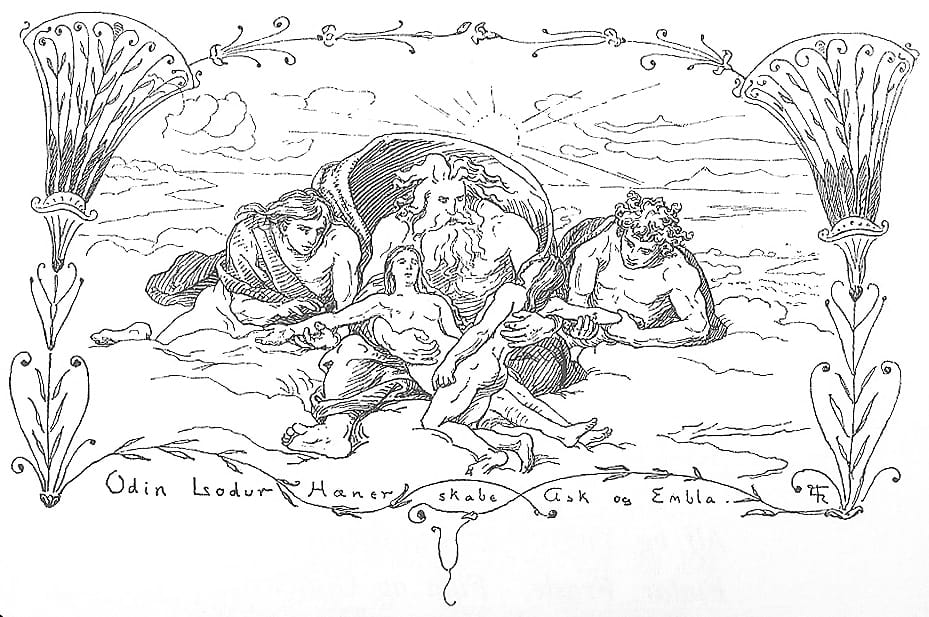
Image source: Lorenz Frølich (Public domain), via Wikimedia Commons
The names are no clearer. Ask is certainly the ash tree. Embla has been read as elm, as vine and as creeper, with no proposal winning the field. What is certain is that the first humans in the North are made of trees or driftwood rather than clay. For a culture whose halls, ships, carts and god-figures were all timber, no other material would have made sense.
In our editorial judgement this is the most underrated part of the whole story. The first humans are not created, they are found and fitted out. The raw material was already lying on the beach, and the gods picked it up and finished it. A myth that opens this way has very little to say about omnipotence and a great deal to say about craft.
Myth Versus Source: Where the Norse Creation Myth Gets Retold Wrong
Popular versions smooth the material considerably. The comparison below marks the points where retelling and text drift furthest apart.
| Common assumption | What the sources say |
|---|---|
| Odin creates the world out of nothing. | Nothing is created. Odin, Vili and Vé kill an existing being and build with his body. The material was already there. |
| Ginnungagap is total emptiness. | The gulf has two edges, Niflheim to the north and Muspelheim to the south, and fills with layered rime and drifting sparks. |
| Audhumla is ancient tradition. | The primeval cow appears in Snorri alone. The Poetic Edda never mentions her. |
| The dwarfs are a separate creation of the gods. | In Gylfaginning they begin as maggots in Ymir’s flesh and are granted mind and shape only afterwards. |
| Sun and moon move peacefully through the sky. | Sól and Máni are hunted by the wolves Sköll and Hati. The ordering of time is a chase from the start. |
| The first humans are shaped from earth. | Ask and Embla are wood found on a shore, given breath, mind and warmth. |
Why This Beginning Had to End in Fire
Set beside other cosmogonies, the shape of this one is unmistakable. There is no plan, no blessing and no day of rest. There is a gulf, a body, three armed brothers and a flood of blood that nearly erases everything that came before. The ground Midgard stands on is the flesh of a murdered being, the sky above it is his skull, and four dwarfs hold that skull at the corners.
It is an uncomfortable picture, and it fits what follows exactly. A world that begins with a killing is unlikely to end quietly, and it does not: it ends in the fire of Surtr, who was already standing at the southern edge of the gulf on the first day. Beginning and ending are not two stories in the Norse tradition but one story read from either side, which is why the Norse creation myth and Ragnarok mirror each other so precisely. Understanding that is also the clearest way to understand why the Eddas offer so little comfort and so much construction.
Hero image source: Nicolai Abildgaard, “Ymer dier koen Ødhumbla” (circa 1777, Statens Museum for Kunst), Public domain, via Wikimedia Commons