Mythology
The Jotnar: The Giants of Norse Mythology
Jotnar giants in Norse mythology: why they are older than the Aesir, far sharper than their reputation, and related by blood to the gods of Asgard themselves.

Contents
- Jotnar, giants and the Norse words we keep mistranslating
- Ymir: the world is made out of a jotunn
- Related, not merely opposed: a thoroughly mixed family tree
- Myth versus fact: six corrections
- Knowledge as a weapon: Mimir, Suttung and the contest with Vafthrudnir
- Utgard: the day Thor lost to old age
- Conclusion: where the lumbering giant actually comes from
The trouble with the jotnar, the giants of Norse mythology, starts with the translation itself. The Old Norse word is jotunn, plural jotnar, and “giant” is a poor fit for it. The English word drags a whole cartoon behind it: a slow lump with a club, roaring, outwitted in the last act by someone half his size. Open the Eddas and that creature is nowhere to be found. What you find instead is a family of beings older than the gods, whose ancestor’s body is the physical material of the world, who owned poetry before Odin stole it, and who once came within one unfair question of beating the Allfather in a contest of knowledge.
The evidence sits in the Poetic Edda, chiefly Voluspa, Vafthrudnismal, Skirnismal, Hymiskvida and Thrymskvida, and in Snorri Sturluson’s Prose Edda, above all Gylfaginning and Skaldskaparmal. One caution applies to everything that follows. Snorri was a thirteenth-century Christian writing about a pagan tradition he wanted to tidy, explain and preserve as literature. What reached him was oral, contradictory and regionally varied. Wherever his account is unusually neat, that neatness is his, not the tradition’s.
Jotnar, giants and the Norse words we keep mistranslating
Old Norse does not have one word for these beings. It has a cluster of them, and they overlap. Alongside jotunn stand thurs and troll, plus the subgroups bergrisar, the mountain giants, and hrimthursar, the rime or frost giants. A culture that only meant “very large person” would not need five terms. And size, when you actually look for it, is oddly absent from the stories. Nobody in Skirnismal remarks on Gerd being enormous. Nobody warns Njord that Skadi will not fit through the door.
What defines the jotnar is not their measurements but their address. They are the older power that sits outside the settled order of Asgard and Midgard. Scholars often frame this with the Old Norse pair innangards and utangards, inside the fence and outside it: within lies the farm, the law, the assembly; beyond it lies whatever was there first. Jotunheim is not the land of the tall. It is the land of the outside. Utgard carries the same idea in its very name, the enclosure beyond the enclosure.
| Term | Meaning | Where it appears |
|---|---|---|
| jotunn (pl. jotnar) | the standard collective term; usually linked to a root meaning “eater, devourer”, though the etymology is not settled | Vafthrudnismal, Gylfaginning |
| thurs | older and harsher in tone, with a distinctly threatening ring; also a rune name | Skirnismal, where Skirnir carves thurs as a curse |
| bergrisi (pl. bergrisar) | mountain giant, tied to rock and highland | Prose Edda; a bergrisi is also one of the four land spirits of Iceland in Snorri’s Heimskringla |
| hrimthurs (pl. hrimthursar) | rime giant, born out of the primordial frost | Gylfaginning, Vafthrudnismal |
| troll | vague in the sources and often interchangeable with jotunn; the sharp separate category is later | Prose Edda, saga literature |
That vocabulary is the first hard argument against the popular image. Fine distinctions are not something you develop for a creature you consider simple.
Ymir: the world is made out of a jotunn
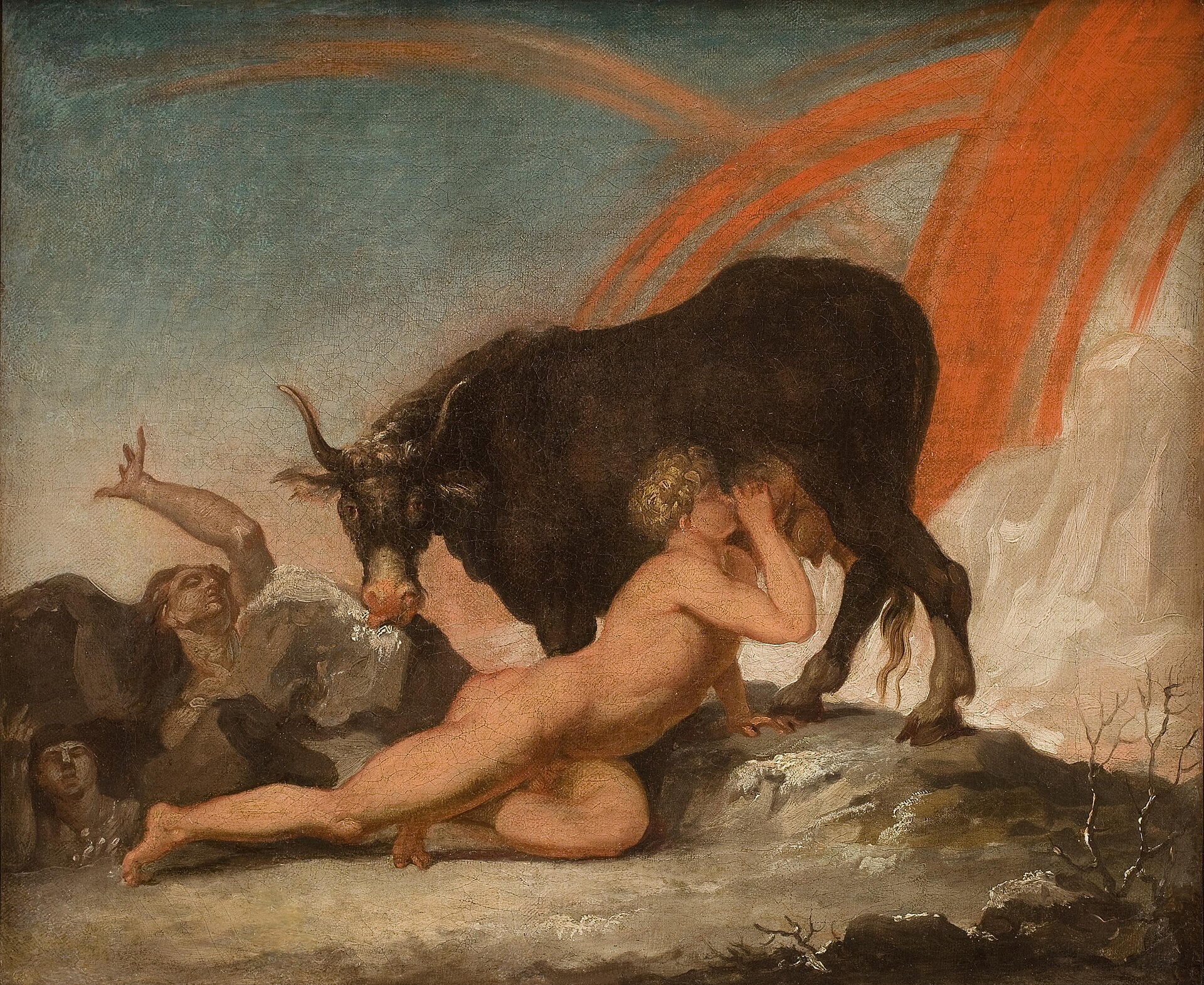
Everything begins before the gods. In the Prose Edda, frost and heat meet in the void of Ginnungagap and produce Ymir, the first of the rime giants. Other beings descend from him while the Aesir do not yet exist. Only afterwards do Odin and his brothers Vili and Ve appear, kill Ymir, and build the world out of his corpse: earth from his flesh, sea from his blood, mountains from his bones, sky from his skull. Vafthrudnismal confirms the same cosmogony independently of Snorri, and does so, fittingly, in the mouth of a jotunn.
It is worth sitting with what that means. The jotnar are not an external threat that turns up later and knocks at the gate. They are the raw stock of creation. Walk anywhere in Midgard and you are walking on a dead jotunn. Snorri adds that Ymir’s blood drowned the rime giants in a flood, with only Bergelmir and his household escaping, a detail Vafthrudnismal also preserves. So the long enmity between the two sides opens with a killing and a near extinction, and the gods are the ones who committed it.
Related, not merely opposed: a thoroughly mixed family tree
Take the genealogies seriously and the two sides refuse to separate. Odin’s mother Bestla is a jotunn, which makes the Allfather half of what he spends his career fighting. Loki, who lives in Asgard and swore blood-brotherhood with Odin, is the son of the jotunn Farbauti. Skadi, daughter of Thjazi, arrives in Asgard after her father’s death and marries into the divine household. And in Skirnismal the Vanir god Freyr wants the jotunn Gerd so badly that he sends his servant Skirnir with threats and curses rather than an army.
What strikes the Nordweg editorial team here is that none of these matches is told as a scandal. Not one verse suggests Freyr married beneath himself. The line between Aesir and jotnar is therefore political rather than biological: a quarrel about power, land and precedence, not about species. Once you see it that way, the conflicts read differently. Thrymskvida, where the jotunn Thrym steals Thor’s hammer and demands Freyja as the price, stops being a monster story and becomes a hostile marriage negotiation between two parties who know each other perfectly well. Loki’s impossible position also makes far more sense once you stop treating him as a traitor inside Asgard and start treating him as what he was from birth: a being with two allegiances.
Domsgard has a track that puts exactly this idea to music, the moment an older power stirs:
Myth versus fact: six corrections
| The popular idea | What the sources actually say |
|---|---|
| Jotnar are defined by enormous size. | Size is rarely mentioned at all. Gerd and Skadi marry into the gods with no comment on their proportions. What defines the group is standing outside the order, not standing taller. |
| Jotnar are stupid and slow. | Vafthrudnir answers every question Odin puts to him about the origin and the end of the world. The well of wisdom belongs to Mimir. The mead of poetry was originally held by Suttung. |
| Gods and jotnar are two separate peoples. | Odin’s mother Bestla is a jotunn and Loki’s father Farbauti is a jotunn. Skadi and Gerd marry into Asgard. The boundary is drawn politically, not by blood. |
| Jotnar fight with brute force. | At Utgard, Utgarda-Loki defeats Thor entirely through illusion. Thrym takes Mjolnir by theft and bargaining. Suttung keeps the mead by hiding it. |
| The jotnar are simply the villains. | They are first of all the elder party, and the violence begins with the gods killing Ymir. Only at Ragnarok do they stand united on the opposing side. |
| Surtr is the biggest giant of them all. | Surtr comes out of Muspelheim and is a fire being. The sources treat him as his own category, not as an unusually large jotunn. |
Knowledge as a weapon: Mimir, Suttung and the contest with Vafthrudnir
The strongest evidence against the stupid giant lies wherever knowledge is at stake. The well beneath a root of the world tree, the one in which wisdom is hidden, belongs to Mimir. Odin has to leave an eye as the price of a single drink. Mimir’s exact classification is disputed and the sources are not explicit; he is often counted among the jotnar. What is certain is the shape of the transaction. Wisdom was not stored in Asgard, and the Allfather had to pay a stranger for access to it.
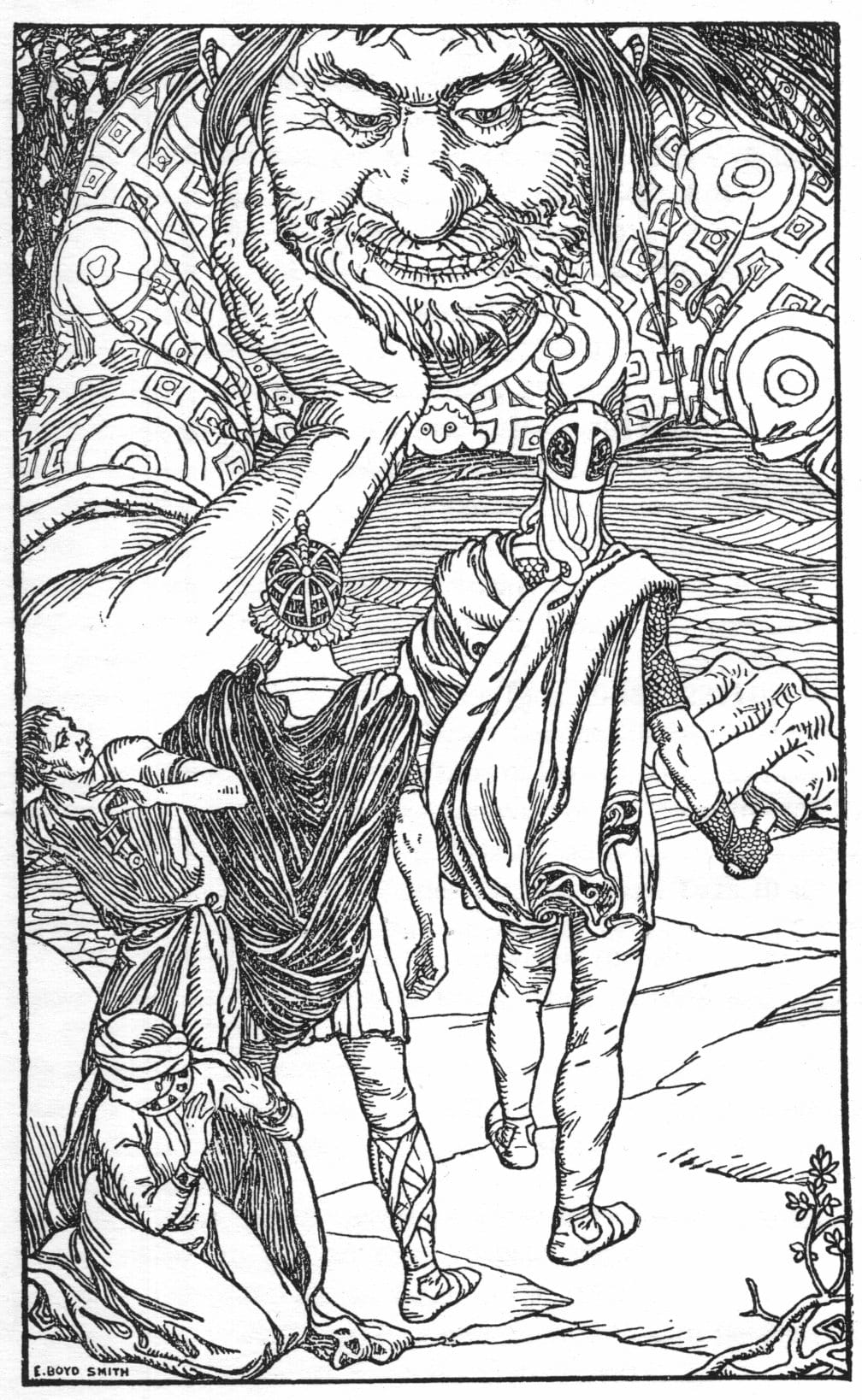
Image credit: Elmer Boyd Smith (Public domain), via Wikimedia Commons
The mead of poetry follows the identical pattern. According to Skaldskaparmal, the drink that grants poetry and learning to whoever tastes it was originally in the keeping of the jotunn Suttung, stored inside a mountain. Odin does not win it in battle. He wins it with a long, patient sequence of disguise, seduction and theft. Poetry, in other words, is not a native possession of the gods. It is something taken from the jotnar.
The point becomes unavoidable in Vafthrudnismal. Odin travels to the hall of the jotunn Vafthrudnir under a false name, and the two enter a contest of knowledge with the loser’s head as the stake. Vafthrudnir answers everything put to him: the world made from Ymir’s body, the origin of sun and moon, what will survive the end. Odin does not out-know him. Odin wins by asking a question only Odin can answer, namely what he whispered into the ear of his son Baldr before Baldr was laid on the pyre. Vafthrudnir recognises from the question who has been sitting opposite him all along, and concedes.
To my reading, that is the hinge of the whole subject. A tradition that lets its chief god win only by cheating does not consider the opponent dim. It considers him dangerously well informed.
Utgard: the day Thor lost to old age
The best known jotnar episode sits in Gylfaginning. Thor travels with Loki and the servant Thjalfi to Utgard, the stronghold of Utgarda-Loki, where the visitors are invited into a series of contests. Thor is asked to drain a drinking horn in three draughts and cannot. He is asked to lift a cat off the floor and manages one paw. He is asked to wrestle an old woman called Elli, and ends up down on one knee.
Only as they leave does the host explain what really happened. All of it was sjonhverfing, illusion of the sight. The far end of the horn opened into the ocean, and Thor lowered the sea. The cat was the Midgard serpent, and he pulled part of it away from the earth. Elli was old age itself, and nothing that lives wrestles old age to the floor, gods included. Then the hall and its owner vanish, and Thor’s hammer swings through empty air.
You can read the whole thing as a comic set piece. It is also a demonstration of power of a very particular kind. A jotunn defeats the strongest god in the north without laying a finger on him, purely through staging, timing and an expert grasp of how perception can be manipulated. Anyone still describing these beings as slow-witted has skipped the chapter.
At Ragnarok the jotnar finally stand united against the gods, and the relationship ends there. That battle has an article of its own and is not worth retelling here. The framing is what matters: the end of the world is the moment when the elder power takes back what was taken from it.
Conclusion: where the lumbering giant actually comes from
The popular picture is not Eddic at all. It comes from what followed. European folktale needed a large, stupid antagonist for a small, clever hero to outwit, and modern fantasy inherited that figure and mass-produced it. Even the familiar motif of a creature turning to stone in the sunrise falls, in the Poetic Edda, on a dwarf rather than a jotunn. The lumbering giant is a later invention, projected backwards onto material that says something quite different.
Strip that invention away and what remains is this: a people older than the gods, whose ancestor’s body became the ground and the sky, who held wisdom, poetry and prophecy before Asgard did, who married into the divine family repeatedly, and who are on record beating the gods twice, once against Thor’s strength and once, very nearly, against Odin’s knowledge. The jotnar of Norse mythology are not chaos set against order. They are the older thing that order was carved out of, and they have never stopped expecting it back.