Daily Life & Culture
Hnefatafl: The Viking Board Game and Its Rules
Hnefatafl, the Viking board game: one king runs, twice his number hunt him down. The rules, the real grave finds and why chess eventually pushed it aside.
Contents
Picture a king boxed into the middle of a board, a handful of bodyguards around him, and twice that many enemies closing in from all four edges. He has to get out. They have to pin him down. That single idea is the whole engine of hnefatafl, the Viking board game that was played in longhouses, on ship decks and in the halls of jarls for centuries before chess arrived. Boards and playing pieces turn up in Scandinavian graves alongside swords, scales and silver. The Poetic Edda even puts gaming pieces in the hands of the gods.
What we do not have is a single complete set of rules written down during the Viking Age. Everything we think we know comes from three places: the ground, the verse, and the travel diary of a Swedish botanist who watched two people play in Lapland in 1732. This article sorts that into what is solid, what is reconstructed and what was simply invented later.
One board, two completely different jobs
The name does most of the explaining. In Old Norse, tafl means the board and, by extension, the board game; hnefi literally means “fist” and refers to the big piece in the middle, the king. So hnefatafl is roughly “the king’s table”. Scholars usually talk about the tafl family, because the same idea shows up across the Norse and Celtic world under different names: brandubh in Ireland, tawlbwrdd in Wales, tablut among the Sámi in Lapland, and alea evangelii, a Christianised variant recorded in England.
What they share is unusual among board games: the two sides are not mirror images. This is not army against army but a siege against a breakout. The king sits in the centre with a small guard, and roughly twice as many attackers line the edges. Boards always have an odd number of squares per side so that a true centre exists, and they range from 7x7 through 9x9 and 11x11 up to 13x13.
That imbalance is the point: both players are in the same game with opposite problems. One needs a single gap; the other cannot afford to leave one.
How to play hnefatafl: the rules of the Viking board game
Start with the awkward part: not one rulebook survives from the Viking Age. Every ruleset packed into a modern tafl box is a reconstruction, and its backbone comes from a source nobody would have predicted.
In the summer of 1732 the young Carl Linnaeus travelled through Lapland. In the notebook later published as Lachesis Lapponica, between observations on plants and birds’ nests, he recorded a board game he watched the Sámi play: tablut. He sketched the opening position, named the two sides the “Swedes” and the “Muscovites”, and wrote down how it worked. It is the only description of a tafl game taken from living play. Everything else is inference.
| Element | Rule, following Linnaeus’ tablut |
|---|---|
| Board | 9x9 squares, with the centre square as the throne |
| Setup | king plus 8 defenders in a cross at the centre, 16 attackers in groups of four at the middle of each edge |
| Movement | every piece moves like a rook in chess: straight, any distance, no jumping |
| Capture | trap an enemy piece between two of your own |
| Moving in between | a piece that moves voluntarily between two enemies is safe |
| Capturing the king | surround him on all four sides |
| Defenders win | the king reaches the edge of the board |
| Attackers win | the king is taken |
| Throne square | only the king may stand on it |
Play a round and the difference from chess hits you immediately. You never capture by moving onto a square, only by pinching, and no piece is worth more than another. Position is everything, and every attacker move that fails to close a lane lets the king slide closer to open ground.
Most modern rulesets break with Linnaeus on one point. Instead of any edge square, they make the king run for one of the four corners. That is not ancient tradition, it is a balance patch: on an open edge, the king escapes too easily for most players’ taste.
What came out of the ground
Finds are far more reliable than rules. They show that tafl games are considerably older than the Viking Age and that a full set belonged to the top of society.
- Vimose, Denmark, around the 4th century. The famous bog deposit on Funen produced a wooden fragment of a gaming board with a grid of squares. It is among the oldest evidence for a tafl-type game in the North, roughly four centuries before the first raid.
- Ballinderry, Ireland, 10th century. A wooden board with 7x7 drilled holes and Norse-style decoration came out of the crannog at Ballinderry in County Westmeath. Pieces were pegged into the holes, a very practical idea on a ship or a wobbly table. It is in the National Museum of Ireland.
- Gokstad, Norway, around 900. The Gokstad ship burial contained a gaming board with a tafl grid on one face and a nine men’s morris board on the other. The burial itself is worth a detour; we covered it in our piece on the Gokstad ship.
- Baldursheimur, Iceland, 9th or 10th century. A pagan grave in the Mývatn district held 24 gaming pieces of whalebone, a die, and a small figure of a seated man gripping his beard with both hands. The obvious reading is that this is the hnefi himself, the king of the game. He now sits in the National Museum of Iceland in Reykjavík.
- Birka, Sweden, 9th and 10th centuries. The chamber graves of the trading town on Lake Mälaren repeatedly produced complete sets of glass gaming pieces. The most argued-over example is grave Bj 581: full weapons, two horses, and a gaming set with its board. A DNA study published in 2017 showed the buried individual was biologically female, and the pieces have since been read as a hint at a tactical, commanding role.
- Lindisfarne, England, recovered in 2019. Excavations on the monastery island turned up a tiny glass gaming piece, blue with a white twisted decoration. A small object that shows how far northern gaming culture travelled.
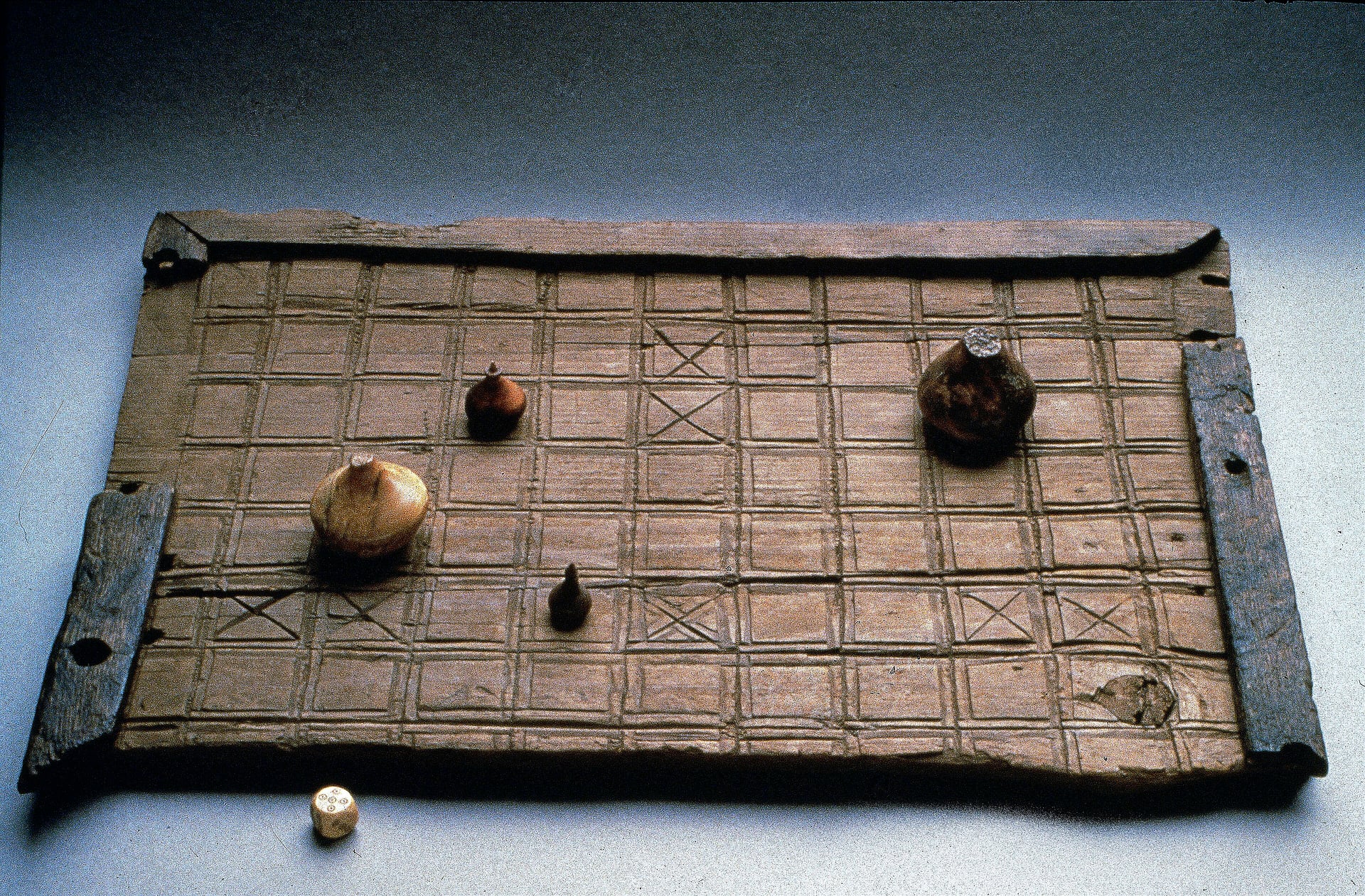
- Trondheim, Norway, 12th century. The large town excavations at the Folkebibliotekstomten site produced a wooden board with an incised grid, thrown out with the rubbish of a backyard, along with gaming pieces and a die. It is the board in our header image.
The pattern is hard to miss. Gaming pieces almost always come out of well-furnished graves. Nearly every free man owned a weapon. A board and a complete set belonged to someone with leisure, standing and a reputation for thinking ahead.
Something for the ears while you read on: Víkingr by Domsgard, a full album of northern noise for exactly this scene of hall, fire, ale and a board between two players.
The game in the Edda and the sagas
The written sources never explain the rules, but they do reveal the game’s standing. In Vǫluspá, the opening poem of the Poetic Edda, the gods play with golden pieces in the meadow during the world’s first age. After the fire of Ragnarök, when the earth rises green from the sea, the surviving gods find those golden pieces again in the grass.
There will once more be found in the grass the wondrous golden gaming pieces they had owned in the earliest days. Paraphrased from Vǫluspá in the Poetic Edda.
That is a remarkably loaded image. The board stands for the world in good order, its loss for catastrophe, its rediscovery for a fresh start. No poet reaches for a random household object at a moment like that.
In Hervarar saga, Odin in disguise, calling himself Gestumblindi, puts riddles to King Heiðrekr. One describes maidens who fight weaponless around their lord, some shielding him while the others come at him. The answer is hnefatafl. A riddle only works that way if every listener can picture the board instantly.
The Orkneyinga saga goes further. Earl Rögnvald Kali Kolsson lists the nine skills he has mastered in a famous verse, and he does not open with the sword.
I am swift at tafl, and I have mastered nine skills. Paraphrased from Earl Rögnvald Kali Kolsson’s verse in the Orkneyinga saga.
Then there is Friðþjófs saga, where the hero uses an ongoing tafl game as a code, answering the king’s messengers as though discussing his next move while actually talking politics. Board game as encryption, written down in the 13th century.
Myth versus fact
A handful of claims about this game circulate endlessly in shop listings and television. They deserve a sober check.
| Common claim | What the sources support |
|---|---|
| ”We know the Viking rules.” | No. Not one Viking Age rulebook survives. Every modern ruleset is a reconstruction built around Linnaeus’ notes of 1732. |
| ”Hnefatafl is Viking chess.” | Misleading. Chess pits two equal armies against each other; tafl pits a siege against a breakout. Different design ideas entirely. |
| ”The king must escape to a corner.” | In Linnaeus’ version any edge square will do. The corner rule is a modern balance fix. |
| ”The game re-enacts a real battle.” | No source says so. Reading it as a king breaking out with his guard is plausible, but it stays interpretation. |
| ”Every farmstead had a tafl board.” | Surviving sets come overwhelmingly from richly furnished graves. A complete game was a status marker. |
| ”Tafl died with the Vikings.” | It lasted much longer at the margins: into the 16th century in Wales, into the 18th among the Sámi. |
Why chess took over
During the 11th and 12th centuries a new game reached the North along the trade routes: chess, which had travelled from India through Persia and the Arab world into Europe. It brought everything tafl lacked. Two equal sides. The prestige of a European fashion. And a cast of pieces mirroring exactly the order the North was growing into: king, queen, bishop, mounted warrior, foot soldier. The Lewis chessmen, carved from walrus ivory around 1150 to 1200, are the clearest monument to that handover. Tellingly, the same hoard held plain counters for an older board game too. The two worlds overlapped for a while.
The key dates at a glance:
- c. 400: a fragment of a gaming board from the Vimose bog on Funen
- 9th and 10th centuries: gaming sets in the graves at Baldursheimur, Birka and Gokstad
- 10th century: the pegged board from the crannog at Ballinderry, Ireland
- 11th and 12th centuries: chess arrives in northern Europe along the trade routes
- c. 1150 to 1200: the Lewis chessmen are carved, most likely in Trondheim
- 1587: the Welshman Robert ap Ifan describes and draws the tawlbwrdd
- 1732: Linnaeus records the rules of tablut in Lapland
It is no accident that tafl survived longest at the geographical edge. New fashions travel through markets and courts; where there are neither, the old game stays on the table a few generations longer.
Our take
Gaming boards are among the most underrated find categories of the Viking Age. A sword tells you someone could fight. A complete gaming set tells you someone had rank, leisure and a reputation for thinking several moves ahead, which says far more about a person. We would also argue that the asymmetry of hnefatafl is the most honest mirror of Norse politics we have: never two equal kingdoms, but one leader breaking out of a closing ring with a few loyal men against a majority determined to stop him. Half the sagas tell that exact story.
And the missing rules? Annoying, certainly, but they are also why the game is still alive. Players have spent decades testing board sizes, throne variants and victory conditions, because no single version satisfies everyone. Anyone playing hnefatafl today is handling an open reconstruction, not a museum piece. We have the frame, not the fine detail, and whoever claims otherwise is usually selling you a board.
Hero image credit: NTNU Vitenskapsmuseet (CC BY 2.0), via Wikimedia Commons


