History
The Skuldelev Ships of Roskilde: Five Wrecks That Tell the Truth
Five wrecks pulled from Roskilde Fjord: what the Skuldelev ships reveal about specialised Viking vessels, and why a ship called Skuldelev 4 never existed.

Contents
Ask anyone to picture a Viking vessel and you get the same answer: something long, low and dragon headed, bristling with axes. The Skuldelev ships at Roskilde took that single mental image and broke it into five pieces. What came out of the mud of Roskilde Fjord in 1962 was not a fleet of showpieces. It was five worn out, deliberately scuttled working hulls, and that is precisely why they matter. A burial vessel like the Oseberg ship tells you what an elite could afford. The Skuldelev wrecks tell you what people actually sailed, and between them they settle a question nobody had been able to answer cleanly before: was there ever such a thing as the Viking ship?
A Barrier in the Peberrenden
Roskilde Fjord is a long, narrow finger of water reaching deep into the Danish island of Zealand, and at the far end of it sits Roskilde, an old seat of kings and bishops. Anyone coming from the sea with hostile intent had to come up that fjord. Near the small settlement of Skuldelev the channel pinches in at a spot known as the Peberrenden, and that is where somebody decided to close the door.
In the 11th century, five ships that had reached the end of their working lives were weighted with stones and sunk across that narrows. This was not shipwreck and not misfortune. It was construction work: a barrier meant to deny an enemy force the run up to Roskilde, or at the very least to squeeze it into one narrow, defensible lane. Similar blockages are known from elsewhere in Danish waters, and the logic behind them is coldly practical. A hull past its prime is worth more as building material than as a boat.
For archaeology that is a stroke of luck with a sting in it. The sting is that the hulls were partly stripped and damaged before they went down. The luck is that nobody curated this assemblage. What sank in the Peberrenden was simply whatever happened to be worn out in that region at that moment, which makes it an accidental cross section of everyday shipping. For centuries the barrier survived as a shoal that local skippers knew to avoid without knowing why. Diving surveys in the 1950s finally established the answer: ships. Several of them. Very old ones.
The 1962 Excavation: A Fjord Pumped Dry
The recovery that followed in 1962 still ranks among the boldest operations in Nordic underwater archaeology. Rather than lift the wrecks piecemeal from the seabed, the team went for the drastic option. A steel sheet piling cofferdam was driven into the fjord bed around the entire site and the water inside it was pumped out. The bottom of the fjord became a dry pit where archaeologists could work with trowels, brushes and a garden hose as though they were digging a field.
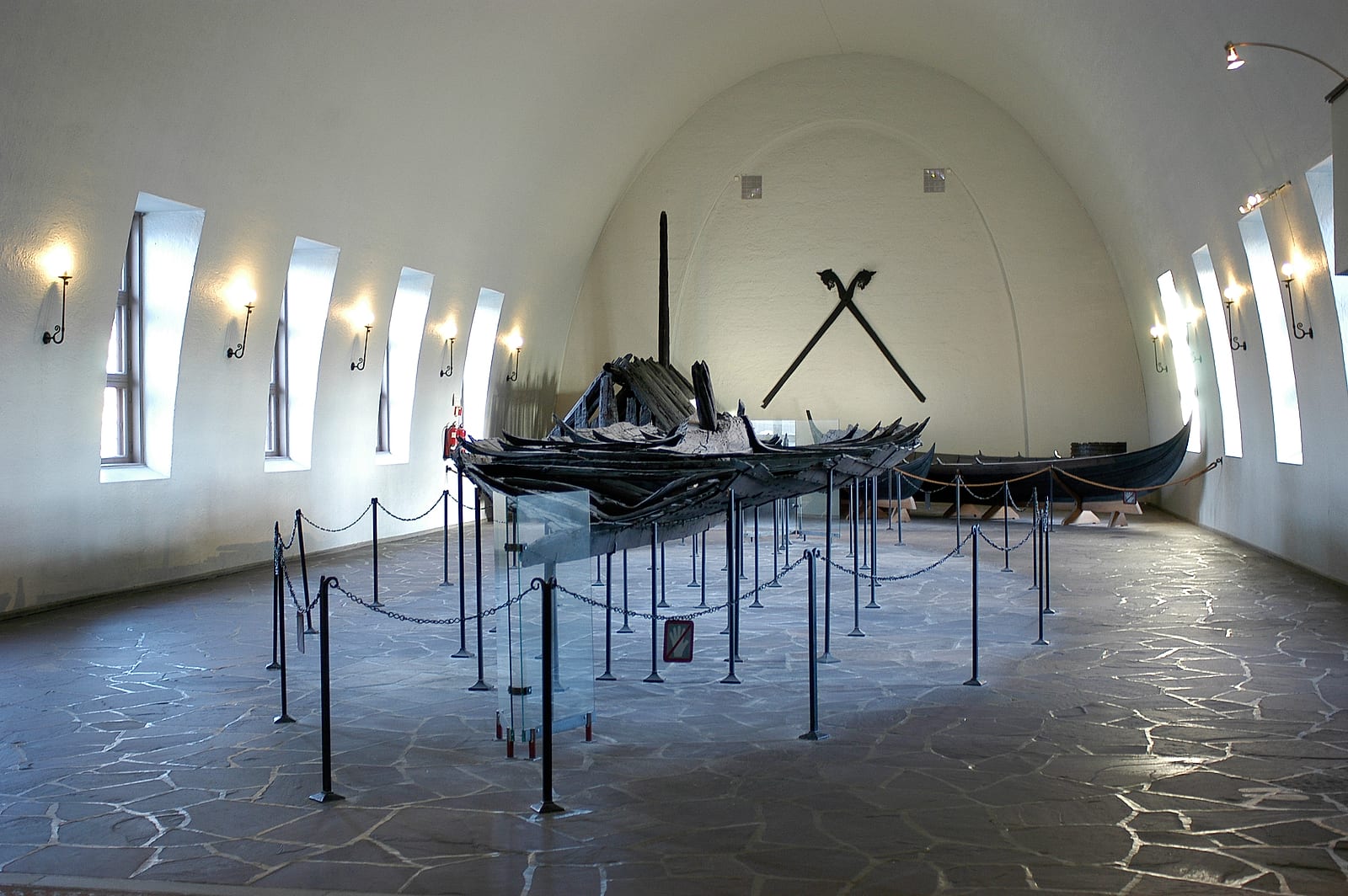
The effort was immense and so was the payoff. Underwater the team would have collected fragments; in the dry box every plank, rib and rivet was measured and recorded exactly where it lay before anything moved. That positional record is the only reason thousands of splinters of timber could later be reassembled into recognisable ships. What visitors see in Roskilde is not a replica dressed up as a relic, but the surviving original timber, mounted on steel armatures that leave the missing parts as empty air.
Then came the slowest phase of all: conservation. Waterlogged archaeological wood turns to dust as it dries, because the water is the only thing still holding the cell walls apart. The Skuldelev timbers were therefore treated over a period of years with polyethylene glycol (PEG), a water soluble wax that gradually replaces the water inside the cells and stabilises the structure. Treatments like this run on a scale of years, not weeks, which is why so much time separates a spectacular dig from a gallery.

Image credit: Boatbuilder (CC BY-SA 3.0), via Wikimedia Commons
A rough sea shanty fits the part of this story that no display case can hold, which is the long wet voyage itself:
The Five Skuldelev Ships of Roskilde, One by One
The standard numbering runs Skuldelev 1, 2, 3, 5 and 6. The missing four gets its own section below. First, the annotated find list, hull by hull.
Skuldelev 1, the ocean freighter. A ship of the knarr type: broad, deep bellied, high sided, built in Norway and made largely of pine. This is the class of vessel that moved cargo across open ocean, the design problem behind the runs to Iceland, the Faroes and the North Atlantic. A knarr is not fast. It is a ship that sits out heavy weather with a full hold.
Skuldelev 2, the great warship. The largest of the five and the headline find of the group: a genuine longship, markedly longer and narrower than any of the freighters, built around a long bank of oars and around speed. Only a fraction of the hull survived. Even so, this wreck rewrote a chapter of European Viking studies, because analysis of its oak points to the area around Dublin.
Skuldelev 3, the coastal trader. A smaller cargo vessel for home waters, for traffic between Danish harbours, through the belts and along the coasts. It is the best preserved of the five, which arguably makes it more useful to shipbuilding research than its famous warship neighbour: on this hull the proportions and the sequence of construction can be studied whole instead of in scraps.
Skuldelev 5, the budget build. A smaller warship, and the most honest object in the room. Its hull demonstrably incorporates reused timber, alongside evidence of repairs. Somebody assembled a serviceable fighting ship out of what was available, patched it, kept it going, and finally spent it as blockade material.
Skuldelev 6, the small boat. The least glamorous of the group, originally interpreted as a fishing or general purpose boat: a small open craft for inshore work, ferrying and catching fish. No warfare, no long haul trade, just daily life on the water.
| Wreck | Ship type | Where the timber grew | Built for |
|---|---|---|---|
| Skuldelev 1 | Ocean going knarr freighter | Norway, largely pine | Cargo across open sea |
| Skuldelev 2 | Large warship, longship | Oak from the Dublin area | Carrying fighting men, speed, prestige |
| Skuldelev 3 | Smaller cargo ship | probably Danish waters | Trade in home waters |
| Skuldelev 5 | Smaller warship | Danish waters, reused timber | Levy service, coastal and fjord warfare |
| Skuldelev 6 | Small open boat | probably Norway | Fishing, ferrying, general purpose |
Something in that table gets lost in the excitement over the longship, and the blog editors want to flag it: four of the five hulls are unremarkable working craft. When a community scuttles five spent ships and four of them are freighters and boats, that ratio says more about the Viking Age than any dragon head ever will. The overwhelming daily business of these waters was moving goods.
There Never Was a Skuldelev 4
Now for the gap in the numbering. During the 1962 dig the archaeologists sorted the mass of timber according to what they could distinguish in the ground, and they came up with six numbers. One cluster of fragments was read as a separate hull and catalogued as Skuldelev 4.
Later analysis, once the timbers had been cleaned, conserved and compared against one another, produced a different verdict. Those pieces were not a ship of their own. They belonged to Skuldelev 2, the great warship. Rather than renumber everything, with the old labels already scattered through the literature, the number was simply retired. Hence 1, 2, 3, 5, 6, and a museum guide explaining the missing four to every new group of visitors.
That story is more than a nice piece of trivia. It is a fair description of how underwater archaeology actually works. You do not excavate ships, you excavate wood, and which plank belongs to which hull is often decided years afterwards on a conservation bench rather than in the field. The lesson for anyone reading archaeological headlines: a first identification on site is a working hypothesis, not a fact.
Dendrochronology: How a Tree Ring Redrew the Map
The method underpinning almost everything we know about these wrecks is dendrochronology, dating and provenancing timber by its growth rings. Trees lay down rings of varying width depending on the season they endured, and across many trees a region builds up a shared sequence that works like a barcode. Match an archaeological timber against a regional reference curve and you can say where that tree grew and when it was felled.
Applied to the warship Skuldelev 2, this produced a result nobody had expected in such sharp focus: the oak came from the region around Dublin. Dublin as a Norse foundation and major centre was already well known, but the timber turns that into something you can put your hand on. A warship was built in Ireland for Scandinavian owners, then brought to Denmark, where it ended its days in a fjord barrier. That is no longer trade in goods. That is production relocated across the sea.
One point of precision, though: growth rings prove where a tree stood, not where the saw ran. With a hull worth of heavy oak the two are hard to separate, since nobody ships raw trunks across open water to split them into planks elsewhere. The specialist literature states the Irish origin plainly, and we follow it, while keeping the distinction visible.
From Wreck to Working Ship
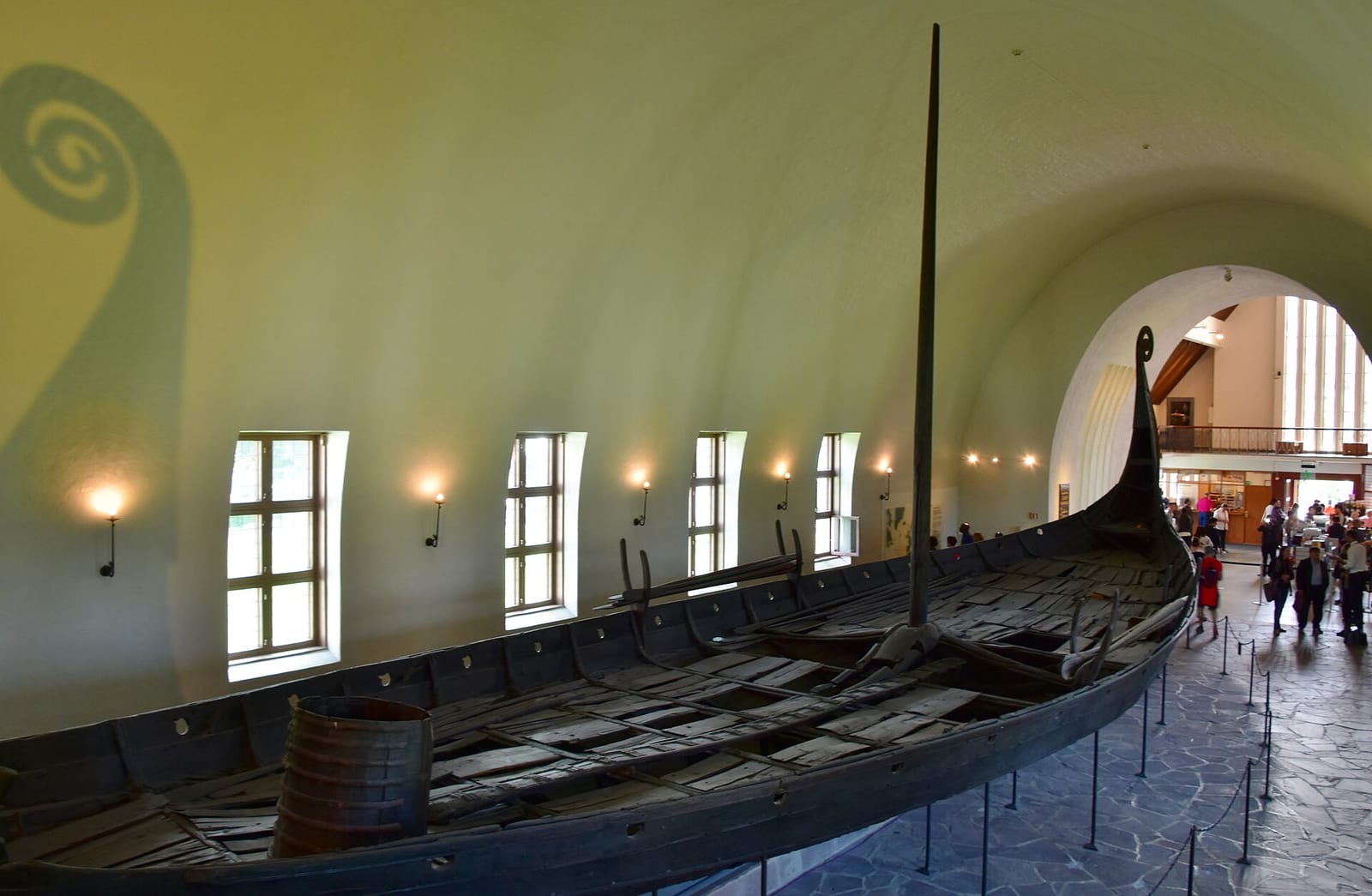
The originals are on display at the Viking Ship Museum (Vikingeskibsmuseet) in Roskilde, sitting on the shore of the very fjord that produced them. The museum does more than mount fragments. Its boatyard builds seaworthy reconstructions of the Skuldelev vessels using period tools and techniques, and those reconstructions are not parked behind glass. They are sailed.
This is experimental archaeology in its purest form: you test a reconstruction by putting it in the water and seeing whether the water agrees. How much rowing does a hull of this shape demand? How does it behave on the wind? How wet does it get aboard? No excavation report answers questions like these; only the voyage does. The clinker built hull form under examination is the same principle that made the longship so formidable.
The best known of these builds is the reconstruction of Skuldelev 2, named Havhingsten fra Glendalough, the Sea Stallion from Glendalough. During the 2000s she sailed from Roskilde to Dublin and home again, retracing the very link that the timber of the original implies. A reconstruction sailing the route of its own raw material is about as neat an illustration of find, laboratory and voyage locking together as this field is ever likely to get.

Image credit: Wikimedia Commons (CC BY-SA 2.0 de), via Wikimedia Commons
The Skuldelev story in stages:
- Scuttled as a barrier: in the 11th century five spent ships are weighted with stones and sunk in the Peberrenden near Skuldelev to protect the approach to Roskilde.
- Centuries as a shoal: the blockage silts up and survives as a known obstruction in the channel, its origin forgotten.
- Discovery: diving surveys in the 1950s establish that several ship wrecks lie beneath the shoal.
- Excavation in 1962: a sheet piling cofferdam dries out the site; the wrecks are recorded and lifted fragment by fragment.
- Conservation: years of treating the waterlogged timber with polyethylene glycol, followed by mounting the pieces on steel armatures.
- Reconstructions: the museum boatyard produces sailing rebuilds, among them the Sea Stallion from Glendalough, which carry the experimental work forward to this day.
What the Five Wrecks Actually Prove
Before Skuldelev, the Viking ship was one thing in the popular imagination. After Skuldelev it was a family of specialists. The five wrecks from Roskilde Fjord demonstrate side by side, in a single find, that cargo and warfare were separate design briefs: the deep bellied ocean freighter, the narrow racer, the coastal trader, the patched little fighting hull and the open working boat. Five hulls, five distinct answers to five distinct problems.
That is the truth these wrecks tell, and it is at once less romantic and more interesting than the cliché. People who build that many different ships are thinking in economic terms. They know a warship makes a poor freighter and a freighter makes a poor warship. They plan their timber supply across the sea and, when it suits them, have a hull built in Ireland. And when a ship is finished, they sink it somewhere it can still do a job.
The irony is quiet but complete. The people who built that barrier were closing a channel, nothing more. What they actually left behind is the clearest window we have onto Viking Age shipbuilding, and it stayed open for a thousand years.