History
The Gjermundbu Helmet: The Only True Viking Helmet Ever Found
The Gjermundbu helmet is the only near-complete Viking helmet ever found: unearthed in Norway in 1943, with spectacle guard, mail shirt and open riddles.

Contents
Picture a Viking. Whatever image just appeared in your head, the helmet on it almost certainly traces back to one single object. The Gjermundbu Viking helmet is the only near-complete helmet from the entire Viking Age that archaeology has ever recovered - a battered, corroded piece of iron pulled from a burial mound in Norway that somehow ended up defining the look of an entire era. It was found, of all times, in the middle of the Second World War, by a farmer who was simply digging on his own land. How this one helmet survived, and why hundreds of thousands of other warriors left us nothing at all, is one of the great detective stories of Viking archaeology.
A Farmer, a Mound and a Wartime Spring
In late March 1943, the University of Oslo’s collection of antiquities received a remarkable message. A farmer named Lars Gjermundbo had been digging into a large earthen mound on his farm, Gjermundbu, near Haugsbygd in the Ringerike district northwest of Oslo, and had struck old iron. Norway was under German occupation at the time, and large research campaigns were out of the question. Even so, archaeologists Sverre Marstrander and Charlotte Blindheim travelled to the site that same spring to excavate it properly.
What they uncovered exceeded every expectation. The mound, roughly 25 meters long, held two Viking Age burials. The richer of the two, known today simply as Grave I, turned out to be one of the most significant warrior graves ever discovered in Norway. It was a cremation burial: the dead man had been burned together with his equipment, and the remains were then laid in the mound. The grave is dated to the second half of the 10th century, somewhere between roughly 950 and 1000 AD.
What Lay in the Grave at Gjermundbu
The contents of the grave leave no doubt that the man buried here held serious rank and wealth. Alongside the famous helmet, the archaeologists found a mail shirt, weapons, riding gear including stirrups and spurs, plus gaming pieces and dice - a combination the Museum of Cultural History in Oslo now interprets as the grave of a mounted warrior. The riding equipment is the telling detail: this was not an ordinary foot soldier, but a member of the military elite of his day.
The mail shirt deserves almost as much attention as the helmet itself. Ring mail was staggeringly expensive in the Viking Age; making a single shirt meant riveting thousands of individual iron rings over many weeks of work. Almost no Scandinavian examples survive - the Gjermundbu byrnie is by far the most important mail find of the Norwegian Viking Age, and it is displayed today right beside the helmet.
 Image credit: Wolfmann (CC BY-SA 4.0), via Wikimedia Commons
If you want the bigger picture of what a warrior like the lord of Gjermundbu carried into battle, our article on Viking weapons covers axes, swords and shields in depth.
The Gjermundbu Viking Helmet in Detail
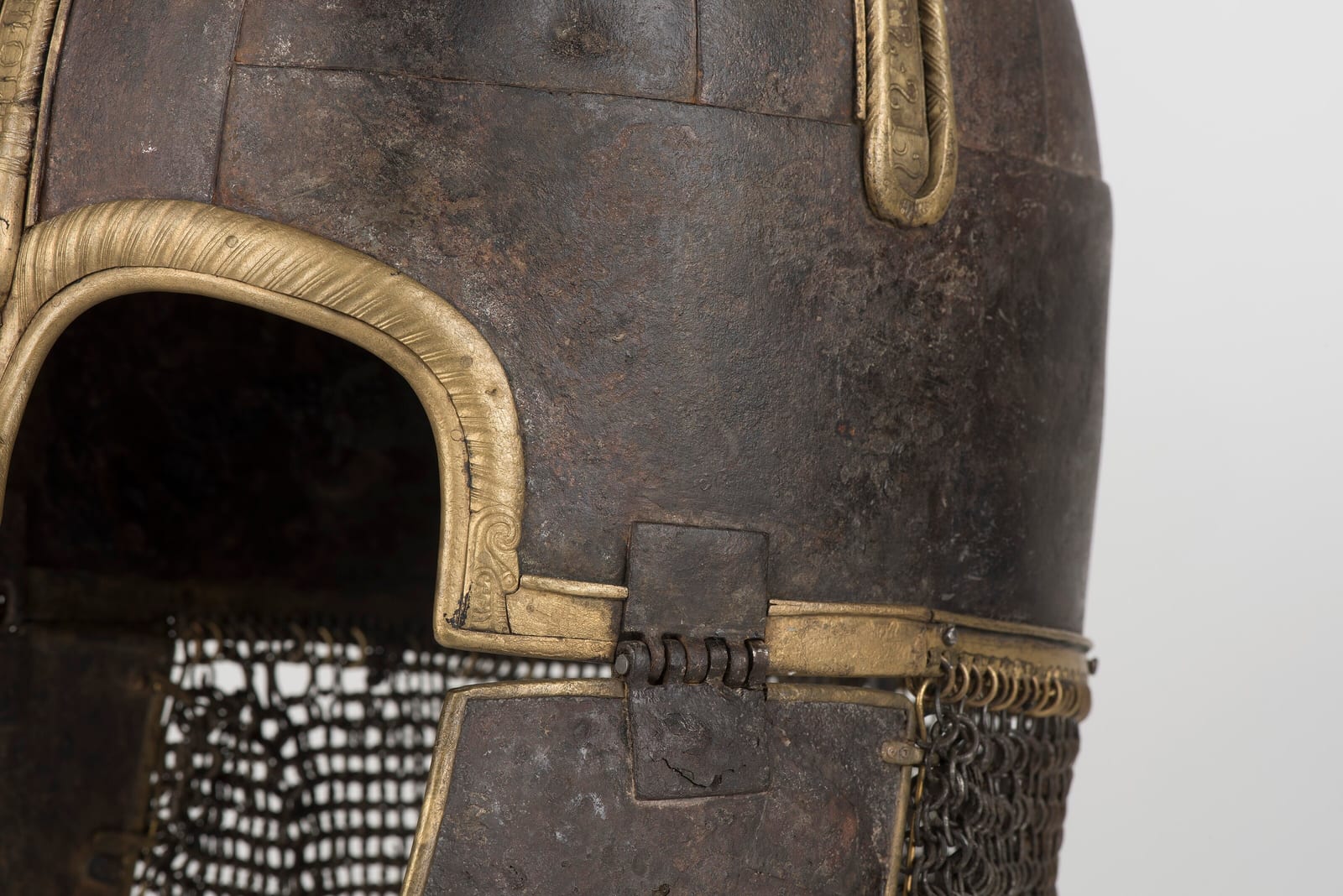
The helmet did not come out of the ground as a gleaming showpiece. It emerged in fragments, which conservators painstakingly reassembled into the shape everyone now recognizes: a rounded iron cap built from several plates, held together by riveted iron bands. A sturdy ridge runs over the crown and ends in a small spike - a detail missing from most modern replicas.
Its most striking feature, though, is the so-called spectacle guard: a curved piece of iron that wraps around the wearer’s eyes and nose and gives the helmet its unmistakable, almost mask-like face. The design stands in a long Nordic tradition - the lavish helmets of the Vendel period, the centuries immediately before the Viking Age, already used comparable face protection. Next to those gilded predecessors, the Gjermundbu helmet looks almost austere: no gold foil, no figural friezes, no display. It is a working piece of war gear.
Whether a curtain of mail once hung from the lower rim to protect the neck is debated; the surviving material does not settle the question. What is certain is that whoever wore this helmet spent more on protecting his head than most of his contemporaries could have afforded in a lifetime.
Listen to Járn ok þrumr (Iron and Thunder) while you read on - a track that captures the clash of iron and the weight of this warrior world:
Why Is There Only One?
Here lies the real riddle of the find. The Viking Age lasted some 250 years, its armies numbered in the tens of thousands, and yet the Scandinavian world has produced exactly one near-complete helmet. Researchers debate two main explanations, and they are not mutually exclusive.
The first: iron helmets were simply rare. Iron was costly, forging a helmet was slow, skilled work, and most fighters probably made do with leather caps or no head protection at all. The second explanation looks at what happened after a helmet was made: iron rots in the ground, and a helmet was far too valuable to throw into a grave lightly. Helmets were inherited, repaired, reworked and passed on until they were quite literally used up. That the lord of Gjermundbu was allowed to take his helmet onto the pyre was an extraordinary exception - and that exception is the only reason we have a complete example to look at today.
One helmet now has to stand in for hundreds of thousands of warriors - few objects in archaeology carry so much weight on so little iron.
Our editorial take: that is also the trap. Because the Gjermundbu helmet has no rival, it gets promoted to the universal standard, the template for every Viking head ever drawn. Strictly speaking, it is just one thing: the helmet of a single, exceptionally wealthy mounted warrior from Ringerike. What an average fighter wore on his head is something we genuinely do not know - and honest archaeology should name that gap instead of papering over it with a single find.
Viking Age Helmet Finds Compared
A look at the handful of other known helmet remains shows just how thin the evidence really is:
| Find | Location | Condition | Dating |
|---|---|---|---|
| Gjermundbu | Ringerike, Norway | near-complete, reconstructed from fragments | late 10th century |
| Yarm | Yorkshire, England | largely complete, Viking Age attribution debated since 2020 | ca. 10th century |
| Tjele | Jutland, Denmark | fragment of an eye and nose guard | 10th century |
| Lokrume | Gotland, Sweden | fragment of a decorated brow band | 10th century |
The Yarm helmet, which sat largely ignored in an English museum for decades, was assessed in a 2020 Durham University study as probably an Anglo-Scandinavian piece of the 10th century. If that interpretation holds, the Gjermundbu helmet would at least gain a distant cousin - though its status as the only near-complete helmet from the Scandinavian heartland would remain untouched.
Myth and Fact: About Those Horns
No article on Viking helmets can dodge popular culture’s favorite mistake, so here it is in brief:
- Myth: Vikings wore horned helmets into battle.
- Fact: Not a single Viking Age helmet find, Gjermundbu included, carries horns or any fittings for them. The image largely comes from the 19th century, when costume designers like Carl Emil Doepler put the Romantic era’s Norse fantasies on stage for Wagner’s Ring cycle in 1876.
- Fact: Horned figures do appear in Scandinavian imagery, most likely in ritual contexts - just never as the combat equipment of historical Vikings.
In a shield wall, horns would also have been a liability: they give enemy weapons something to catch, guiding blows toward the skull instead of letting them glance off.
Where the Helmet Stands Today
The Gjermundbu helmet is kept at the Museum of Cultural History (Kulturhistorisk Museum) of the University of Oslo, where it forms the undisputed centerpiece of the VIKINGR exhibition on the Viking Age. It is shown together with the mail shirt and other finds from the grave, dramatically lit in a case of its own - a remarkable career for an object that arrived in 1943 as a heap of rusted fragments from a field in Ringerike.
 Image credit: Wolfmann (CC BY-SA 4.0), via Wikimedia Commons
And if you are curious how exceptional Viking Age burials could get, from simple cremations to entire ships sealed beneath mounds, our piece on Viking ship burials follows that road into the afterlife.
A Piece of Iron as the Face of an Era
The Gjermundbu helmet is a textbook case of how a single find can shape our entire picture of history. Every serious reconstruction, every museum diorama and every halfway-researched film reaches for this one object, because there is simply nothing else like it. That a nameless mounted warrior from Ringerike, cremated and forgotten under a mound, ended up becoming the face of the whole Viking Age is one of archaeology’s quiet ironies. His name is lost. His helmet is immortal.
Hero image credit: NTNU Vitenskapsmuseet (CC BY 2.0), via Wikimedia Commons