Recipes
Viking Seeded Flatbread: The Recipe for Baking Bread on Hot Stone
A Viking seeded flatbread recipe with no oven needed: crisp barley and flaxseed rounds baked on hot stone, plus the real finds behind Norse daily bread.
Contents
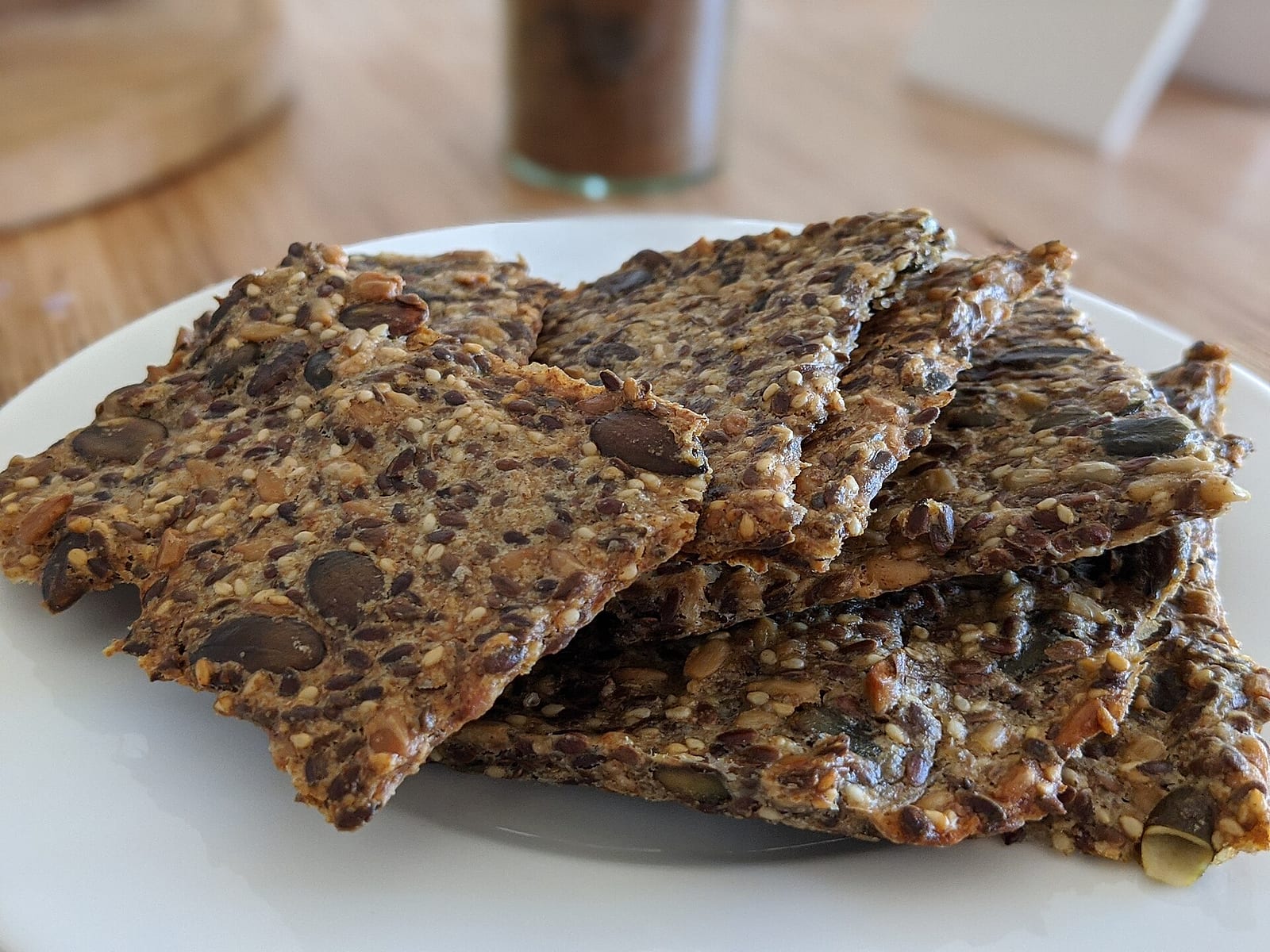
Ovens were a luxury on a Norse farm. Almost nobody had one, which is exactly why this Viking seeded flatbread recipe asks for none either. A hot stone slab, a heavy cast-iron pan, or a grill grate over glowing coals will do the whole job. What comes off the heat is not a risen loaf but a thin, seed-packed round that snaps when you break it, tastes deeply nutty, and keeps for weeks.
If you already know our pan-baked barley flatbread, this one changes a single thing: the seeds. Ground flax, cracked barley and toasted kernels turn the plainest everyday bread in the North into something worth eating on its own. And the idea is far less modern than it sounds.
A Hearth, Not an Oven
The Viking longhouse was built around a long stone hearth running down the middle of the room. Everything happened there: boiling, smoking, drying and baking. Built masonry ovens do turn up in Scandinavian archaeology, but almost exclusively at major trading sites and high-status farms. The ordinary household had none, and so it had no bread in our sense either. No crust, no rise, no crumb. Just flat rounds cooked in minutes on a hot surface.
That surface was the real piece of equipment. In Norway it is still called a bakstehelle: a thin, flat stone plate laid straight into the embers or propped up on three stones. Soapstone was perfect for the job because it soaks up heat, holds it, and does not crack. Norwegian soapstone was quarried and traded across the Viking world, and soapstone vessels show up in settlement layers from Hedeby to Iceland. Where stone was scarce, iron took over: pans and grates are familiar finds from Viking Age graves.
The flour came out of a rotary quern, two stacked grinding stones that belonged to the standard kit of nearly every farmstead. Grinding was brutal work, and it left evidence behind. Fine stone grit ended up in the flour, and Viking Age skeletons show the result as heavily worn tooth crowns, often in people who died young. There is a practical lesson buried in that: the thinner you roll a flatbread, the less chewing it takes.
What the Finds Actually Support in a Viking Seeded Flatbread Recipe
Our best evidence for Norse bread comes from kitchen accidents. The graves at Birka in present-day Sweden produced charred bread fragments from the 9th and 10th centuries, small round flatbreads placed with the dead as provisions for the journey. Charring is what saved them, and laboratory analysis identified the ingredients: barley above all, with oats, occasional pea flour, and in lean years ground pine bark.
Seeds are well represented in northern archaeobotany too, though usually for reasons that have nothing to do with flavour. Flax was cultivated across Scandinavia and in Viking Age York, primarily for linen fibre, but flaxseed also yields oil and grinds down into meal. And the Oseberg ship burial of 834, the richest grave Norway has produced, contained hemp seeds among its finds. Hemp meant rope and sailcloth, and its seeds were edible.
| Grain or seed | Evidence in the Viking North | Everyday use |
|---|---|---|
| Barley | everywhere, the staple crop | flatbread, porridge, ale |
| Oats | widespread | porridge, blended into bread |
| Rye | rising from the 10th century | dark bread, mainly Denmark |
| Flax | grown in Scandinavia and York | fibre, oil, ground seed |
| Hemp | seeds in the Oseberg burial | rope, sails, edible seed |
| Pea | identified in Birka breads | flour extender, pottage |
Myth: Vikings topped their bread with sunflower and pumpkin seeds. Fact: both plants are American and reached Europe centuries later, and sesame would at best have been rare imported goods in the North. Bake it strictly and you use flax, hemp and cracked barley. Bake it for taste and you use pumpkin seeds anyway. We would rather say that plainly than pretend the 10th century had a seed-mix aisle.
One Old Norse poem shows how sharply bread could mark a household apart. The eddic Rígsþula follows the god Ríg as he visits three homes on his travels.
In the poorest house the woman sets down a heavy, thick loaf full of bran. In the jarl’s hall the bread is thin, pale and made of fine wheat, served on a linen cloth. The poem never mentions silver. Describing the bread is enough.
Here is our honest verdict from the test kitchen: flaxseed is the single most important ingredient in this recipe, and not for historical reasons. Ground flax swells into a gel that binds a low-gluten barley dough together. Skip it and the rounds crumble the moment you turn them. Include it and you get a texture that leaves supermarket crispbread far behind. If you cut one thing from the list, do not cut this.
Curious what else went on the table beside the bread? Our overview of the Viking diet covers the rest of the meal.
Ingredients
Makes 8 flatbreads:
- 2 cups barley flour (250 g)
- 1 1/4 cups rye or spelt flour (150 g)
- 1/2 cup ground flaxseed (60 g)
- 1/3 cup sunflower or pumpkin seeds (40 g)
- 2 tbsp sesame seeds (optional)
- 1 level tsp salt
- About 1 1/4 cups lukewarm water (300 ml)
- 1 tbsp rapeseed oil, soft butter or lard
- Coarse salt for scattering
You also need a surface that gets genuinely hot: a baking stone on the grill, a heavy cast-iron skillet on the hob, or a clean flat stone slab over embers. No oven required.
Instructions
- Toast the seeds. Dry-toast the sunflower or pumpkin seeds and the sesame in a pan until they smell nutty and take on a little colour. Tip them out to cool. It costs four minutes and buys half the flavour.
- Hydrate the flax. Stir the ground flaxseed into 100 ml of the water and leave it for 10 minutes, until it turns slightly gel-like.
- Mix the dough. Combine both flours with the salt. Work in the flax mixture, the oil and the remaining water bit by bit until you have a smooth, non-sticky dough, then knead in the toasted seeds.
- Rest. Cover and rest the dough for 30 minutes. Barley dough carries almost no gluten and never turns springy like wheat, which is entirely normal.
- Divide and roll. Cut the dough into 8 pieces, shape them into balls, and roll each one very thin on a floured surface, about 2 to 3 mm. Thinner means crisper.
- Preheat the surface. Bring the stone or skillet to a medium-high heat with no fat at all. A drop of water should hiss and skate across it instantly.
- Bake. Cook each round for 3 to 4 minutes, flip, and give it another 2 to 3 minutes. It is done when dark scorch marks appear and the edges start to curl.
- Salt and cool. Scatter coarse salt over them while hot. Stack them in a cloth for soft flatbreads, or cool them separately on a rack for the crisp version.
Tips & Variations
- The real stone method: set a flat natural stone slab on three stones over the embers and let it heat through for at least 20 minutes. The dough goes straight onto the hot stone with no fat. Nothing gets you closer to a longhouse hearth without a time machine.
- Strictly historical: barley flour, flax, hemp seed, water and salt only. Drop the pumpkin, sesame and sunflower, and stir in 2 tbsp of coarsely cracked barley instead.
- With buttermilk: swap half the water for buttermilk. The rounds turn softer and pick up a gentle tang that suits barley well.
- Savoury: caraway, dill or chopped wild garlic in the dough lifts everyday bread into something you would serve guests.
- Storage: fully cooled and airtight, crisp seeded flatbreads keep for two weeks. Soft stacked ones last three days.
- Dough cracking as you roll? Either it needs more water or the flax needed more time. Knead in a spoonful of warm water, wait five minutes, and it will behave.
This recipe is one taste from a much bigger collection. Our cookbook “Viking Feast” gathers 141 Nordic recipes, from flatbreads and cauldron dishes to mead and sweet food cooked in the coals. Visit the cookbook
The Bread That Survived the Winter
A thin, unleavened round baked without an oven is exactly the bread a mobile society needs. It dries out instead of going mouldy. It stacks flat. It survives sea spray, snow and weeks at sea. The sagas hand their pages to kings and battles, but it was this unremarkable bread that actually kept the North running. Bake a batch on hot stone, break it with your hands, and you understand at once why people were buried with it.
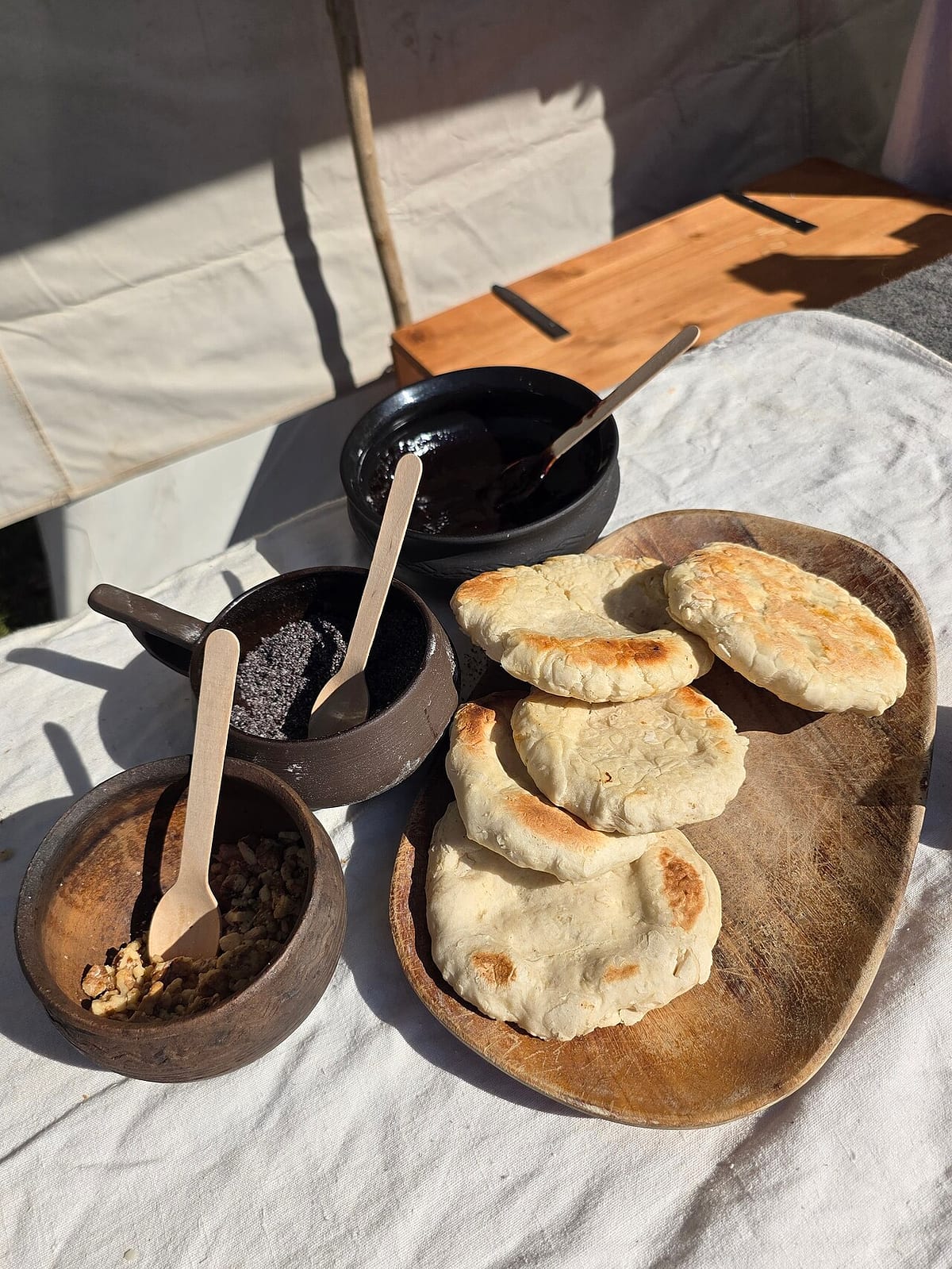
Image credits: Shisma (CC BY 4.0) and Auctor quaerendae (CC BY-SA 4.0), via Wikimedia Commons