Daily Life & Culture
Viking Names and Their Meanings: From Björn to Sigrid
Viking names and their meanings explained: what Björn, Sigrid and Thorstein really mean, how bynames like Bluetooth arose, and what runestones tell us today.
Contents
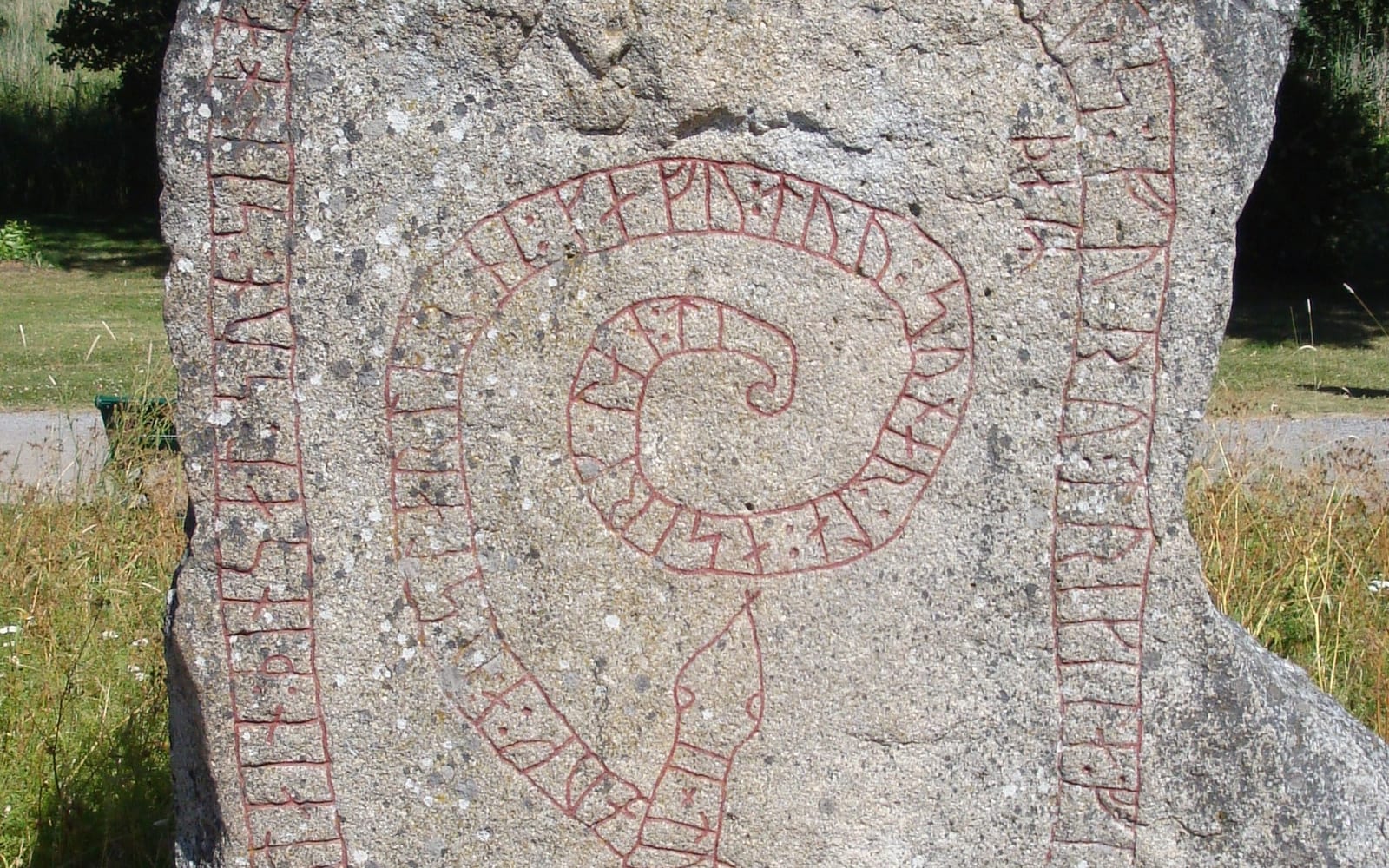
On a granite boulder near Lake Mälaren in Sweden, a mother named Tola had a message carved almost a thousand years ago: a few lines of runes for her son Harald, who never came home from the east. Three personal names survive on that single stone, and thousands more survive on stones like it. If you want to understand viking names and their meanings, this is where the trail starts, because no other source tells us so directly what people in the North hoped for, feared, and wanted to be remembered as.
A name in the Viking Age was never just a label. It was a wish spoken over a newborn, a link to a dead grandfather, sometimes a claim to land or luck. And thanks to runestones, Icelandic records like the Landnámabók with its more than 3,000 named settlers and relatives, and the sagas themselves, we can still decode most of it. The short version: Björn really does mean bear, Sigrid really does carry victory in her name, and the system behind both is far cleverer than it first appears.
How Norse naming worked: two words and a destiny
Most Old Norse full names are compounds, built from two meaningful elements drawn from a fairly small shared pool. Take sigr (victory) and fríðr (beautiful, beloved) and you get Sigríðr. Take the god Þórr and steinn (stone) and you get Þorsteinn. Take ragn (the ruling powers, the gods) and hildr (battle) and you get Ragnhildr. Around fifty core elements, shuffled and recombined, produced hundreds of distinct names.
Two habits shaped which combination a child actually received. The first was variation: passing one element of a parent’s name down the line, so a Þorsteinn might raise a Þorbjǫrn, and a Ragnhildr a Gunnhildr. The second was alliteration, keeping the same opening sound within a family, so that kinship could literally be heard. In a world without written contracts or ID papers, a name did real administrative work. It told strangers roughly who you were, whose son or daughter you were, and which farm might take offense if they treated you badly.
Seen that way, Norse naming was less romantic poetry than social engineering with a poetic surface. That it also produced some of the most beautiful names in European history was a happy side effect.
Viking names and their meanings: a field guide from Björn to Sigrid
Here are some of the most common Viking Age names, their Old Norse forms, and what they literally say. Notice the pattern: battle and victory everywhere, but also gods, protection, and beauty.
| Modern name | Old Norse | Literal meaning |
|---|---|---|
| Björn | Bjǫrn | bear |
| Ulf | Úlfr | wolf |
| Erik | Eiríkr | sole ruler or ever-ruler (the first element is debated) |
| Sigrid | Sigríðr | beautiful victory (sigr + fríðr) |
| Sigurd | Sigurðr | guardian of victory (sigr + vǫrðr) |
| Gunnar | Gunnarr | battle warrior (gunnr, battle) |
| Ragnhild | Ragnhildr | battle of the divine powers (ragn + hildr) |
| Astrid | Ástríðr | beautiful as a god (áss + fríðr) |
| Ingrid | Ingríðr | beautiful one of the god Ing (Freyr) |
| Freydis | Freydís | dís, protective spirit, of Freyr |
| Thorstein | Þorsteinn | Thor’s stone |
| Leif | Leifr | heir, descendant |
| Helga | Helga | the holy one, the blessed one |
| Gudrun | Guðrún | secret lore of the gods (guð + rún) |
| Sven | Sveinn | boy, young man |
| Knut | Knútr | knot |
One detail worth dwelling on: women’s names were every bit as martial as men’s. Gunnhild, Ragnhild, Sigrid - battle and victory were considered perfectly fitting things to wish upon a daughter, which says a great deal about how the North imagined its women. And fríðr, despite how it looks, meant beautiful or beloved rather than peace, so Sigrid is not a peace name at all. She is, literally, a beautiful victory.
Listen to Ættblóð while you read on:
Gods hiding in first names
Run your finger down any list of runestone names and one element keeps surfacing: Þór-. Thorstein, Thorbjörn, Thorgeir, Thorkel, Thordis, Thorgunna - the thunder god appears in dozens of male and female name forms, more than any other deity. That fits neatly with the archaeology, which counts Thor’s hammer pendants among the most common amulets of the late Viking Age. Thor was the god of farmers and sailors, of ordinary households, and ordinary households named their children after him.
Other gods travelled incognito. Freyr, the fertility god, hides behind his older title Ing in names like Ingvar, Ingrid, Ingibjörg and Ingolf. The element áss, meaning simply a god, sits inside Astrid and Asgeir. A name like Freydis placed a girl under a deity’s direct protection from her first day of life. For the wider cast behind these names, see our guide to the Norse gods.
What happened to all this god-naming when Christianity arrived is the quietly funny part: almost nothing. Icelanders and Scandinavians kept baptizing children called Þorsteinn and Þórdís for centuries, apparently untroubled by the pagan god embedded in the first syllable. Family tradition, it turns out, beat theology every time.
Bynames the sagas never let die
A naming pool this small guaranteed duplicates, and duplicates bred nicknames. The sagas and king lists overflow with bynames recording looks, temper, and biography with brutal honesty: Skalla-Grímr (Bald Grim), Auðr in djúpúðga (Aud the Deep-Minded), Sigtryggr silkiskegg (Silkbeard), Magnús berfœttr (Barefoot), Eiríkr blóðøx (Bloodaxe), Ívarr beinlausi (the Boneless), Ragnarr loðbrók (Shaggy-Breeches), a byname so vivid it ended up carrying an entire legend on its own.
The most famous byname of all belongs to Haraldr blátǫnn, Harald Bluetooth, the Danish king whose conspicuous dark tooth probably earned him the name. A millennium later, engineers looking for a name for a standard that unites devices borrowed his, and the Bluetooth logo still combines the runes of his initials. Snorri Sturluson, writing in the Heimskringla, preserves the best byname origin story: Harald Fairhair of Norway swore not to cut or comb his hair until all Norway was his, and until that day people called him Haraldr lúfa, Harald Mop-Head. Only victory upgraded the mop to fair hair.
Myth vs. fact: the myth says Vikings had surnames like Lodbrok or Bloodaxe that passed to their children. The fact: the Viking Age knew no family names at all. A person carried a given name, a patronymic (Erikssen, Sigurdsdottir), and at most a personal byname earned by their own body or deeds. Bynames died with their owner; the patronymic changed with every generation.
Bynames were serious business, too. Several sagas mention the custom of nafnfestr, name-fastening: whoever bestowed a new name or byname owed the bearer a gift to seal it. A name carried weight, so giving one carried a price.
Carved to last: names on runestones
The largest database of Viking Age names is still standing outdoors. Sweden alone preserves well over a thousand runestones, most of them from the 11th century, and nearly all follow one formula: X raised this stone in memory of Y, his or her kinsman. Scholars can search them today through the Scandinavian Runic-text Database maintained at Uppsala University, and the stones preserve names of farmers, mothers and travellers no chronicle ever bothered to record.
The Gripsholm stone in Södermanland, catalogued as Sö 179 and one of the so-called Ingvar stones commemorating a disastrous expedition toward the Caspian Sea around 1040, shows how much life fits into a few carved lines:
Tola had this stone raised in memory of her son Harald, Ingvar’s brother. Like men they travelled far for gold and in the east gave food to the eagle. They died southward in Serkland.
Three names, one catastrophe, and a mother’s grief, cut into granite with poetry worthy of a court skald. Denmark’s royal Jelling stones work the same way: Gorm raised a stone naming his wife Thyra, and their son Harald answered with a larger one naming both parents and his own achievements. If you want to read the writing system behind these monuments, start with our introduction to the Elder Futhark runes.
Water, ancestors, and the name reborn
Receiving a name was a ritual moment long before Christianity reached the North. Several sagas, along with a stanza of the Eddic poem Hávamál, mention sprinkling a newborn with water (vatni ausa in Old Norse) as the name was given. The parallel to baptism is striking, but the sources describe it explicitly as a pagan custom. Once sprinkled and named, a child was legally part of the family, with everything that implied.
The name itself usually came from a dead relative, most often a grandparent, and the sagas repeatedly hint at the belief that something of the dead person’s luck and character travelled with it. In that worldview a name was closer to an heirloom soul than to a label, which explains a rule the sources follow with striking consistency: you did not name a child after a living relative. That name was still occupied.
From the longhouse to your passport
Iceland never really stopped. Most Icelanders still use no surname at all but a patronymic or matronymic: Jón’s son is Jónsson, his daughter Jónsdóttir, exactly as in the settlement age, and an official naming committee still rules on whether new given names fit the language. Across Scandinavia, Björn, Erik, Astrid and Sigrid have never left the name charts, and every new Viking drama on television sends them climbing again.
Our editorial take: the real lesson of Viking naming is not the aesthetics but the intent. Every name was an argument about the future, a bet that a child would live up to a bear, a victory, an inheritance. A thousand years on, most of us choose names by sound alone. The people who raised the Gripsholm stone would have found that baffling. A name, to them, was the one thing guaranteed to outlive you - so it had better say something worth carving.
Image source: JøMa (Public domain), via Wikimedia Commons