Daily Life & Culture
Childhood Among the Vikings: Toys, Work and Growing Up
Viking children and childhood: what toy finds, graves and sagas reveal about play, farm work, fosterage and the age at which a Norse child became an adult.
Contents
There was no classroom, no birthday cake and no long, protected adolescence. Childhood among the Vikings was brief, physical and shot through with work almost from the moment a child could walk. And yet it would be wrong to picture Viking children purely as small labourers. The waterlogged town layers of Dublin, Trondheim and Hedeby have given up carved wooden boats, toy horses, little wooden swords and bone skates in sizes that only a child’s foot could fill. There was play. It simply stopped far earlier than it does now.
Before any of it can be believed, the sources deserve a warning label. Children leave thin traces: their bones decay faster, their possessions were handed down or burned, and the Icelandic sagas were written two to three centuries after the Viking Age by Christian scribes who cared about heroes, not infants. What we know is stitched together from three very unequal sets of evidence, and each one pulls in a slightly different direction.
Water, a Name, and Admission to the Family
A newborn in the Norse world was not automatically a member of the household. It became one through a ritual that several sagas and a verse of the Eddic Hávamál describe: sprinkling the infant with water, Old Norse vatni ausa, and giving it a name at the same moment. The resemblance to Christian baptism is obvious, but the custom is attested explicitly for the pre-Christian period. Only after that rite did the child count fully as a person, and only then did killing it count as murder.
Before it, the picture is harder. Exposure of newborns, barnaútburðr, was a real if presumably rare recourse in famine, after a difficult birth, or when a farm could not feed another mouth. How seriously that right was taken shows up in one of the most matter-of-fact passages in all Norse writing. Ari Þorgilsson records in the Íslendingabók that when Iceland accepted Christianity around the year 1000, the assembly also agreed that the old rules on exposing infants and on eating horse meat would stand for the time being. Both concessions were repealed a few years later. An entire society negotiated its change of religion, and newborns were one of the bargaining chips.
The name itself carried weight. Children very often received the name of a dead grandparent, and the sagas repeatedly hint that something of the dead person’s luck travelled with it. How tightly that naming system was built is the subject of our piece on Viking names and their meanings. A child, in other words, was handed a role on day one and expected to grow into it.
The Missing Children of the Cemeteries
Anyone approaching childhood through archaeology runs straight into a paradox. In many Viking Age cemeteries, children are buried far less often than the likely mortality rate would predict. In any pre-industrial society a substantial share of children died before the age of five, yet the grave rows do not reflect that.
Several explanations compete, and probably all of them contribute. Children’s bones are thin and porous, and acidic Nordic soil destroys them quickly. Small, shallow graves are easier to miss in excavation than a monumental chamber burial. And it is entirely plausible that the youngest children were not buried in the formal cemetery at all, but close to the farm where they had lived.
Where children’s graves have been documented, as on the great cemetery at Birka in Sweden, the pattern is quietly moving: beads, small knives, occasionally miniature versions of adult equipment. A child was not disposed of anonymously; it was equipped as a person, often with exactly the objects that would have marked its future role. Our own reading of this is uncomfortable but hard to avoid. The gap in the cemeteries is the most honest source we have. It describes a society in which the death of a small child was ordinary enough that it did not always require a monument, while the same farm could sink an entire ship into the ground for a grown warrior.
Those who survived the first years, however, had decent odds. Skeletal studies from a range of burial grounds show that people who made it through childhood could reach fifty, sixty years and beyond.
Something to listen to while you read on:
Toys of Viking Children: Boats, Horses and Bone Skates
The best proof that Norse childhood existed at all was thrown away a thousand years ago. Waterlogged urban deposits in Dublin, Trondheim and Bergen preserved wood that would otherwise have vanished, and among it sit dozens of small ship models: hulls a few centimetres long, some pierced for a mast, some with rowing ports suggested along the side. No adult needed these. They were toys, and surprisingly good ones.
Alongside them come carved horses, small wooden swords, animal figures and spinning tops. The most widespread item of all may be the bone skate: a horse or cattle metapodial ground flat on one side and tapered at the front, used to push across frozen lakes with a pole. Bone skates are among the most common finds at Birka, Hedeby and Viking Age York, and plenty of them are small enough that only a child could have worn them.
| Find | Site | What it says about children |
|---|---|---|
| Wooden ship models | Dublin, Trondheim, Bergen | Toys that rebuild the adult world of seafaring in miniature |
| Carved horses and animal figures | Nordic town excavations | Early role play centred on livestock and the farm |
| Small wooden swords | Settlement and town layers | Imitation and practice of the men’s world of weapons |
| Bone skates | Birka, Hedeby, York | Winter play that doubled as practical transport |
| Bone whistles and spinning tops | York, Hedeby | Noise, music and games of skill |
| Gaming pieces and boards | Gokstad ship burial among others | Board games such as hnefatafl as a pastime for all ages |
| Beads and miniature tools in child graves | Birka | Children buried as individuals with a role of their own |
Hnefatafl, an asymmetric siege game played across Scandinavia, turns up as pieces and boards in rich burials, including the Gokstad ship grave. No find proves directly that children played it, but the idea that a game this widespread stayed off limits to them through long winter evenings is not very convincing.
Work Instead of School
There were no schools. Knowledge moved by watching, copying and listening, and the apprenticeship began early. At five or six, children took on light but genuine tasks: minding animals, gathering firewood, fetching water, scaring birds off the fields, collecting eggs and berries. By ten the demands had shifted to field work, fishing, milking and craft, and by twelve a child in many trades worked like an adult, only slower.
The division of labour followed the same lines as it did for grown-ups, which we cover in detail in our article on Viking daily life. Girls grew into textile work, spinning, weaving and the management of stores; boys into fields, livestock, tools and boats. Spindle whorls of clay or stone are among the most common artefacts recovered from Norse farms anywhere, a quiet indication of how many hands were on the thread at any given moment.
Nothing states the link between birth and destiny more bluntly than the Eddic poem Rígsþula. The god Ríg visits three households on his travels and fathers a son in each, and from them the three social ranks descend: the children of Þræll with coarse names and heavy farm labour, the offspring of Karl as free farmers, and finally Jarl, whose youngest son Konr ungr alone learns the runes. The poem is not social statistics. It is a myth written to justify an existing order, and that is exactly what makes it useful: it tells us a Norse child’s future was largely settled before it could walk.
For the children of unfree parents the logic was harshest. A child born to a thrall was unfree from birth, and children were among the people seized and sold on raids. Viking Age childhood had a floor, and that floor was brutal.
Fosterage: Why Raising a Child Was Politics
One institution sets the North apart: fosterage, Old Norse fóstr. Children very often grew up not with their own parents but with relatives, friends or allies of the family. The bonds that resulted carry remarkable weight in the sagas, frequently more than blood. Foster-brothers stand by each other; foster-fathers avenge their charges.
Snorri Sturluson records in the Heimskringla the principle that whoever raises another man’s child is reckoned the lesser man. That idea sits underneath the famous episode in which Harald Fairhair sent his son Hákon to King Æthelstan of England, who brought the boy up and left him with the byname Aðalsteinsfóstri for good.
Fosterage was therefore never simply care. It was leverage: a pledge, an alliance, a standing obligation. That the upbringing of a child could become hard currency between royal houses says more about Norse society than any description of a raid.
When Did Viking Childhood End?
The North had no single age of majority. The Icelandic law collection Grágás names sixteen as the age at which a person could manage their own affairs, while Norwegian legal texts such as the Gulating law show thresholds anywhere between twelve and fifteen depending on the matter at hand. In practice capability mattered more than birthdays. Whoever could do adult work, carry a weapon or run a farm was treated as an adult.
The sagas supply scenes that cannot be read as reportage but work perfectly well as a mirror of expectations. Egil’s saga has the three-year-old Egill refusing to be left behind on the way to a feast, and the same Egill, at roughly six or seven, picking up an axe after losing a round of the rough ball game knattleikr and killing an older boy. The saga does not present this as a scandal. It presents it as early evidence of character. The attitude behind that is unmistakable: hardness was not a defect, it was a promise.
- Birth to 2: water rite and naming, highest mortality
- 5 to 7: first fixed duties, herding, gathering, running errands
- From around 7: common age for a fosterage placement away from home
- 10 to 12: full participation in field, byre, workshop or loom
- 12 to 16: legal capacity depending on region and matter, marriage possible
What Remains of Norse Childhood
What emerges is neither sentimental nor purely grim. Viking children were needed early, worked early and often buried early, and they were still not simply small adults without a world of their own. Someone carved them boats. Someone shaped a horse out of a scrap of wood and ground a cattle bone into a skate. Someone named them after a dead grandmother and handed them a story along with it.
Our assessment, after weighing the finds against the texts: the real difference from today is not harshness but timing. A society with no insurance and rarely two winters of stores could not afford a long protected phase, so childhood ended when the hands were needed. That somebody still sat down in the evening and whittled a piece of wood into a ship is the genuinely remarkable part of the story.
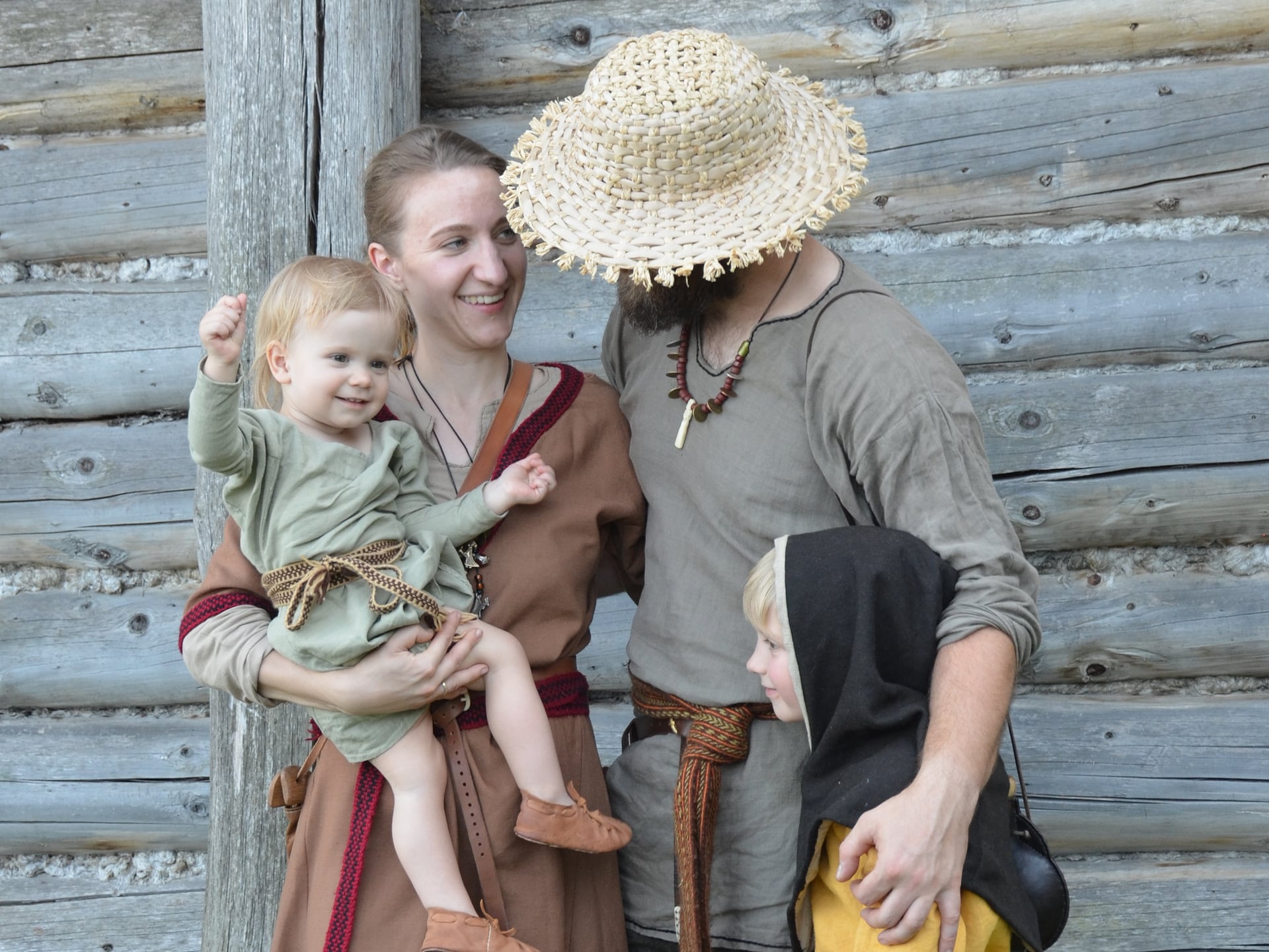
Image source: Marsilar (CC BY-SA 4.0), via Wikimedia Commons