Daily Life & Culture
The Thing Assembly: How Viking Law Was Actually Spoken
Viking thing assembly law explained: how a case reached court, what fines, outlawry and confiscation meant, and why one procedural slip could sink a whole suit.

Contents
- A Legal System With No Executive Branch
- From Quarrel to Lawsuit: Getting a Case to the Assembly
- Quarter Courts, and the Court That Fixed Them
- Penalties Under Viking Thing Assembly Law
- When the Technicality Beats the Truth
- Gulathing, Jutland and the Assembly That Never Stopped
- Conclusion: The Rule of Law Without a State
A quarrel over grazing land, a killing in midwinter, a land sale gone bad. If you were wronged in the Viking Age there was nobody to report it to. No police, no prosecutor, no salaried judge, and in Iceland, for well over three centuries, not even a king. What there was instead was the assembly, and a body of Viking thing assembly law that specified in remarkable detail how a man was supposed to bring his grievance forward. So the real question is not whether the Norse were fair-minded. It is procedural: deadlines, witnesses, set phrases, and above all the awkward matter of who enforced a verdict once it had been handed down.
This piece is about that machinery. If you want the bigger argument about whether the assembly counted as an early democracy and who was allowed to speak there at all, that sits in our fact check on the Thing as a people’s assembly. What follows starts where that debate ends: at the lawsuit.
A Legal System With No Executive Branch
The defining feature of the Icelandic Free State was an absence. There was legislation. There were courts. There was no executive. Nobody arrested, nobody seized goods, nobody carried out a judgment on behalf of the community. A verdict was not an instruction to an official. It was a publicly witnessed licence for the winning party to go and collect what the court had said was his.
The load-bearing figures were the goðar, chieftains who held a share of authority called a goðorð. There were originally thirty-six of them; after Iceland was divided into quarters around 965 the number rose to thirty-nine. The goðar staffed the courts, brought their farmer-followers to the assembly, and argued their cases. A man without a chieftain behind him held a right in theory and a problem in practice.
Legislation belonged to the lögrétta, made up of the chieftains with two advisers apiece. It made, amended and interpreted law, but it never judged. Its voice was the lawspeaker (lögsögumaður), who recited the whole body of law from the Law Rock over a three-year cycle, because at first nobody had written it down. According to Ari Þorgilsson’s Íslendingabók, the laws were first committed to parchment in the winter of 1117 to 1118 at the farm of the chieftain Hafliði Másson. What survives is Grágás, the “Grey Goose”, preserved chiefly in two thirteenth-century manuscripts, Konungsbók and Staðarhólsbók.
From Quarrel to Lawsuit: Getting a Case to the Assembly
A case did not begin at the court. It began at the defendant’s front door, and every stage carried its own deadline. The sequence below is the shape Grágás lays out for an ordinary dispute.
- The summons (stefna). The plaintiff rode to the defendant’s home with witnesses and recited the charge aloud, in full, within earshot of the household. Not by messenger. Not in passing.
- The panel of neighbours (búakviðr). For many kinds of action the plaintiff had to name a body of nine neighbours who would later pronounce on whether the events had happened as claimed. They were not witnesses in the modern sense but a local panel ruling on the facts.
- Publication at the assembly. The suit was announced openly on the assembly ground so that everyone present knew it existed and nobody could later claim to have been ambushed.
- The pleading. Before the relevant court, both sides restated their positions in fixed formulas. Legal specialists frequently pleaded on another man’s behalf, for payment or for political credit.
- The judgment. The judges ruled. And then the genuinely difficult part began, which was making the ruling stick.
The chain looks bureaucratic, and it was. It also had a hard practical purpose. Every step manufactured witnesses. In a society without files or officials, the memory of bystanders was the archive, and a fixed formula is far easier to remember than a free-form speech.
That world of oaths, assemblies and feuds still echoes in the music that takes the Viking Age as its subject.
Quarter Courts, and the Court That Fixed Them
The quarter reform of about 965 gave Iceland four quarter courts (fjórðungsdómar), sitting at the annual Althing, each handling suits from one region of the country. Their judges were nominated by the chieftains. In practice a verdict required something close to unanimity, and there lay a design flaw. If the defence could pull even a handful of judges to its side, the court deadlocked and the case simply died. A dead case did not vanish, though. It went back out into the world of family feud.
Around 1005 the Fifth Court (fimmtardómr) was created to deal with deadlocks, with the gravest offences, and with disputes about procedure itself. Its crucial innovation was that it decided by majority. Njáls saga credits the reform to the lawyer Njáll himself, which is very likely literary tidying, but the thrust of it rings true. Someone had worked out that a court capable of paralysing itself is not really a court.
Around this sat the rhythm of the year: the local spring assembly (várþing) in May for regional disputes, the Althing at midsummer, and in autumn the leið, a follow-up gathering where those who had travelled reported the decisions back home. Law in this society was less a place than a calendar.
Penalties Under Viking Thing Assembly Law
Norse criminal law had no prisons. Imprisonment as a punishment assumes a state that can feed and guard people indefinitely, and no such state existed. So punishment fell on property and on belonging.
| Sanction | Old Norse term | What it meant in practice |
|---|---|---|
| Compensation payment | bót | Money or goods to the injured party or his kin; by far the most common way a case ended |
| Graded kin payments | baugatal | Grágás sets out which relative pays and receives how much, scaled by degree of kinship |
| Lesser outlawry | fjörbaugsgarðr | Three years’ banishment from Iceland plus a silver payment; the condemned man had a small number of protected places until he could take ship |
| Full outlawry | skóggangr | Permanent loss of legal standing, literally “forest-going”; nobody might feed, shelter or ferry him, and he could be killed with impunity |
| Confiscation | féránsdómr | A court convened at the outlaw’s farm fourteen days after the assembly to distribute his property |
Full outlawry was the system’s heaviest sanction, and its weight came not from the sentence but from the geography. In a landscape of long winters, scattered farms and a single route out by sea, a man with no right to hospitality is not an outcast. He is a dead man on a delay. That is precisely how a legal order with not one enforcement officer generated its authority: it threatened people not with violence but with the withdrawal of community.
When the Technicality Beats the Truth
Because procedure was so tightly specified, the form itself became the battlefield. Name a witness incorrectly, miss a deadline by a day, file in the wrong court, fumble a formula, and a claim that was entirely justified on the merits could collapse. Men who knew where those traps lay, and who knew how to set them, were in demand at every assembly.
The famous case is in Njáls saga. After Njáll and his family are burned alive in their house, the saga stages the largest lawsuit in Icelandic literature, with advocates on both sides, competing legal opinions, and the Fifth Court as the arena. The suit does not founder on the question of guilt. It founders on a procedural defect, and what follows is a pitched battle on the assembly ground itself. The saga was written down in the thirteenth century and is literature rather than a court record. What it does prove is what its audience took for granted: that a case can die of its own form.
Our own reading is that this is simultaneously the most modern feature of Norse law and its structural risk. A procedure that produces losers on formal grounds only holds up while everyone believes the form applies equally. Once a small number of families had accumulated enough chieftaincies to fill benches and hire expertise, form stopped being a brake and became a weapon. The Free State did not fail in the thirteenth century because its law was crude. It failed because its law was sophisticated and had nothing standing behind it.
Gulathing, Jutland and the Assembly That Never Stopped
Iceland is the best-documented case, not a unique one. In Norway the Gulathing on the western coast and the Frostathing in Trøndelag regulated entire provinces and left written law books of their own. In Denmark the Code of Jutland (Jyske Lov) came into force in 1241, and its preamble opens with a line that became the proverb of the North. A closely related version of it appears in Njáls saga:
With law shall the land be built, and with lawlessness laid waste.
The sentence is more than an elegant motto. It states a conviction that order is not a natural condition but a constructed one, requiring maintenance and repetition. The Code of Jutland stayed in force in Denmark for more than four centuries, until the Danish Code of 1683 replaced it.
The tradition survives most literally where you would least expect it. On the Isle of Man, Tynwald still assembles in the open air each year on a stepped mound at St John’s, where the laws passed during the year are read out in English and in Manx. Until they are read there, they are not in force.
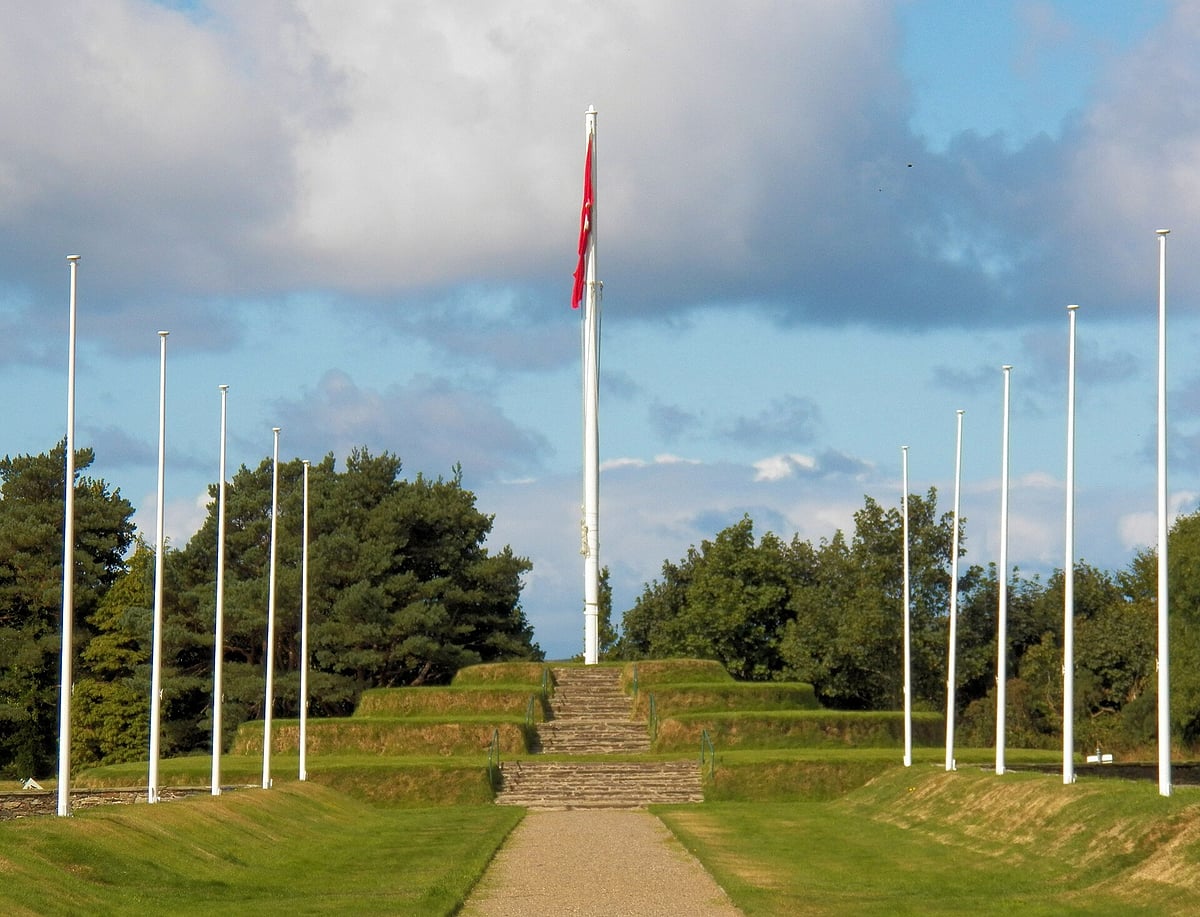
Image credit: Shritwod (CC BY-SA 3.0), via Wikimedia Commons
The map remembers the old courts too. Dingwall in the Scottish Highlands, Tingwall in Shetland and Tynwald itself carry the same root as Þingvellir, the “assembly plains”. Where road signs stand now, there were once tents, booths and litigants. At Þingvellir the stone footings of those seasonal búðir are still legible in the turf, and the plain has been a UNESCO World Heritage Site since 2004.
Conclusion: The Rule of Law Without a State
How the Vikings spoke law comes down to a single tension: an extraordinary amount of procedure paired with an extraordinary lack of power. They had summons deadlines, neighbour panels, tiers of jurisdiction, an appellate court deciding by majority, and a graded scale running from compensation through temporary banishment to total exclusion. What they lacked was anyone whose job it was to make the outcome happen.
That such a system worked for three centuries is more striking than any clause within it. It worked because a judgment created public knowledge, and public knowledge governed hospitality, trade and marriage in everyday Viking life. When a handful of great families bought up the chieftaincies during the Sturlung Age, the balance tipped, and between 1262 and 1264 Iceland submitted to the Norwegian crown. Not long after, the law book Jónsbók replaced the old Grágás.
What outlives all of it is an idea still audible in the names Althing, Storting and Folketing: law does not exist because someone is strong enough to impose it, but because a community sits down at regular intervals and says it out loud.
Hero image credit: Diego Delso (CC BY-SA 4.0), via Wikimedia Commons