History
Urnes Stave Church in Norway: Where Paganism Meets Christianity
Urnes Stave Church in Norway is the country's oldest stave church. Its famous Viking Age carvings capture the moment paganism gave way to Christianity.
Contents
- The Oldest of Norway’s Stave Churches
- What Lies Beneath: The Vanished Earlier Churches
- A Lion, a Serpent, or the World Tree? Reading the North Portal
- The Urnes Style: The Final Chapter of Viking Art
- Inside the Church: A Painted Christ and a Ship of Light
- Timeline: From Post Church to World Heritage
- Visiting Urnes Stave Church in Norway Today
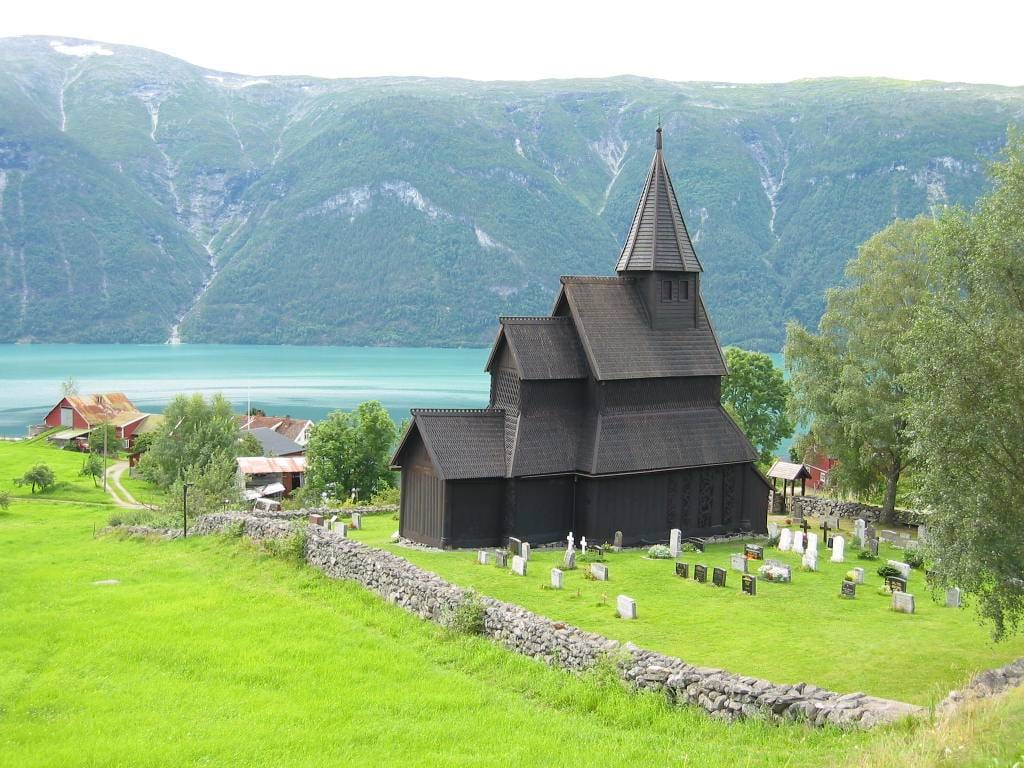
On a grassy shelf high above the Lustrafjord, deep in Norway’s Sogn region, stands a small, tar-black wooden building that has been holding its ground for almost nine centuries. Urnes Stave Church in Norway is the oldest of the country’s surviving stave churches and one of the oldest wooden buildings anywhere in Europe. Yet the real treasure is bolted to its north wall: a doorway and wall planks salvaged from an even older church, carved with writhing, interlaced beasts that come straight out of the Viking imagination. There is no other place where you can watch pagan art being folded into a Christian building quite so literally. UNESCO added the church to the World Heritage list in 1979, and one look at that north portal explains the decision better than any committee report ever could.
The Oldest of Norway’s Stave Churches
The church that stands today was raised around 1130. Tree-ring analysis of its structural timbers shows the pines were felled around 1129 and 1130, which makes Urnes the senior member of a very exclusive club: of the wooden churches that once dotted medieval Norway, likely well over a thousand, only 28 stave churches survive. Fire, rot, storms and nineteenth-century demolition crews claimed the rest, often because growing parishes simply wanted bigger buildings.
The name comes from the staves, the massive load-bearing pine posts that form the church’s skeleton. Earlier Norwegian churches had planted their posts directly in the ground, where damp soil devoured them within a few generations. The builders of Urnes set their staves on a frame of horizontal sill beams resting on stone, lifting every piece of structural wood clear of the earth. That single engineering decision is the reason the building still exists. Slow-grown pine heartwood, kept dry and regularly tarred, is astonishingly durable. Since 1881 the church has been in the care of Fortidsminneforeningen, the Norwegian Society for the Preservation of Ancient Monuments, one of the oldest heritage organisations in the world.
What Lies Beneath: The Vanished Earlier Churches
The 1130 church was not the first house of worship on this spot. During archaeological investigations in the 1950s, led by the architect and stave church scholar Håkon Christie, excavators found postholes and construction traces beneath the floor pointing to at least one, possibly two, earlier churches. Those predecessors were post churches of the old type, their timbers set straight into the soil, and the soil did what soil always does.
One of those lost buildings, however, refused to disappear completely. When the new church went up around 1130, its builders reused several magnificently carved elements from the old one: the famous portal now set into the north wall, two carved wall planks, a corner post and a gable. On stylistic grounds these pieces are dated to roughly 1050 to 1070, making them about two generations older than the church that carries them. The portal probably served as the main entrance of the earlier building. The fact that nobody burned it or sawed it up for scrap suggests the people of Urnes knew exactly how remarkable those carvings were, and chose to keep them in plain sight.
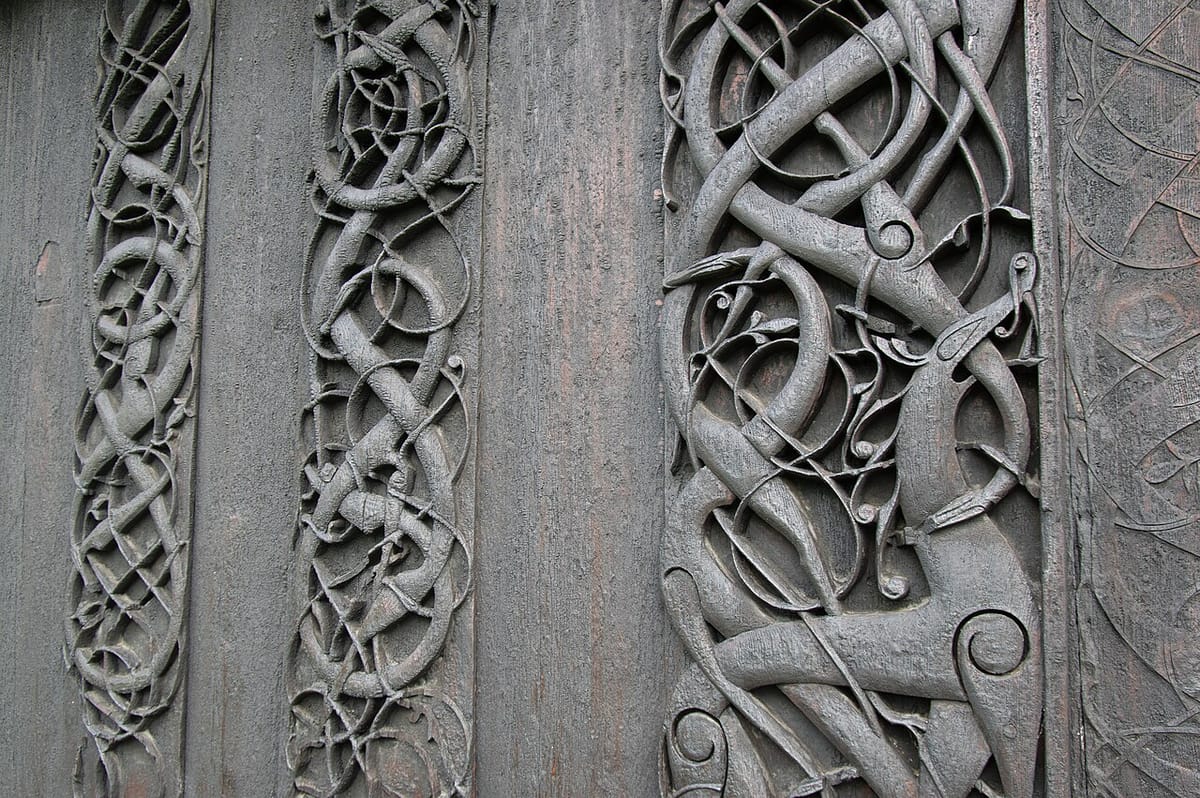 Image credit: Bjørn Erik Pedersen (CC BY-SA 4.0), via Wikimedia Commons
A Lion, a Serpent, or the World Tree? Reading the North Portal
So what do the carvings actually show? At first glance, an elegant tangle of ribbon-thin bodies. Look closer and a scene emerges: a large four-legged animal caught in the coils of serpents, biting one of them while the serpents bite back. Scholars have argued about the meaning for well over a century, and the debate boils down to two readings.
The Christian interpretation sees the four-legged creature as a lion, an ancient symbol of Christ, locked in combat with the serpent, the embodiment of Satan. The doorway becomes a sermon in wood: to enter the church is to pass through the victory of good over evil. The Norse interpretation reaches instead for the old mythology. The animal would then be a stag, like the harts that graze in the branches of the World Tree in the Eddic poems, and the gnawing serpents recall Nidhogg, the dragon that chews the roots of Yggdrasil. Destruction and renewal, endlessly entwined, carved onto the wall of a Christian church.
Our editorial take: the most convincing answer is both at once. In eleventh-century Norway, an image that pagan eyes could read as the World Tree and Christian eyes as the triumph of Christ was not a contradiction. It was smart missionary work.
Neither reading can be proven, because the carvers left no inscription. But that ambiguity is precisely what makes the portal such a rare witness. It was made for people standing between two worlds, at a moment when the old gods were not yet forgotten and the new faith was not yet taken for granted.
The Urnes Style: The Final Chapter of Viking Art
The carvings at Urnes are so distinctive that art historians named an entire period after them. The Urnes style is the last phase of Viking Age animal ornament, fashionable from around the middle of the eleventh century into the early twelfth. Its hallmarks are extremely slender, almost thread-like animal bodies looping through each other in graceful figure-of-eight patterns, almond-shaped eyes, and a deliberate rhythm of broad and narrow lines.
The style was anything but a local Norwegian quirk. In the Swedish province of Uppland, hundreds of eleventh-century runestones carry serpent bands drawn in exactly this idiom. The style even crossed the sea to Ireland, where masterpieces of church metalwork such as the Cross of Cong, made around 1123, blend Irish craftsmanship with Scandinavian-flavoured animal interlace, a fusion scholars call the Hiberno-Urnes style. There is a fine irony in that: the very last art form of the Viking Age became one of its most successful exports, carried abroad not by raiders but by merchants, craftsmen and monks.
Inside the Church: A Painted Christ and a Ship of Light
Step through the low doorway and you find yourself in a surprisingly tall, dim space held up by round columns crowned with carved cube capitals, their surfaces alive with beasts, masks and vines. Above the chancel opening hangs the interior’s greatest treasure: a carved Calvary group from around 1150, Christ on the cross flanked by Mary and John, still bearing traces of its original paint. It ranks among the oldest surviving works of its kind in Norway. And in a delightful footnote, the church also preserves a medieval metal candle holder shaped like a little Viking ship, as if the old world had been allowed to leave one small memento inside the new one.
The interior tells the same story as the north portal, with the roles reversed: Viking beasts on the outside, the new God in Romanesque form on the inside. For a sense of how political this change of faith was across Scandinavia, few monuments say it more bluntly than the Jelling Stones in Denmark, where King Harald Bluetooth had the conversion of an entire people chiselled into granite. By the time Urnes was built, around 1130, Norway’s conversion was long settled. The ancestors’ art stayed on the wall anyway.
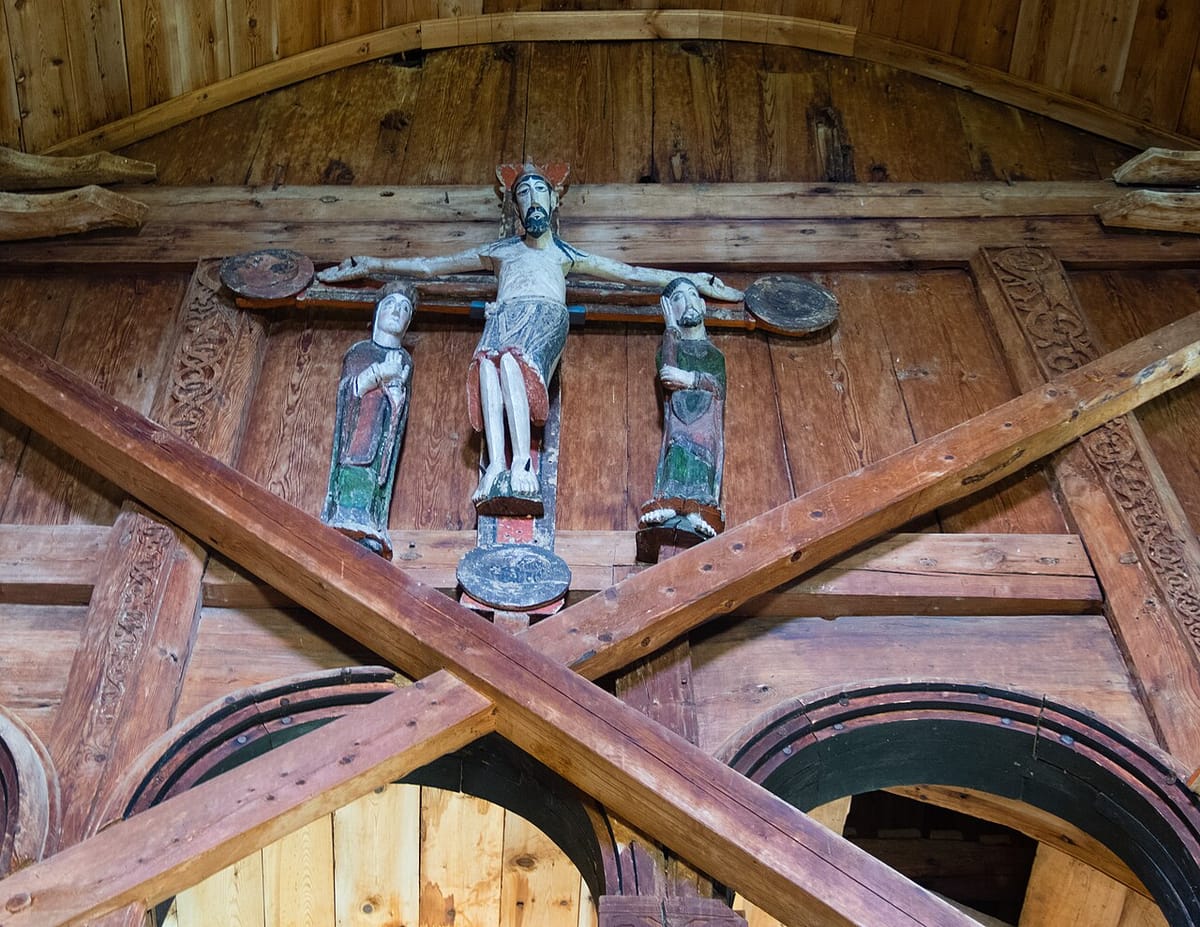 Image credit: Bjørn Erik Pedersen (CC BY-SA 4.0), via Wikimedia Commons
Timeline: From Post Church to World Heritage
| Period | Event |
|---|---|
| 11th century | One or two early post churches stand on the Ornes plateau |
| c. 1050-1070 | The famous carvings are made, later reused on the north wall |
| c. 1129/1130 | Timbers felled; the present stave church is built |
| c. 1150 | The Calvary group is carved for the interior |
| 17th century | Alterations, new windows and pews |
| 1881 | Fortidsminneforeningen takes over the church |
| 1950s | Excavations under Håkon Christie confirm earlier churches |
| 1979 | Inscribed on the UNESCO World Heritage list |
More than nine centuries separate the oldest carvings from the UNESCO listing, and through all of them the building never stopped being used. Very few monuments of the Viking Age can say the same.
Visiting Urnes Stave Church in Norway Today
Getting to Urnes Stave Church in Norway takes a little commitment, which is part of its charm. The church stands by the hamlet of Ornes on the eastern shore of the Lustrafjord, an inner arm of the vast Sognefjord. Most visitors take the small summer ferry across from Solvorn and walk up the hillside from the jetty. The reward at the top is one of the finest views in the country: fjord, orchards and snow-streaked mountains arranged as if for a painting.
The church is open in season, roughly May to September, and the interior can only be seen on a guided tour, a sensible rule given how fragile 900-year-old wood is. Our honest assessment after years of covering Viking Age monuments: there are bigger stave churches and more photogenic ones, but none that tells the story of the North’s conversion with such quiet honesty. Here the centuries are not behind museum glass. They are within arm’s reach, soaked in tar, black with age. You walk in past the serpents of the Vikings and stand before the crucified Christ. No shorter road through two hundred years of Norwegian religious history exists anywhere.
Header image credit: Leo-setä (CC BY 2.0), via Wikimedia Commons