Daily Life & Culture
The Viking Horned Helmet Myth: Where It Really Comes From
The Viking horned helmet myth debunked: not one real helmet find has horns, the true horned helmets are Bronze Age, and an 1876 opera invented the look.
Contents
- What Viking Helmets Actually Looked Like
- The Real Horned Helmets Are Almost 2,000 Years Too Early
- Horned Figures in Norse Art: Ritual, Not War
- How the Viking Horned Helmet Myth Was Actually Born
- Why Horns Would Be a Terrible Idea in Battle
- Myth vs. Fact: The Quick Check
- What Vikings Really Wore on Their Heads
Picture a Viking. Chances are you just saw a bearded giant with two horns jutting from his helmet, because that image is welded into modern culture at the factory level. It decorates football logos, cartoon strips, costume shops, and beer labels. There is just one inconvenient detail: archaeologists have never found a single Viking Age helmet with horns on it. Not one, anywhere, ever. The Viking horned helmet myth is one of history’s most successful fabrications, and its true birthplace is not a Norwegian fjord but a German opera house in 1876.
This article follows the trail backwards: from the handful of real helmets that actually survive, past two magnificent horned helmets that are genuine but nearly two thousand years too old, to the costume designer and the Romantic painters who invented the look that refuses to die.
What Viking Helmets Actually Looked Like
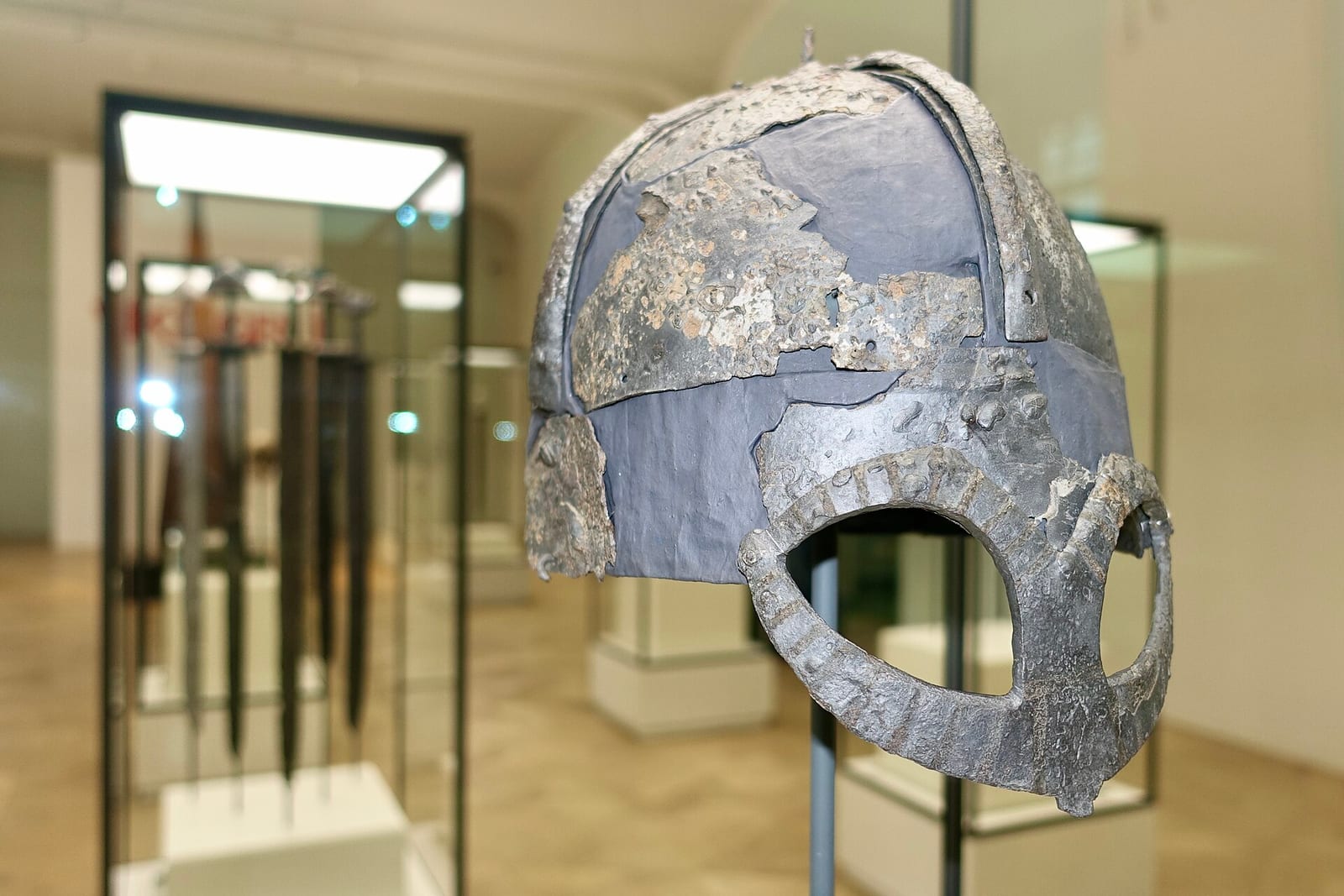
Start with the uncomfortable truth about the evidence: real Viking helmets are astonishingly rare. Across roughly three centuries of the Viking Age, exactly one largely complete example is known - the Gjermundbu helmet, unearthed in 1943 in a richly furnished warrior’s grave at Gjermundbu farm in Ringerike, Norway. Built from several iron plates, it has a rounded cap, a small spike at the crown, and a distinctive spectacle-shaped guard protecting the eyes and nose. It was buried in the tenth century alongside a mail shirt, weapons, and riding gear, and it sits today in the Museum of Cultural History in Oslo. Horns? Not a trace, and no fitting where horns could ever have been attached.
Beyond Gjermundbu, the entire body of evidence consists of a few scattered fragments:
| Find | Location | Date | What survives |
|---|---|---|---|
| Gjermundbu helmet | Ringerike, Norway | 10th century | near-complete iron helmet with spectacle guard, no horns |
| Tjele fragment | Jutland, Denmark | 10th century | iron brow and nose guard with bronze details |
| Lokrume fragment | Gotland, Sweden | 10th century | brow piece with silver decoration |
| Yarm helmet | Yorkshire, England | c. 900 | assessed in a 2020 study as probably Anglo-Scandinavian |
Why so few? Iron was expensive, rusted away in most soils, and was endlessly recycled. A helmet that did not follow its owner into a grave usually ended its life in a smith’s forge. What matters is how consistent the surviving pieces are: plain, practical, smoothly rounded domes designed to make blades glance off. Nothing about them is theatrical.
The Real Horned Helmets Are Almost 2,000 Years Too Early
Here is the twist that makes this story so good: horned helmets from Scandinavia genuinely exist. In 1942, peat cutters working the bog of Brøns Mose near Veksø on the Danish island of Zealand pulled out two superb bronze helmets crowned with great sweeping horns. They are among the most famous objects in the National Museum of Denmark, decorated with bosses and stylized bird features, and they look every bit as dramatic as anything Hollywood ever put on screen.
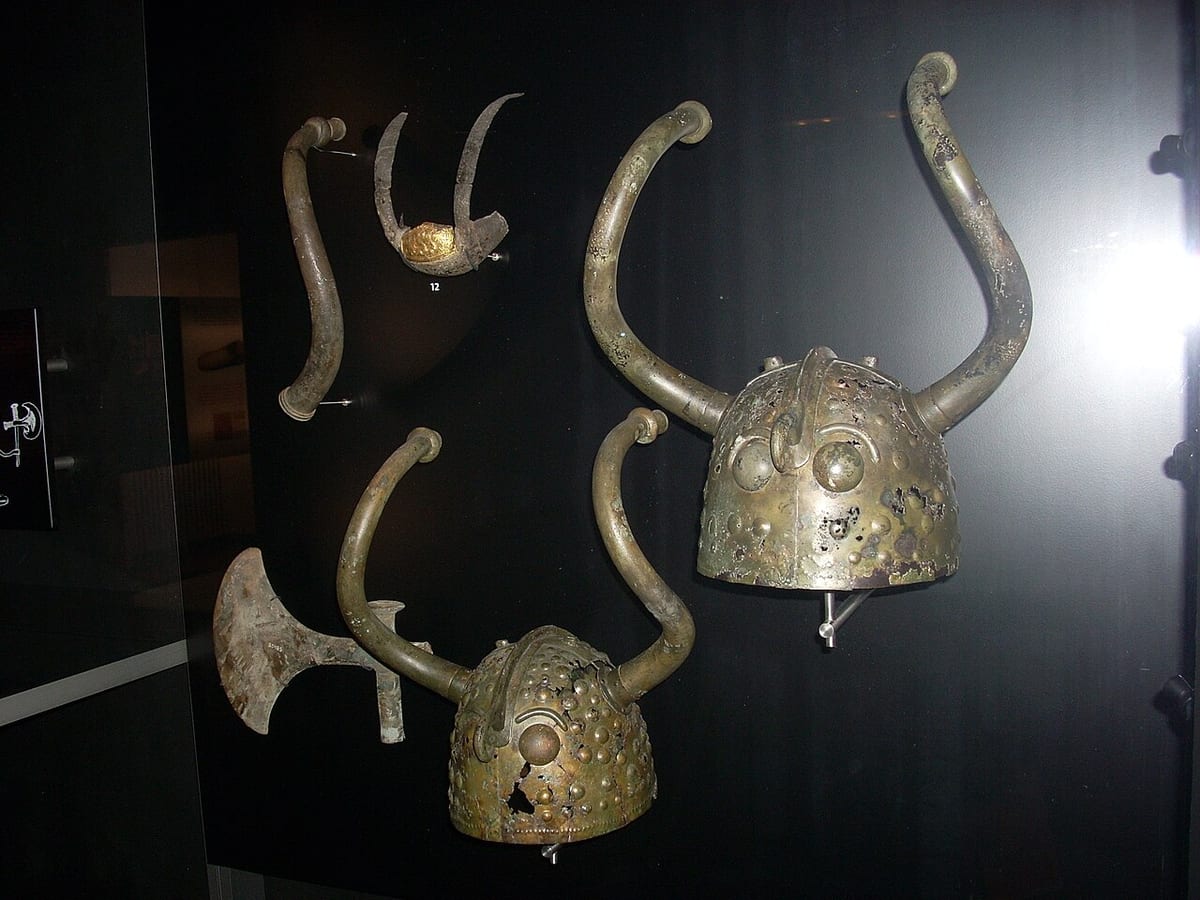 Image credit: Simon Burchell (CC BY-SA 3.0), via Wikimedia Commons
They simply have nothing to do with Vikings. A study published in 2022 in the journal Praehistorische Zeitschrift radiocarbon-dated birch pitch preserved inside one of the horns to around 900 BC - the Nordic Bronze Age, roughly 1,800 years before the first longship ever beached on an English shore. Researchers read the Veksø helmets as ritual and prestige objects tied to a sun cult, deposited in the bog as an offering to higher powers. They were display pieces for ceremony, never battlefield equipment.
The same logic applies to the Waterloo Helmet, a Celtic bronze helmet with two cone-shaped horns dredged from the Thames in London in the nineteenth century and now in the British Museum. It too predates the Viking Age by centuries and is interpreted as ceremonial. So horned helmets were real things - just rare cult objects from distant eras, worn by entirely different peoples for entirely different reasons.
Listen to Járn ok þrumr while you read on:
Horned Figures in Norse Art: Ritual, Not War
The Norse imagination was not entirely horn-free, though, and this is where the story gets genuinely interesting. Tapestry fragments from the Oseberg ship burial in Norway, one of the richest graves of the whole era, depict a procession that includes figures wearing horned headgear. Even more striking are the Torslunda plates, four bronze dies found on the Swedish island of Öland and dating to the period just before the Viking Age: one shows a dancer in a horned helmet carrying spears, side by side with a warrior wearing a wolf skin.
Modern technology added the decisive detail. Laser scanning of the Torslunda die revealed that the horned dancer is missing one eye - almost certainly a deliberate feature. Many scholars, among them the archaeologist Neil Price, read the figure as Odin himself or a cult performer impersonating the one-eyed god, dancing beside an animal-warrior of the kind echoed in accounts of the Viking berserkers. In other words, horned headgear belonged to the world of ritual, masking, and divine imagery. It may well have appeared at ceremonies. It demonstrably did not appear in the shield wall, and the pictorial sources agree with the graves on that point.
How the Viking Horned Helmet Myth Was Actually Born
The roots of the confusion reach back to antiquity. Greek and Roman authors described horned and beast-crested helmets among Celtic and Germanic peoples, and those passages were sitting in every educated library when Europe rediscovered its northern past. Diodorus Siculus, writing in the first century BC, said of the Celts:
They wear bronze helmets with tall attachments, some with horns and some with figures of birds or beasts, to make themselves look larger and more terrifying. - paraphrased from Diodorus Siculus, Bibliotheca historica, Book 5
Eighteenth and nineteenth century antiquarians blended such descriptions, stray Bronze Age finds, and the sagas into one romantic soup. Scandinavia’s national romantic movement wanted heroic ancestors, and artists happily supplied them: the Swedish painter Johan August Malmström gave the heroes of Esaias Tegnér’s epic Frithiof’s Saga horned and winged helmets in his illustrations from the 1860s onward.
The decisive push came from the stage. For the premiere of Richard Wagner’s complete Ring of the Nibelung at the first Bayreuth Festival in 1876, costume designer Carl Emil Doepler created hundreds of costumes and crowned his Germanic gods and heroes with horned and winged helmets. The Ring became a continent-wide cultural sensation, Doepler’s designs were printed, copied, and absorbed into schoolbooks, and within a single generation a stage fantasy had hardened into imaginary fact. That Wagner’s operas are about figures of Germanic legend rather than historical Vikings made no difference; the public happily fused the two into one shaggy northern barbarian, horns and all.
Why Horns Would Be a Terrible Idea in Battle
You do not need a military historian to see the problem, although they all agree on it. A smooth, rounded helmet is engineered so that blows glance away. Horns achieve the exact opposite: they catch an incoming blade, trap its energy, and channel the full force of the strike into the wearer’s head and neck. In a tight formation, wide horns would snag on your own comrades’ shields and spears. To an enemy, they would offer a convenient handle for wrenching your head sideways in a grapple.
Weight makes it worse. Even a plain iron helmet strains the neck over hours of fighting, and every extra gram mounted far from the skull’s axis multiplies the leverage of every movement. Our editorial view is blunt: the real question is not why Vikings never wore horned helmets, but why anyone ever believed that a society of experienced professional fighters would choose headgear this spectacularly impractical. The myth tells us far more about the nineteenth century’s appetite for picturesque barbarians than about the pragmatic Scandinavians who picked their equipment with the same cold sense they applied to shipbuilding.
Myth vs. Fact: The Quick Check
| Claim | Verdict |
|---|---|
| Vikings wore horned helmets into battle | False. No Viking Age helmet find has horns |
| Genuine horned helmets exist in Scandinavia | True, but they are Bronze Age cult objects (Veksø, c. 900 BC) |
| Horned figures appear in Norse art | True, as ritual imagery like the Torslunda dancer, not as combat gear |
| The sagas describe horned helmets | False. Neither Snorri Sturluson nor the Icelandic sagas mention them |
| The cliche was born in the 19th century | True. Malmström’s illustrations and Doepler’s 1876 Wagner costumes spread it worldwide |
What Vikings Really Wore on Their Heads
The honest answer: most of the time, probably nothing made of metal at all. An iron helmet was a costly piece of kit that only a fraction of warriors could afford, much like the sword whose rarity we covered in our article on Viking weapons. Those who did own one wore a plain iron dome of the Gjermundbu type, perhaps with a nose guard. Caps of leather or thickly padded cloth are frequently assumed, but organic materials rot in the ground, so the archaeological record stays nearly silent about them.
There is a fine irony in the fact that the least historical part of the Viking outfit became its universal trademark. Hägar the Horrible, the Minnesota Vikings logo, and a million costume parties keep the horns alive, and no museum case will ever fully compete with that. Perhaps it does not need to. Stand in front of the real Gjermundbu helmet in Oslo, meet that cold spectacled stare across a thousand years, and you understand immediately: reality never needed horns to be intimidating.
Hero image credit: Wolfmann (CC BY-SA 4.0), via Wikimedia Commons